
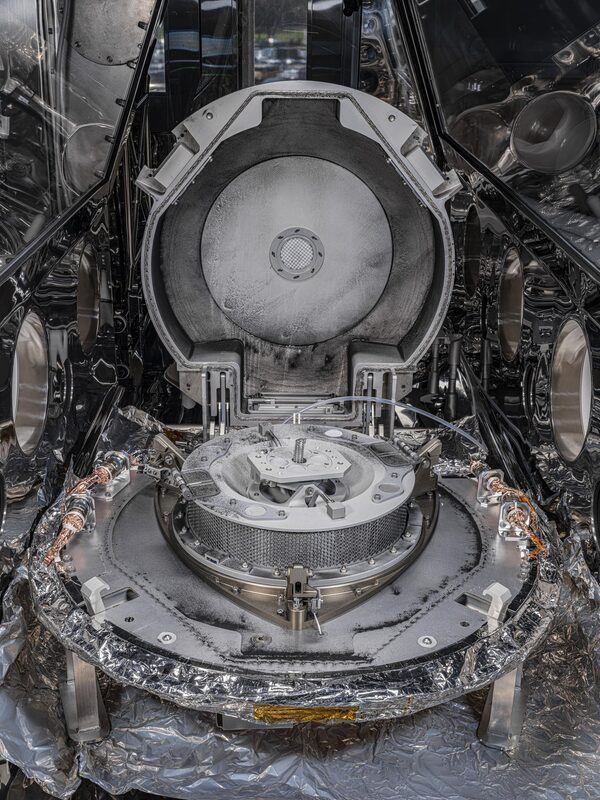
Planetary missions rarely end with their accounts tidier than they started, and they almost never publish a frank account of how it went. OSIRIS-REx, NASA's third New Frontiers mission, has now done both. On Nov. 23, principal investigator Dante S. Lauretta and co-authors Heather L. Enos and C. W. V. Wolner posted a lessons-learned report on arXiv. It covers the mission from its 2010 proposal through the delivery of asteroid Bennu samples to Earth in September 2023.
The top-line numbers are why the report is worth reading. The mission was proposed at a lifecycle cost of $811 million and finished at $828 million. More than $52 million in NASA Headquarters reserves went back unused. It also delivered at least 121.6 grams of Bennu material, more than twice its Level-1 science requirement. NASA's NSSDCA spacecraft record lists that requirement as at least 60 grams of regolith.
Strictly speaking, $828 million is about 2 percent above the proposal figure, so "on budget" needs a small asterisk. The overrun is modest, though, and the unused reserves are the more telling figure. For a seven-year round trip to a near-Earth asteroid, through a pandemic, that is a strong financial record.
The mission in brief
OSIRIS-REx launched on Sept. 8, 2016, at 23:05 UT. It was a compact machine: about 2.72 meters tall and 3.1 meters wide, with a launch mass of 1,529 kilograms. It reached Bennu in December 2018, collected its sample at a site named Nightingale in October 2020, and left the asteroid in May 2021. The sample capsule came home in September 2023.
That outline makes it sound smoother than it was. The report's abstract is clear about what went wrong or turned out differently from the plan:
- A far more rugged surface than predicted. Bennu's terrain was rougher than the models had suggested, which made finding a safe and sampleable site much harder.
- Particle ejection. The team discovered that the asteroid was throwing small particles off its surface.
- Regolith weaker than expected. The mission sampled in regolith much weaker than anticipated.
- COVID-19. The mission had to carry out operations during the pandemic.
- An off-nominal parachute sequence during the sample capsule's return to Earth.
Any one of these could have pushed a mission over budget or behind schedule. The report's main argument is that the project's structure and planning gave it room to absorb all of them.
Six areas, a few recurring themes
The authors group their recommendations into six areas: leadership and governance; cost, schedule and risk management; systems engineering; mission operations; sample return, curation and analysis; and data archiving. A handful of ideas run through all six.
A PI-led structure
New Frontiers missions are led by a principal investigator rather than run directly by a NASA center, and the report counts that model as a strength. According to the abstract, a PI-led structure integrating science, engineering and project management gives the discipline to make fast, informed decisions. When one scientific leader owns the mission's goals and its trade-offs, decisions about where to spend margin stay tied to what the mission is for.
Buy down risk early
The report's clearest example of early risk reduction is funding Natural Feature Tracking as a backup navigation system. It is the kind of investment that looks optional on paper and essential once the target turns out rougher than the models said. The broader lesson is to spend reserves and schedule margin early on retiring risk, which buys the flexibility to absorb discoveries, rather than holding them back for emergencies that arrive when fewer options remain.
Heritage hardware has limits
Reusing flight-proven hardware is a standard way to cut cost and risk. The report adds a caveat: heritage reduces risk only when its verification and engineering knowledge are preserved. A component that worked on a past mission is not low-risk if nobody remaining knows how it was verified, or what its limits are. The design history matters as much as the part itself.
Contamination and data last the whole mission
For a sample-return mission, the science value of the sample depends on knowing exactly what else might have touched it. The report treats contamination knowledge, sample science and data stewardship as mission-long responsibilities, not post-flight tasks. Contamination control, in other words, does not end with a single cleanliness milestone, and the authors treat stewardship of the data that documents the sample the same way.
Why It Matters
Sample return is getting harder and more ambitious. Future missions to small bodies will face the same basic problem OSIRIS-REx did: the target is only well understood once you get there, and by then the hardware is fixed. The report's recommendations amount to a playbook for that situation. Keep clear lines of authority, spend margin early on backup capabilities, don't assume heritage hardware is safe, and treat sample and data provenance as part of the core science. The report says each of its sections pairs background with specific recommendations for future sample-return and small-body missions.
The cost record also matters for the budget arguments around planetary science. Big NASA missions are often discussed in terms of overruns, so a well-documented case of a complex mission ending near its proposed cost, with reserves returned, gives planners something concrete to point to. Because the report comes from the mission's own leadership, it is not an independent audit. Its value is in how specific it is about decisions that worked.
The spacecraft itself is still at work. As described on the University of Arizona mission site, it now flies as OSIRIS-APEX, a follow-on mission that will study the physical changes to asteroid Apophis after that asteroid's rare close encounter with Earth in 2029. In a gravity assist on Sept. 23, 2025, it passed within about 2,136 miles (3,438 km) of Earth. The lessons in the report are partly a record of one mission and partly a guide for the next phase of the same spacecraft.
