
The International Space Station's crew already grows some of its own food. In a NASA video released Nov. 23, astronaut Anil Menon showed off plants growing aboard the orbiting lab and said he plans to eat the greens on Thanksgiving with a tortilla, pasta and hot sauce. It's a nice holiday scene. It also doesn't answer the hard question: how do you grow enough food, efficiently and reliably, to feed people living on the Moon or traveling to Mars?
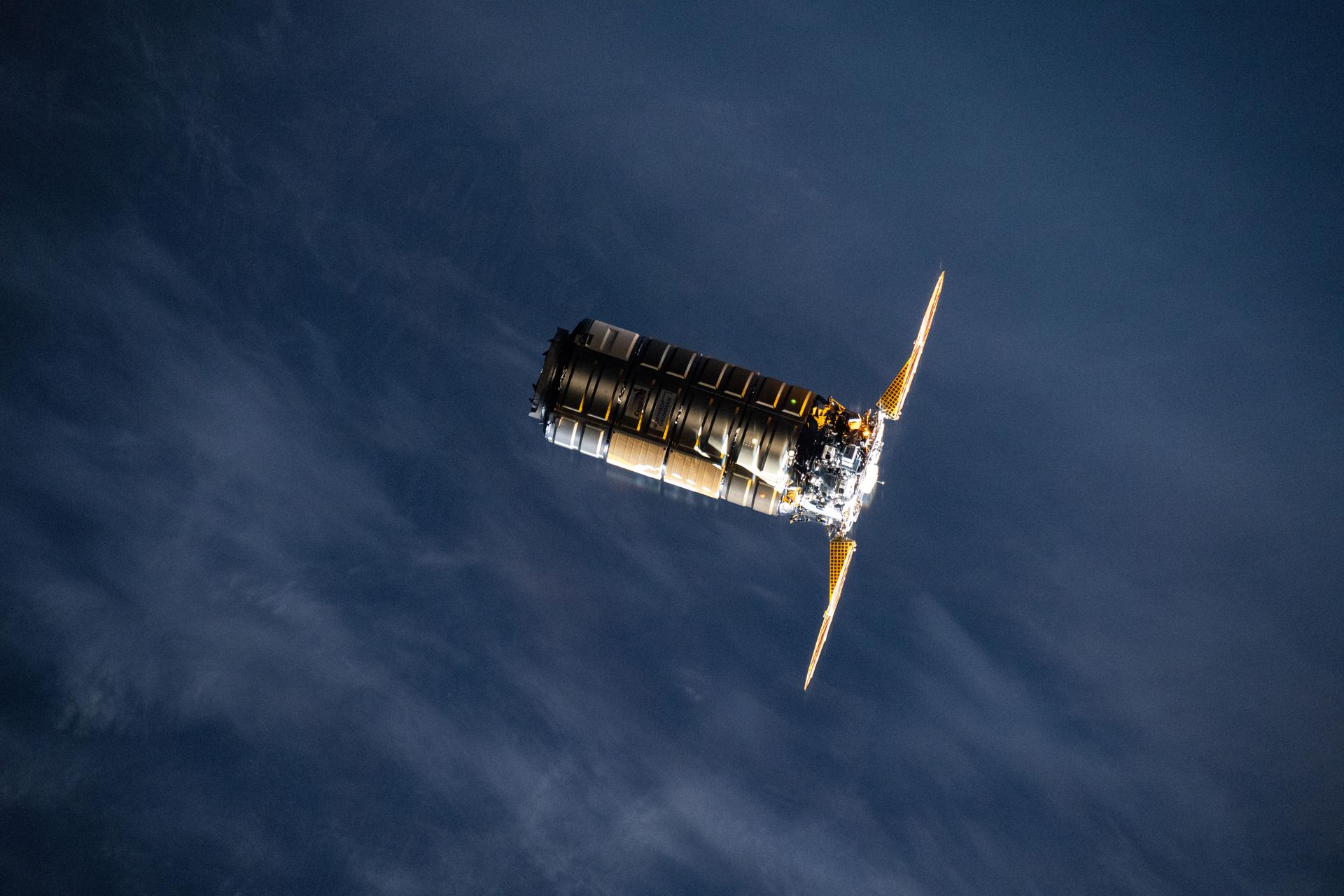
NASA's next cargo delivery is meant to help with that. Northrop Grumman's 25th Commercial Resupply Services mission, NG-25, will carry what NASA calls a first-of-its-kind space crop production system. It's a prototype growth chamber known as the Ohalo III facility. It flies aboard a Cygnus XL spacecraft named the S.S. James "Jim" Lovell, along with a second experiment that tackles a very different problem: keeping lab-grown human brain tissue alive in orbit.
The Ride Up
According to details from a Nov. 23 preview news teleconference reported by Spaceflight Now, NG-25 is scheduled to launch no earlier than Sunday, Nov. 29, at 10:47 a.m. EST (1547 UTC) from Space Launch Complex 40 at Cape Canaveral. A SpaceX Falcon 9 will fly it, and the first-stage booster, B1096, is making its ninth flight. It's expected to come back for a landing at LZ-40.
Cygnus doesn't dock on its own. It's scheduled to reach the station on Tuesday, Dec. 1, at about 2:35 a.m. EST. NASA astronauts Jessica Watkins and Luke Delaney will use the station's Canadarm to capture the spacecraft and berth it to the Unity module. The spacecraft carries about 11,000 pounds of cargo, science and hardware. Besides the crop chamber and the brain-tissue hardware, the science manifest includes a follow-up study on muscle loss and a nanomedicine study.
What Ohalo III Is Actually Testing
Growing plants in microgravity is mostly a plumbing problem. On Earth, gravity pulls water down through soil and lets air fill the gaps around roots. In orbit, water doesn't drain. It clings to surfaces and can form blobs that either starve roots of water or drown them by cutting off oxygen. Getting the right amount of water to roots, consistently, has been one of the stubborn engineering problems of space agriculture.
According to NASA, researchers will use the investigation to validate the system's water delivery and volume optimization technology aboard the station. The first is the plumbing question. The second matters just as much for real missions. On a spacecraft or in a lunar habitat, every cubic meter is expensive, and a food system has to produce a meaningful harvest within a tight footprint. A chamber that grows a handful of leaves for a crew snack and a chamber that contributes a real share of a crew's diet are very different machines.
NASA says the insights are aimed at future Moon Base habitats and Mars missions. The agency also points to a payoff on the ground: the knowledge could help inform agricultural practices such as vertical farming and indoor growing systems.
What Would Go Inside
The hardware is only part of the picture. NASA also has to decide which crops are worth growing. In a Nov. 25 update, the agency said recent testing points to strawberries, cucumbers and lemon basil as potential crops for future explorers.
The strawberry work shows how detailed that selection process gets. Researchers at NASA's Kennedy Space Center, the University of Melbourne and the University of Western Australia compared a wild strawberry against NASA's leading candidate, a variety called "Delizz." Their results were published in September in Life Sciences in Space Research. The wild strawberry was more productive on paper: grown from seed, it produced twice as many buds, flowers and fruit. But it also grew too many runners, which would take up valuable room aboard a spacecraft. Delizz kept its top spot.
It's a good example of the tradeoffs Ohalo III is meant to measure. Raw yield doesn't decide much if the plant won't fit the space you have. Volume optimization, one of the two things NASA wants the system to validate, is the same constraint seen from the hardware side.
Cucumbers bring their own first. NASA says many crops have been grown in space, but none so far from the gourd family, and cucumbers could be the first. Lemon basil adds an herb to the list. NASA notes that menu fatigue can quickly become a problem for astronauts, and that fresh herbs help transform packaged meals into something new, which Menon's hot sauce illustrates in its own way.
The agency also notes that space crops can absorb carbon dioxide, produce oxygen and recycle water. A working crop system could plausibly take on some of the life-support load that machines carry today, which is part of why the plumbing matters so much.
The Other Passenger: Brain Tissue
The second NASA investigation highlighted for NG-25 is a different kind of biology. It builds on an earlier investigation that sent small, lab-grown models of the human brain, called miBrains, to the station. This experiment will validate a miniature fluid-handling system designed to mix, deliver and maintain the nutrient-rich liquid needed to keep the tissues alive.
Tissue models like these need a steady, controlled supply of nutrients to stay alive. In microgravity, managing small volumes of liquid runs into the same physics that makes watering plants hard. According to NASA, the investigation is the next step toward enabling long-duration studies of human brain tissue in space, which could help identify potential neurological risks of spaceflight and may advance human tissue research on Earth.
The two experiments share a theme. Ohalo III and the miBrains hardware are both, at bottom, tests of fluid handling in an environment where liquids don't behave as they do on Earth. One feeds plants and the other feeds human cells, and both have to work before the science they enable can begin.
Why It Matters
The plants Menon showed in his holiday video are small-scale proof that crews can grow and eat fresh food in orbit. Crews on the Moon, and especially on Mars, will be much farther from resupply than the station's crew is. For them, a crop system that can't reliably deliver water, or that takes up too much room for the food it produces, isn't really a food system.
Ohalo III is a prototype, and NASA describes the investigation in terms of validating its water delivery and volume optimization technology. That's the right expectation. Its job is to show whether those approaches hold up in real microgravity, not to feed the crew. Combined with crop selection work like the Delizz strawberry study, it's part of the slow, unglamorous engineering needed before astronauts can count on fresh food far from Earth. The same lessons, NASA notes, could help vertical farming and indoor growing on Earth.
The first step is getting off the pad. If the weather and the vehicle cooperate, that happens Sunday morning from Cape Canaveral.
Sources
- NASA's NG-25 Mission to Launch Pioneering Space Crops Research (NASA Science)
- NASA Eyes Crop Candidates for Future Menus (NASA Science)
- Space plants with hot sauce: What ISS astronauts will be eating on Thanksgiving (Space.com)
- As it happened: NG-25 preview news teleconference (Spaceflight Now, via Wayback Machine snapshot)
