
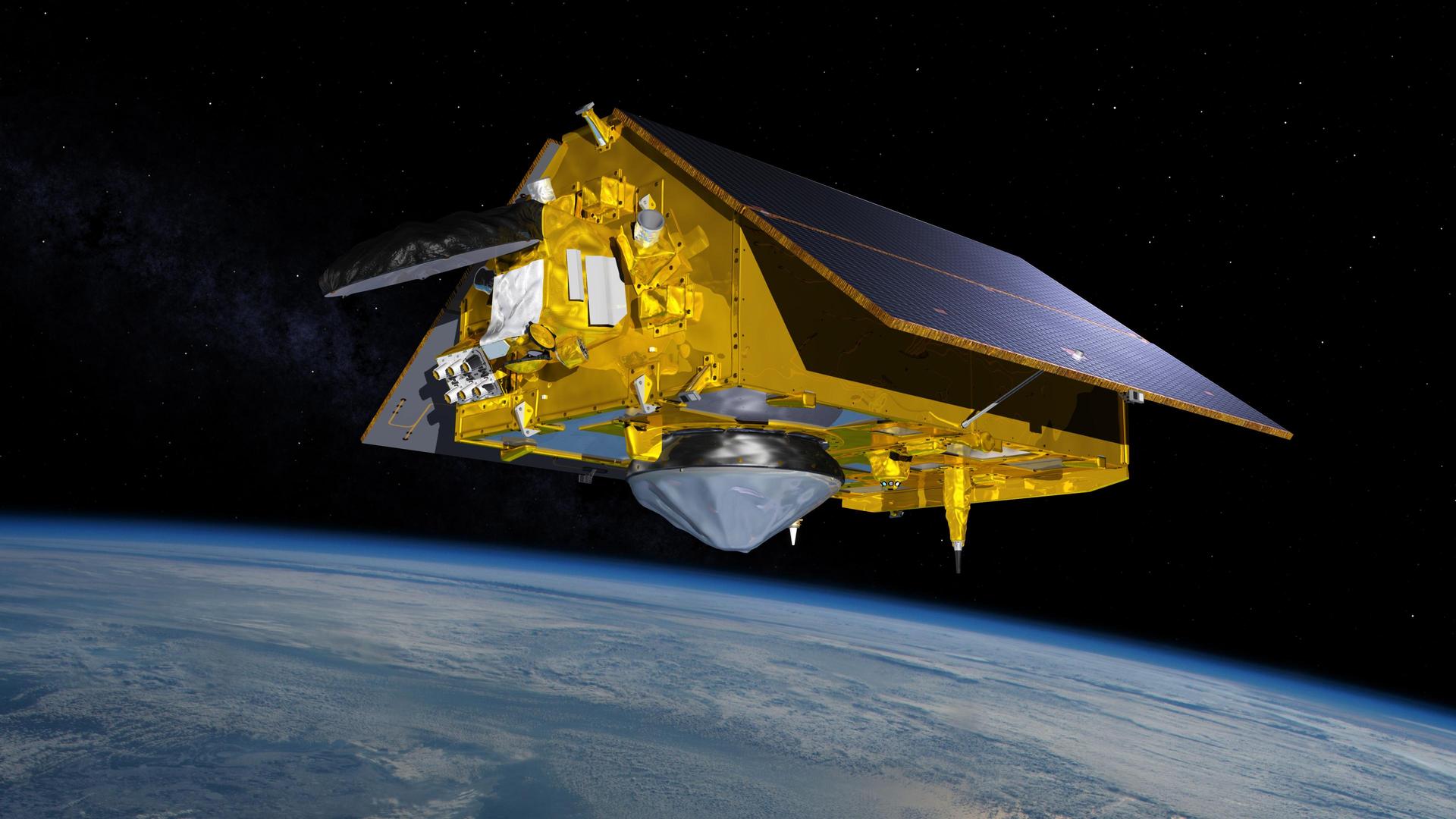
At 03:21 CEST on September 15, a Vega-C rocket climbed away from Europe's Spaceport in Kourou, French Guiana, carrying a pair of satellites that have almost nothing in common except the ride they shared. One will stare at farmland and forests to catch light that plants emit but humans can't see. The other will keep a decades-long watch over the oceans, ice, and atmosphere running. It was Flight VV30, and it marked the first time a Vega-C has ever launched two payloads on the same mission.
The satellites are FLEX, ESA's newest Earth Explorer, and Sentinel-3C, the third spacecraft in the Copernicus program's Sentinel-3 series. Both separated cleanly: Sentinel-3C left the rocket at 04:21 CEST, an hour after liftoff, and FLEX followed nearly an hour after that, at 05:17 CEST.
What is FLEX actually measuring?
FLEX stands for Fluorescence Explorer, and its job is to detect something almost nobody thinks about when they look at a field or a forest: the faint red glow that chlorophyll gives off during photosynthesis. Plants absorb sunlight to convert carbon dioxide and water into sugar, but the process isn't perfectly efficient — some of that captured energy leaks back out as a dim fluorescent signal, invisible to the naked eye but detectable from orbit with the right instrument.
That instrument is FLEX's Fluorescence Imaging Spectrometer, which will produce global maps of this fluorescence at 300-by-300-meter resolution. Because the fluorescence signal rises and falls with how actively a plant is photosynthesizing, it functions as a real-time gauge of vegetation health — catching drought stress, heat stress, or disease before those problems become visible as browning leaves or dead crops.
And Sentinel-3C?
Sentinel-3C is a more familiar kind of mission — the third satellite in a series that Copernicus has relied on for years to monitor oceans, land surfaces, ice, and the atmosphere. That data feeds directly into weather and ocean forecasting models, making Sentinel-3C less a novel experiment than a continuation of infrastructure that meteorologists and climate scientists already depend on.
Why fly them together?
The pairing came down to logistics as much as science. Vega-C is a relatively light-lift rocket, rated to carry 2,300 kilograms to orbit, and weighs about 210 tonnes at liftoff. Flying an Earth Explorer and a Copernicus satellite on one rocket — using a Vespa adapter to stack the payloads, with Sentinel-3C deploying first and Vespa then opening to release FLEX — let ESA get both missions up without waiting for two separate launch windows. It's the kind of dual-manifesting trick that larger rockets have used for years, now extended to Vega-C's first attempt at it.
Why It Matters
FLEX gives agronomists and climate scientists a genuinely new instrument, not just a sharper version of an old one. Existing satellites can already tell you where vegetation is green or brown, but by the time a plant visibly browns, the damage is usually done. Fluorescence tracks the photosynthetic machinery directly, which means it can flag stress — from drought, heat, or disease — while a crop or forest is still outwardly healthy. At a 300-meter resolution across the globe, that's a tool with real relevance for food security and drought monitoring, not just an academic curiosity.
Sentinel-3C's contribution is less flashy but no less important: it keeps an operational data stream running that weather services and ocean researchers already build forecasts around. Continuity satellites like this one don't generate headlines the way a novel instrument does, but losing that continuity would be felt immediately in forecast accuracy.
And the fact that both flew on the same rocket says something about how ESA is managing a tighter launch manifest. Successfully pairing an Earth Explorer mission with a Copernicus mission on a single Vega-C flight — a first dual launch for the vehicle — suggests Europe's mid-size launcher can take on more complex, multi-payload assignments going forward, which matters as the agency tries to keep its Earth observation program on schedule without leaning entirely on larger, pricier rockets.
What happens next
Both satellites now enter their commissioning phases, during which ground teams check out their systems and instruments before routine science operations begin. For FLEX, that means calibrating the Fluorescence Imaging Spectrometer against known references before its global maps start flowing to researchers. For Sentinel-3C, it means slotting into the existing Sentinel-3 constellation alongside its predecessors to extend the ocean, land, ice, and atmosphere data record without interruption.
