
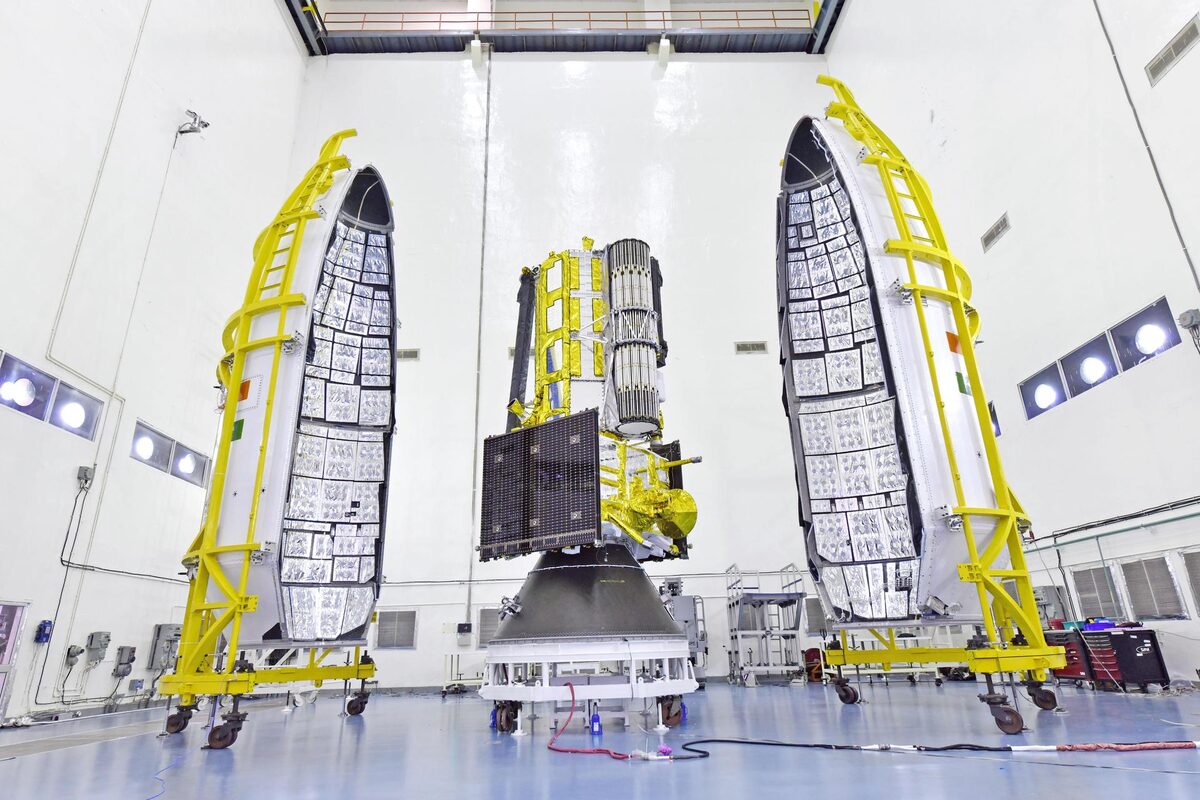
A navigation system needs at least four satellites before it can work out a position on its own. That is just how the geometry works. A receiver has to solve for three spatial coordinates plus its own clock error, and every satellite in view gives it one equation. India's regional system, NavIC, had been running below that line. On the night of Oct. 30, 2026, the Indian Space Research Organisation (ISRO) launched the satellite meant to bring it back above it.
A GSLV Mark II rocket, flying as GSLV-F18, lifted off from the Satish Dhawan Space Centre in Sriharikota at 11:51 p.m. IST (2:21 p.m. EDT, 1821 GMT). It carried NVS-03, a 2,250 kg spacecraft that is the third in ISRO's next-generation navigation series. ISRO said the rocket put the satellite into a 170.3 km by 38,080 km transfer orbit. Less than a day later, the agency reported that the first orbit-raising burn had gone as planned and that the satellite's health was normal.
How NavIC fell to three satellites
NavIC is India's answer to GPS, but with a regional footprint. It covers the Indian land mass and an area reaching about 1,500 km (930 miles) beyond the country's geopolitical boundary. Within that zone it is meant to provide positioning, navigation and timing (PNT) service that does not depend on foreign constellations.
The original IRNSS satellites have had a hard run. The Hindu reports that the older satellites used imported Swiss atomic clocks, and those clocks failed repeatedly. A navigation satellite without a working clock cannot do its main job, because the whole system works by timing signals to extreme precision. Losing clocks, along with NVS-02's failure to reach its final orbit, shrank the working fleet to three satellites. Space.com describes the constellation as having three fully functioning satellites going into this launch, one short of the four needed for PNT service.
NVS-03 is the satellite meant to close that gap. ISRO frames it as providing continuity for the IRNSS series, which is a careful way of saying it is replacing capability the older spacecraft lost.
What's new on board
Two changes stand out, and both answer problems the system has already had.
An Indian-built clock. NVS-03 carries an indigenous rubidium atomic clock developed by ISRO's Space Applications Centre, flying alongside procured clocks. Given NavIC's history with imported timekeepers, carrying both kinds looks like a sensible hedge. A mission life of 12 years gives that clock a long time to prove itself.
An L1 signal. Earlier NavIC satellites broadcast in the L5 and S bands. NVS-03 adds L1 to that mix. According to The Hindu, the L1 band is widely used in commercial GPS receivers, which will make it easier for everyday mobile chipsets to use NavIC. A navigation system that consumer devices can't easily receive is limited to specialized users.
The orbit-raising campaign
The launch leaves the satellite in a long, lopsided ellipse. NVS-03 has to raise itself to its operating orbit using its own propulsion. ISRO reported that the first manoeuvre, a burn of its Liquid Apogee Motor (LAM) lasting 2,174.8 seconds (just over 36 minutes), finished at 16:48 hrs on Oct. 31.
That one burn raised the low point of the orbit from 170.3 km to an estimated 5,477.6 km, while the high point settled at about 37,833.4 km. ISRO says more manoeuvres are planned in the coming days to place the satellite in geosynchronous orbit at the 111.75 degrees East slot.
NVS-02, by contrast, never reached its final orbit, so a clean start matters here. ISRO's update on NVS-03 so far is brief and positive: the burn is done and the satellite's health is normal.
The rocket's record
The GSLV Mark II is a three-stage rocket about 170 feet (roughly 52 meters) tall that first flew in 2010. Space.com counts this as its 14th launch, with 12 of the 14 successful. The mission was India's fourth orbital launch of 2026 and ISRO's third. The other Indian launch this year was Skyroot's orbital flight in July.
Who is using NavIC now
Smartphones aren't the main users yet. Speaking about the launch, ISRO chairman V. Narayanan said 10,400 locomotives and 64,000 fishing vessels are being tracked in real time using the system. He said the goal is to reach 1 lakh (100,000) fishing vessels within six months. He added that 15 lakh (1.5 million) tracking devices have been fitted across vehicles.
Narayanan also set expectations for consumers. He said NavIC would reach civilian phones once the full seven-satellite constellation is complete. So getting back to four satellites restores standalone service, but it is not the finish line. The L1 signal on NVS-03 is groundwork for a phone rollout that still depends on more launches.
Why It Matters
Satellite navigation is now basic infrastructure. Railways, fisheries, logistics and timing for power grids and telecom networks all lean on it. A country that relies entirely on another nation's constellation for that service accepts a dependency it does not control. NavIC exists to remove that dependency across India and its surrounding region. Lately, though, it has been held back by a shortage of working satellites.
If NVS-03 completes its orbit raising and enters service, it fixes the most immediate problem by putting the constellation back at the four-satellite minimum. It also tackles the deeper causes. The indigenous rubidium clock goes after the hardware weakness that has plagued the first-generation fleet. The L1 signal goes after the adoption problem of getting NavIC into everyday devices. Neither change pays off right away. One satellite does not make a seven-satellite system, and a new clock has to run reliably for years before anyone can call it a success. Still, this is a step in the right direction for NavIC's numbers.
