
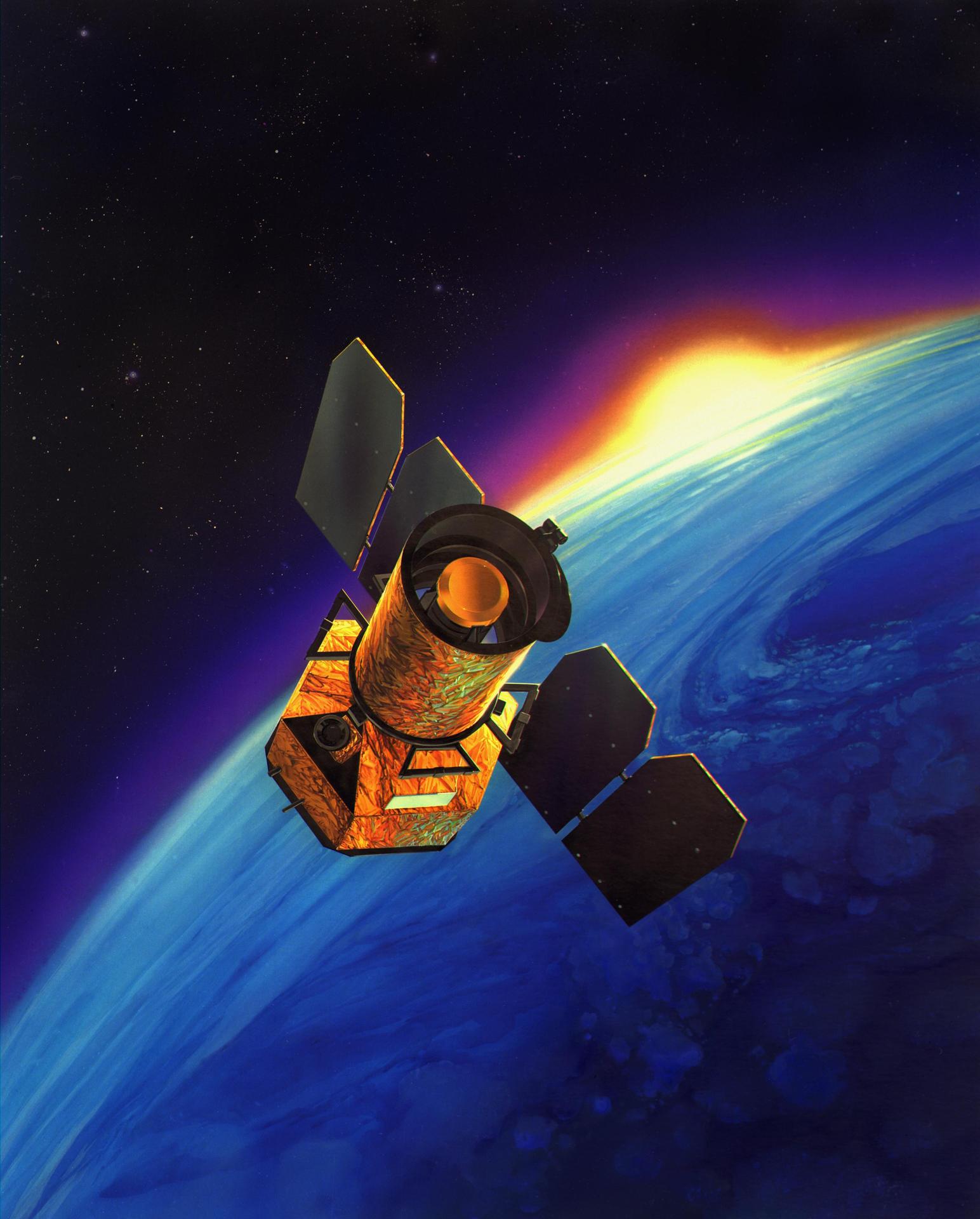
NASA's next ultraviolet survey telescope is no longer just a selected proposal. It is now a confirmed mission. On Oct. 27, 2026, the agency announced that the UltraViolet Explorer, or UVEX, has passed Key Decision Point C (KDP-C). With that, NASA committed to launching the observatory by January 2031 at a total lifecycle cost of $590 million.
Confirmation is the point where a mission stops being a plan and becomes a promise. Before KDP-C, a project is still being shaped. Once it passes, the agency has signed up to a specific budget and schedule, and everyone outside NASA can hold it to those numbers. For UVEX, the numbers it signed up to are noticeably different from the ones attached to it at selection.
What UVEX is built to do
NASA picked UVEX in 2024 as a Medium-Class Explorer mission. Its main job is a sensitive survey of the whole sky in ultraviolet light. According to NASA, that survey is meant to complement wide-field surveys at other wavelengths, including those from the Nancy Grace Roman Space Telescope, to help create a modern map of the universe across different wavelengths of light.
The second job is reacting fast. NASA says UVEX can quickly point at explosions that follow gravitational-wave bursts from neutron star mergers. Gravitational waves are ripples in spacetime, and a telescope that can point quickly is better placed to catch the ultraviolet light from such an explosion.
Caltech's announcement at selection pointed to the merger event GW170817 as the kind of follow-up target UVEX is built for. The observatory will also carry an ultraviolet spectrograph, which splits light into its component wavelengths. The spectrograph is meant to study stellar explosions and massive stars, and spectra can reveal more about an object than an image alone.
Who is building it
The principal investigator is Fiona Harrison of Caltech, who also leads NASA's NuSTAR X-ray mission. NASA lists UC Berkeley, NASA's Jet Propulsion Laboratory, Northrop Grumman and the Space Dynamics Laboratory as partners. UC Berkeley's Space Sciences Laboratory manages the mission.
The Caltech team members named at selection include Shri Kulkarni, Mansi Kasliwal, Kareem El-Badry, Christopher Martin, Sterl Phinney, Harry Teplitz and Matthew Graham. Caltech also named Brian Grefenstette as project scientist. The mission pairs an all-sky survey with a rapid-response role.
The numbers moved
The new commitments are the part that needs a closer look. When UVEX was selected in early 2024, Caltech said the mission was aiming for a 2030 launch. UC Berkeley described it as a $300 million mission expected to fly in 2030 and called it the first all-sky ultraviolet survey.
The confirmed figures are a launch by January 2031 and a $590 million lifecycle cost. On paper, that is a slip of roughly a year or less and a near doubling of the headline dollar figure.
Readers should be careful with that comparison. The 2024 figure and the confirmed figure may not count the same things. A "lifecycle cost" usually covers more than building the spacecraft, and the sources here do not explain what was in the original $300 million or what caused the change. NASA's announcement does not say why the cost or schedule moved. Still, what NASA has committed to is the $590 million figure and the January 2031 date, and those are the numbers UVEX will be measured against.
Why It Matters
Ultraviolet astronomy relies on space telescopes, because Earth's atmosphere blocks most ultraviolet light. That makes a dedicated all-sky ultraviolet survey hard to replace with anything built on the ground. If UVEX delivers, astronomers would get a full ultraviolet map of the sky to sit alongside surveys at other wavelengths, rather than scattered pointed observations.
Its rapid-response role may matter even more. Caltech cited GW170817, first detected by LIGO in August 2017, as the kind of event UVEX is meant to follow up, and a telescope that can quickly cover the ultraviolet side of a neutron star merger adds to that kind of science.
Confirmation also matters for the Explorer program. The committed cost is well above the roughly $300 million figure cited at selection. Now that UVEX has passed KDP-C, the question is whether it can stay within the $590 million and January 2031 commitments.
