
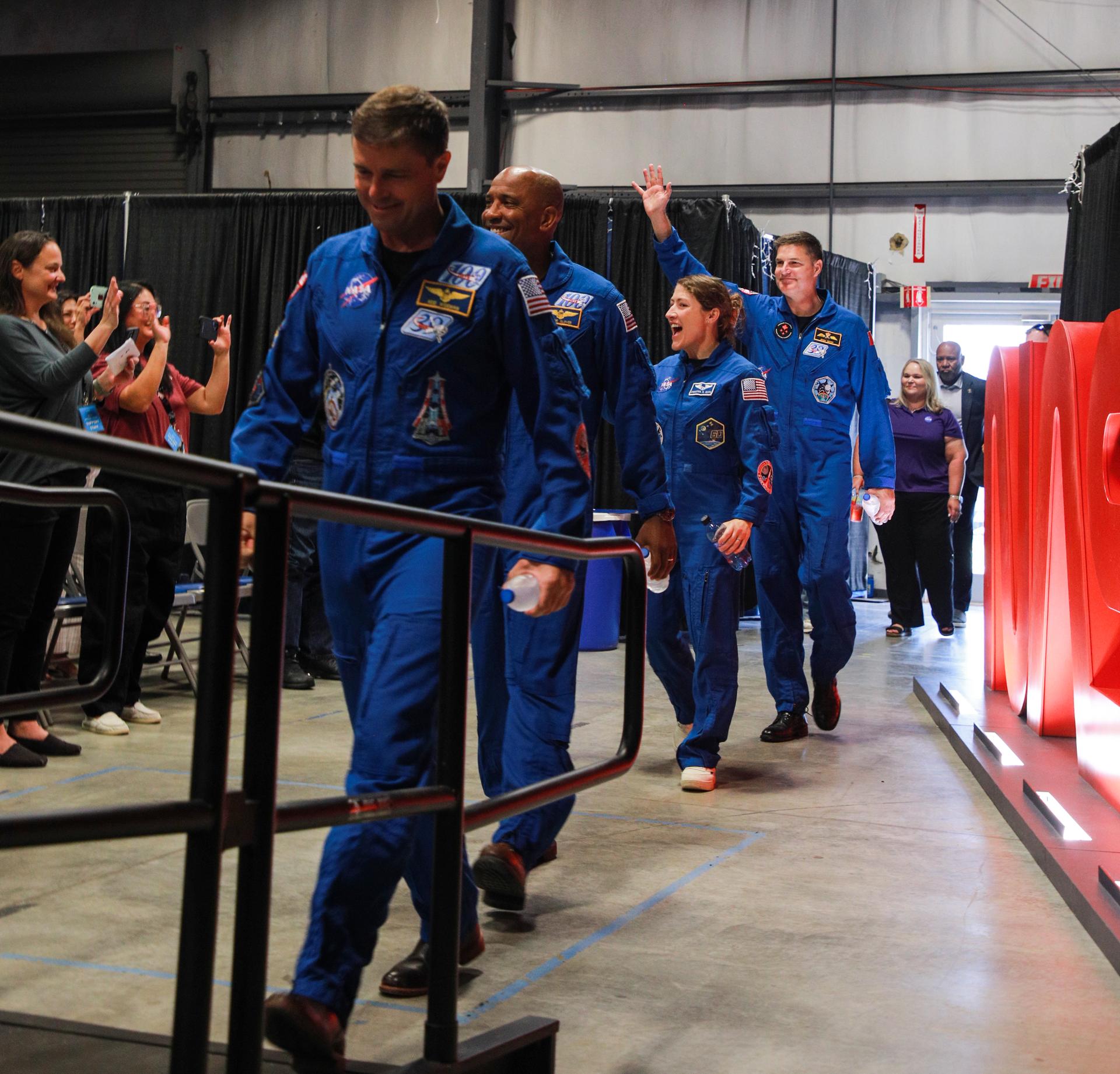
The man who commanded the first crewed flight around the Moon in more than half a century is taking a job running much of NASA's busiest robotic science center. On Oct. 28, Caltech and NASA's Jet Propulsion Laboratory said that Reid Wiseman, commander of Artemis II, will become Caltech associate vice president and JPL deputy director. He starts on Nov. 30, 2026.
Wiseman is an emeritus astronaut and a retired U.S. Navy captain. With this announcement, all four Artemis II crew members have now said where they are going next after leaving active flight status. That flight carried Wiseman, Victor Glover, Christina Koch and Canadian Space Agency astronaut Jeremy Hansen 695,081 miles on a lunar flyby, according to NASA.
What the Job Actually Is
A deputy director post can sound ceremonial. This one is not. NASA describes the role as strategic leadership, stewardship and continuous improvement of laboratory operations, including close partnership with Caltech on institutional planning, management and compliance. Wiseman will also serve as the lab's Center Management Authority for mission execution, ensuring operational excellence across mission support functions in line with NASA requirements and applicable federal and state regulations. In addition, he will be JPL's primary interface for national security programs.
That combination matters because of how JPL is set up. The lab is NASA's only federally funded research and development center, and it is managed by Caltech for NASA. That is why the appointment comes with a Caltech title as well as a JPL one. The deputy director sits where those two institutions meet, with responsibility for the operational side of how the lab runs its missions.
He will work with JPL Director Dave Gallagher, who is also a Caltech vice president. Gallagher and NASA Administrator Jared Isaacman were both quoted in NASA's announcement. NASA also noted that JPL is approaching its 90th anniversary.
An Announcement Timed to a Caltech Milestone
The news was announced at a Caltech event. According to Pasadena Now, Caltech President Ray Jayawardhana and Gallagher announced the appointment on Oct. 28 at Caltech's Brave New Space Age event, on the eve of Jayawardhana's inauguration as the Institute's 10th president.
The event included a panel with Isaacman, Eric Schmidt and planetary scientist Lindy Elkins-Tanton. Announcing a well-known astronaut's arrival at the lab on that stage, the day before an inauguration, suggests that Caltech's new leadership sees JPL as central to its plans.
In his own remarks, as reported by Pasadena Now, Wiseman pointed to the professionalism, deep technical understanding and enthusiasm of the Caltech and JPL community as reasons for taking the job.
The Résumé Behind the Appointment
Artemis II is Wiseman's best-known credential, but it is far from his only one. NASA's announcement gives a career with a fair amount of management experience alongside the spaceflight:
- 2009: Joined NASA's astronaut corps.
- 2014: Flew as a flight engineer on the International Space Station for the 165-day Expedition 41 mission.
- 2016: Commanded NASA's 21st Extreme Environment Mission Operations expedition, living for eight days in a habitat on the ocean floor.
- December 2020 to November 2022: Served as NASA's chief astronaut, leading the astronaut corps and overseeing crew flight readiness and crew safety for all NASA human spaceflight missions.
- Artemis II: Commanded the crewed lunar flyby.
He also has a technical education. He holds a bachelor's degree in computer and systems engineering from Rensselaer Polytechnic Institute and a master's degree in systems engineering from Johns Hopkins University. After Rensselaer he joined the Navy, flew combat missions and served as a test pilot.
The chief astronaut years are probably the most relevant entry for a job built around operations and institutional management. Leading the astronaut corps means managing people, training and readiness. JPL is a different kind of organization, mostly engineers and scientists building and flying robotic spacecraft. But Gallagher said Wiseman knows what it takes to lead teams through high-stakes missions, and that is the experience the lab is drawing on.
Where the Rest of the Crew Went
Space.com notes that Wiseman was the last Artemis II astronaut to announce his next step after retiring from active astronaut duty. The four crew members have gone in noticeably different directions:
- Victor Glover became executive advisor to the president of Cal Poly.
- Jeremy Hansen entered reserve duty with the Royal Canadian Air Force.
- Christina Koch was named NASA's acting deputy chief engineer, effective Nov. 1.
- Reid Wiseman goes to Caltech and JPL as deputy director.
Two of the four, Koch and Wiseman, are staying in NASA's engineering and mission world, in roles focused on the organizations that build and fly hardware rather than on flying it themselves. Glover has gone to a university and Hansen to military reserve service. The crew that flew together is now spread across the space enterprise.
Why It Matters
JPL builds and operates many of NASA's most ambitious robotic missions. The person responsible for its operations has real influence over how those missions get done. Putting a recent lunar mission commander in that seat ties the crewed and robotic sides of NASA's exploration program more closely together, at least in terms of people and leadership.
It also shows something about where this crew is landing after Artemis II. Several of its members have taken leadership, advisory or service roles rather than stepping away entirely. Wiseman's new role carries formal authority over mission execution. Koch's new role is in NASA's own engineering leadership. Both give people who flew the mission a direct say in the technical work that follows.
For JPL, the appointment arrives as the lab approaches its 90th anniversary and as its parent institution starts a new presidency. How much Wiseman's background in crewed spaceflight changes the way a robotic science lab is run will become clear only after he starts on Nov. 30.
