
There is a neat symmetry buried in Vast's Haven-1 program. The station itself — a single module now in flight-vehicle integration at Vast's Long Beach, California, headquarters — carries large metal 3D-printed hardware in its thermal control system. And once it reaches orbit, the laboratory inside it is booked with payloads that want to do the same trick in reverse: use microgravity to print, grow, and crystallize things that can't be made as well on Earth.
That makes Haven-1 a useful lens on the question behind a lot of commercial-station skepticism: what would anyone actually produce up there? As of mid-2026, Vast's answer is taking concrete shape — even as the station's launch date has slipped into early 2027.
Where Haven-1 actually stands
Haven-1 is a 14,600-kilogram single-module station, 4.4 meters in diameter and 10.1 meters tall, with 45 cubic meters of habitable volume. It launches on a SpaceX Falcon 9 to a 425-kilometer, 51.6-degree orbit, and is designed to host four astronauts at a time for missions of up to two weeks, arriving by Dragon. Vast currently targets a 2027 launch — specifically the first quarter, per the company's flight-readiness goal.
That is a slip. In early 2025, after pressure-testing a qualification model of the primary structure in Mojave — including a proof test at 1.8 times normal operating pressure and a 48-hour leak check that showed an "indiscernible" leak rate — Vast reset its target from 2025 to no earlier than May 2026. In January 2026 the company pushed the launch again, to the first quarter of 2027, while laying out a three-phase integration plan for the flight vehicle: thermal control and life support first, then avionics and navigation, then crew habitation outfitting and micrometeoroid protection, followed by environmental testing.
The schedule news isn't all one-directional, though. In November 2025, Vast launched Haven Demo, a pathfinder satellite built to wring out the station's uncrewed systems in flight. Over three months it worked through 49 test objectives — guidance, navigation and control, avionics and power distribution, solar array deployment, communications, thermal control, and in-space propulsion — before Vast deliberately deorbited it in February 2026. "You can model propulsion, radiation effects, and navigation on the ground, but until you operate in orbit, you don't truly know how your systems perform," Jim Martz, Vast's senior vice president of engineering, said after the mission. The company describes itself as roughly 40 percent of the way to its real goal: a continuously crewed station.
A station partly built by 3D printers
Vast's additive manufacturing story starts on the factory floor, not in orbit. The company acquired the rocket-engine startup Launcher in February 2023, inheriting one of the more advanced metal laser powder bed fusion operations in aerospace. In 2025 it showed off large 3D-printed cold plates destined for Haven-1's thermal control system — components that pull heat from the station's avionics into its cooling fluid, printed on an AMCM M 4K machine, alongside parts produced on Velo3D Sapphire systems in materials ranging from Inconel to titanium to copper alloys.
Printing consolidated, internally channeled metal parts is standard practice for rocket engines; applying it to a crewed station's thermal hardware is newer, and it matters for the same reasons — fewer joints, less mass, complex internal geometry that conventional machining can't reach. Vast also notes that Haven-1's primary structure is the first space station flight article built in the United States in over 20 years.
The lab: 10 slots, and a queue of people who want to manufacture in them
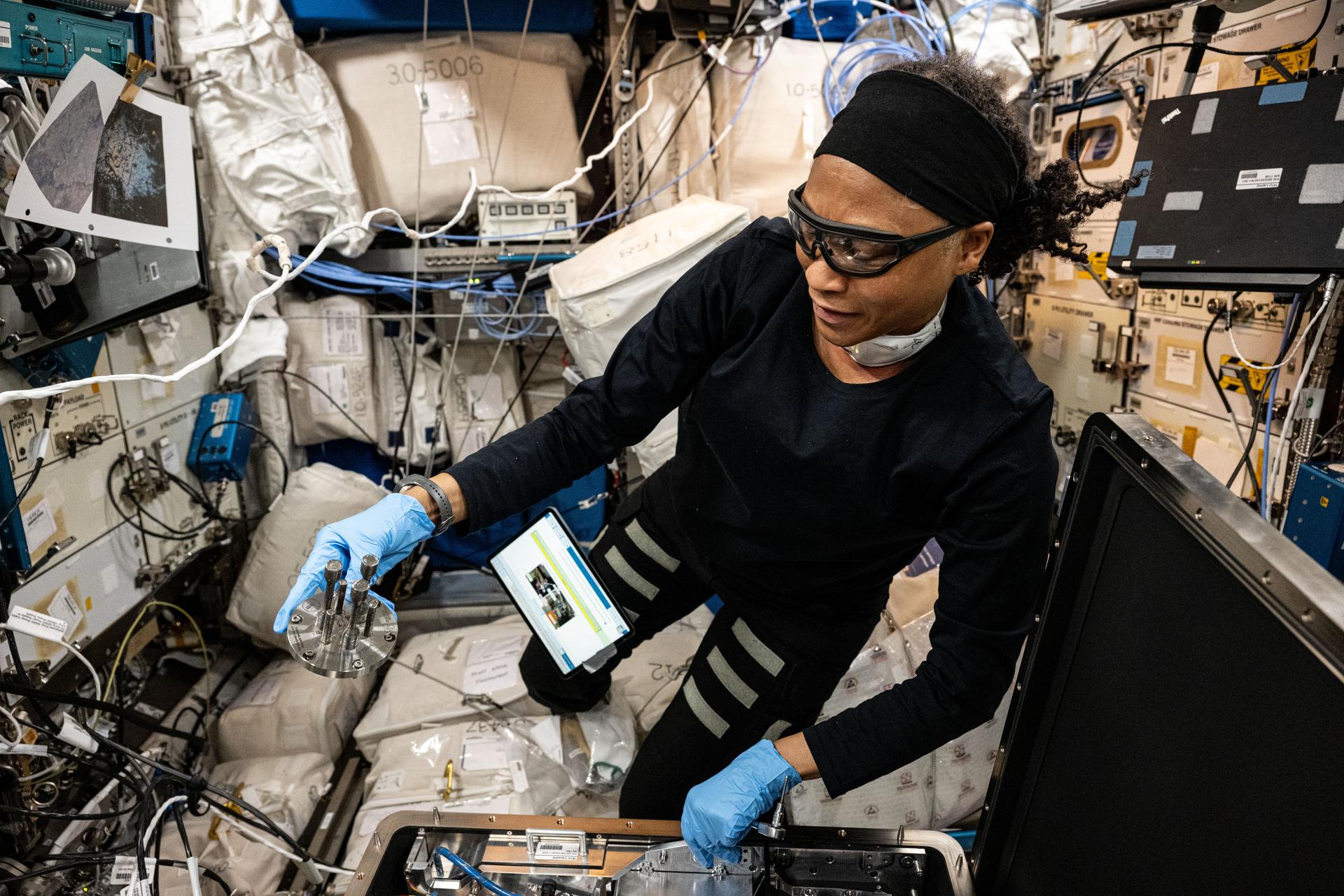
Inside the module, Vast has fitted what it calls the Haven-1 Lab: 10 middeck-locker-equivalent payload slots, each roughly microwave-sized, taking payloads up to 30 kilograms with 100 watts of continuous power, Ethernet connectivity, and gigabit-class downlink through Starlink laser links. Finished products and samples ride home on Dragon.
The first tenants, announced in 2024, were Redwire — flying its ADSEP4 processor for pharmaceutical research and biotech production — and the space-biotech firm Yuri, with its ScienceTaxi incubator, a centrifuge-equipped life-science facility that can host up to 38 experiment units. In April 2025, Vast added three more partners: Japan's JAMSS with a multi-purpose experiment facility, France's Interstellar Lab with its Eden 1.0 plant-growth capsule, and Luxembourg's Exobiosphere with a high-throughput drug-screening device — and said the lab was already nearing full capacity.
The manufacturing thread got noticeably thicker this June, when Vast signed memoranda of understanding with a second wave of partners aimed at Haven-1's successors as much as Haven-1 itself. The standout is Auxilium Biotechnologies, whose AMP-1 platform — already flown on the International Space Station — is the first 3D bioprinter to produce eight implantable medical devices simultaneously in orbit, completing a full print run in under two hours with less than a minute of astronaut time. LambdaVision, which has flown nine ISS missions maturing its protein-based artificial retina (built from 200 stacked protein thin-film layers), wants dedicated Haven lab space to push toward clinical-scale production. BioOrbit is exploring flying its protein-crystallization hardware for pharmaceutical work, and UC San Diego's Sanford Stem Cell Institute is weighing moving its accelerated-aging stem cell research program onto a commercial platform with faster flight cadence.
None of this is mass production — every one of these payloads fits in a locker the size of a microwave. But it is exactly the portfolio NASA's commercial LEO strategy has been hoping someone would assemble: pharma crystallization, bioprinted implants, and materials work that has already been de-risked on the ISS, looking for somewhere to go when the ISS retires around 2030. NASA's own commercial space stations program page describes Haven-1 as providing "a microgravity environment for crew, research, and in-space manufacturing."
The NASA dimension: PAM-6 and Haven-2
Vast's relationship with NASA deepened this year on two fronts. In February, NASA awarded Vast the sixth private astronaut mission to the ISS — the first such mission not won by Axiom Space — targeted for no earlier than summer 2027, with four crew spending up to two weeks aboard the station and SpaceX providing the ride. For Vast, it's flight heritage for crewed operations before its own station hosts anyone.
The bigger prize is NASA's Commercial LEO Destinations program, restructured in 2025 into Phase 2 funded Space Act Agreements covering design and demonstration of ISS-successor stations. Vast — which sat out Phase 1 and has developed Haven-1 outside the program — is pitching Haven-2, an evolved, NASA-certifiable multi-module design whose first module the company has said could be operational in 2028 if selected, growing to a full station with a 7-meter core module by the early 2030s.
Why It Matters
The ISS is scheduled to retire around 2030, and with it goes the only crewed laboratory where two decades of microgravity manufacturing research — protein crystals, bioprinted tissue, exotic materials — has been demonstrated. Whether that work survives the transition depends on commercial stations existing on time and having customers. Haven-1 is the nearest-term test of both: a privately funded station with a fully subscribed lab and a genuine, if early-stage, manufacturing manifest. Its slip to 2027 narrows the margin before the ISS goes away — but its pathfinder flew, its structure passed qualification, and its customer list keeps growing. For in-space manufacturing, Haven-1 is where the rhetoric meets a launch date.
Sources
- NASA — NASA Selects Vast for Sixth Private Mission to Space Station (Feb. 12, 2026)
- NASA — Commercial Space Stations program overview
- Vast — Haven Demo Mission Complete: Successful Deorbit Validates Path to Haven-1 (Mar. 19, 2026)
- Vast — Vast Expands Microgravity Research and Manufacturing Network (Jun. 24, 2026)
- SpaceNews — Vast begins Haven-1 testing and reschedules its launch (Feb. 6, 2025)
- Payload — Vast Delays Haven-1 Launch to 2027 (Jan. 20, 2026)
- VoxelMatters — Vast shows 3D-printed cold plates for Haven-1 space station (Mar. 25, 2025)
