
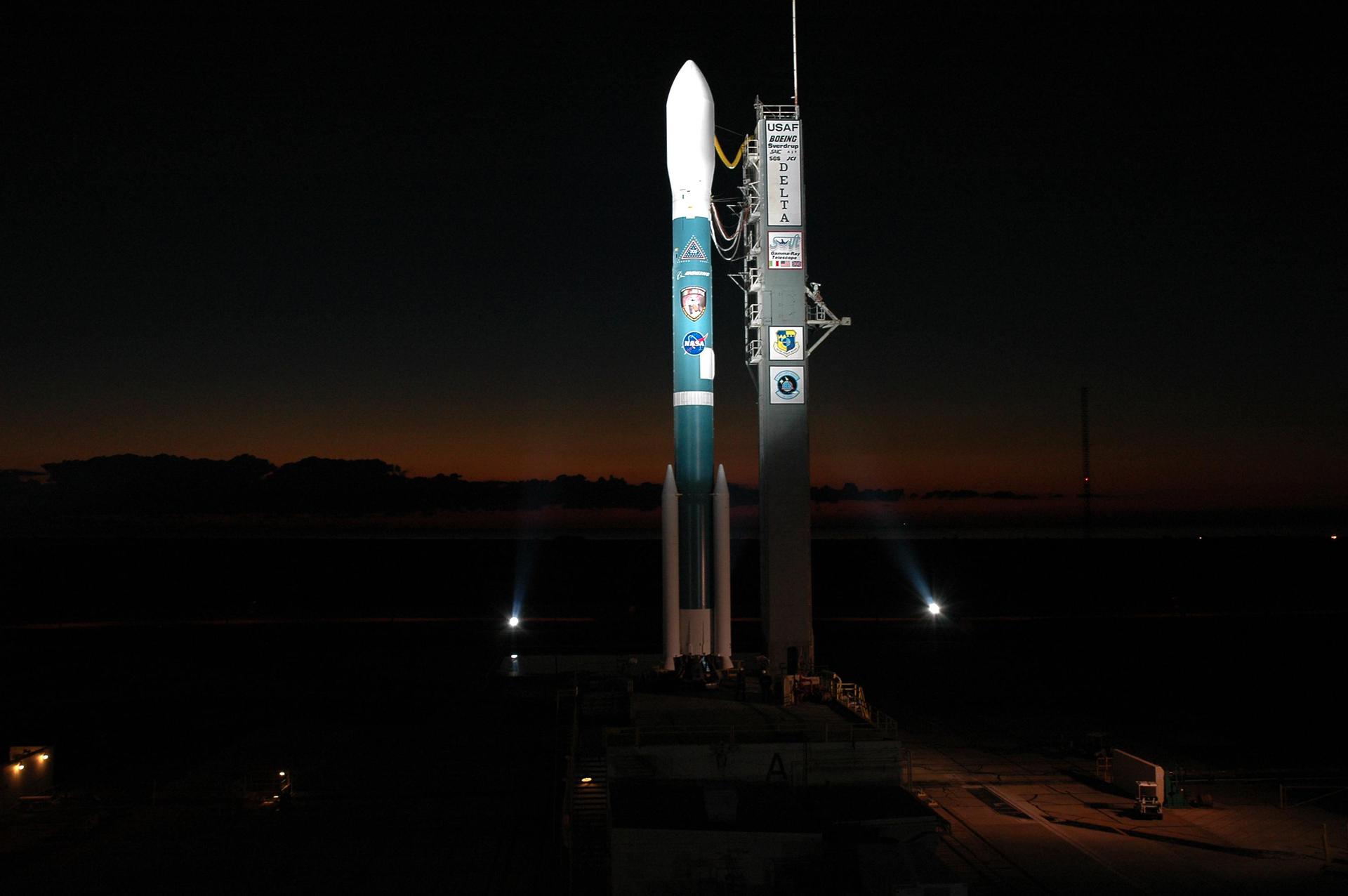
A week after launching atop a Northrop Grumman Pegasus-XL rocket, Katalyst Space Technologies' LINK servicing spacecraft is running through its paces in orbit, according to a July 10 update from NASA. The commissioning campaign is a prelude to a mission with no real precedent: docking a commercial vehicle to a government satellite that was never built to be docked with at all, in an attempt to keep NASA's Neil Gehrels Swift Observatory from tumbling into the atmosphere before the year is out.
LINK lifted off July 3, and NASA says the checkout process is expected to run a few weeks, with flexibility built in for the team to pause, assess data, and adjust as needed. So far, the spacecraft has cleared some of the basics: deploying its solar arrays, delivering power to its systems, establishing routine communications with ground controllers, and stabilizing its momentum through autonomous management systems. Engineers are now moving into a more consequential phase — putting LINK's three xenon-fueled electric propulsion thrusters through their paces, along with the other subsystems it will need for the rendezvous itself.
None of this is glamorous. It's the unglamorous, methodical work that has to happen before a spacecraft can be trusted to approach — let alone latch onto — another spacecraft in low Earth orbit. But the stakes attached to this particular checkout list are higher than usual.
Why It Matters
Swift has been flying since 2004, and in more than two decades of operation it has become one of astronomy's more prolific workhorses for gamma-ray burst detection. Those bursts — the violent afterglow of collapsing stars and neutron-star mergers — are exactly the kind of fleeting, unpredictable events that benefit from a spacecraft built to swivel and stare quickly, which is Swift's specialty.
The problem is orbital decay. Increased solar activity has been dragging on Swift's low-Earth orbit, according to Via Satellite, and the observatory's orbit is expected to drop below a safe operating altitude by October 2026, after which a reboost would no longer be feasible, according to SpacePolicyOnline. That's the gap Katalyst is trying to close. NASA awarded the company a $30 million contract in September 2025 specifically to build and fly a servicer capable of boosting Swift back to a safer altitude, according to SpacePolicyOnline.
What makes the mission notable beyond the rescue itself is the docking method. Swift, like most satellites of its era, was never designed with a berthing mechanism, grapple fixture, or any of the hardware that servicing missions typically rely on. As Via Satellite has reported, a successful docking would mark the first time a commercial servicer has attached itself to a NASA spacecraft that wasn't built for servicing in the first place — a capability with implications well beyond one aging gamma-ray telescope. If Katalyst can pull it off, it opens the door to servicing, refueling, or deorbiting a huge population of satellites currently written off as unreachable simply because nobody thought to add a docking ring when they were built.
What Happens Next
For now, LINK's job is simpler, if no less critical: prove that its propulsion and stabilization systems work as designed. The three xenon thrusters currently under test are what will eventually maneuver LINK close enough to Swift to attempt the docking, and any anomaly discovered now is far cheaper to fix than one discovered during final approach.
NASA has not published a specific date for the docking attempt itself, framing the current phase only as lasting "a few weeks." Given the urgency around Swift's decaying orbit, though, there isn't much slack in the schedule. The observatory's orbit is degrading in real time, and the same solar activity that's accelerating the decay isn't going away — it fluctuates with the roughly 11-year solar cycle, and current activity remains elevated.
That timeline pressure sets up an unusual dynamic for a technical demonstration: Katalyst isn't just proving that novel docking is possible, it's racing to prove it in time to matter for the specific spacecraft the technique was designed to save. A purely technical failure would be a setback for commercial servicing broadly. A failure that comes too late to save Swift would also mean the loss of an instrument that, after more than two decades in orbit, is still actively hunting for gamma-ray bursts.
A Bet on Commercial Servicing
The Swift rescue fits into a broader push — one NASA has been signaling for years — toward treating in-space servicing as a viable commercial capability rather than a one-off government program. That contract structure is itself a signal: NASA's $30 million award is designed to push a demonstrated technology toward operational, repeatable use — not simply to fund a one-off technology demonstration in a lab.
If LINK's thruster tests go cleanly and the spacecraft proceeds to rendezvous, the docking attempt will be the real test of everything the commissioning phase is meant to de-risk. Grappling an uncooperative target — one with no purpose-built capture point, spinning or drifting in ways its original designers never planned for a rescue vehicle to compensate for — is a fundamentally harder problem than docking with a spacecraft designed for it, like the ones that meet the International Space Station. Katalyst's approach to that problem hasn't been detailed publicly beyond the broad strokes of the mission; how LINK actually latches on will likely be the most closely watched part of the entire campaign once it happens.
For now, the story is a spacecraft quietly testing its thrusters in orbit, watched by an observatory that's running out of altitude and time.
