
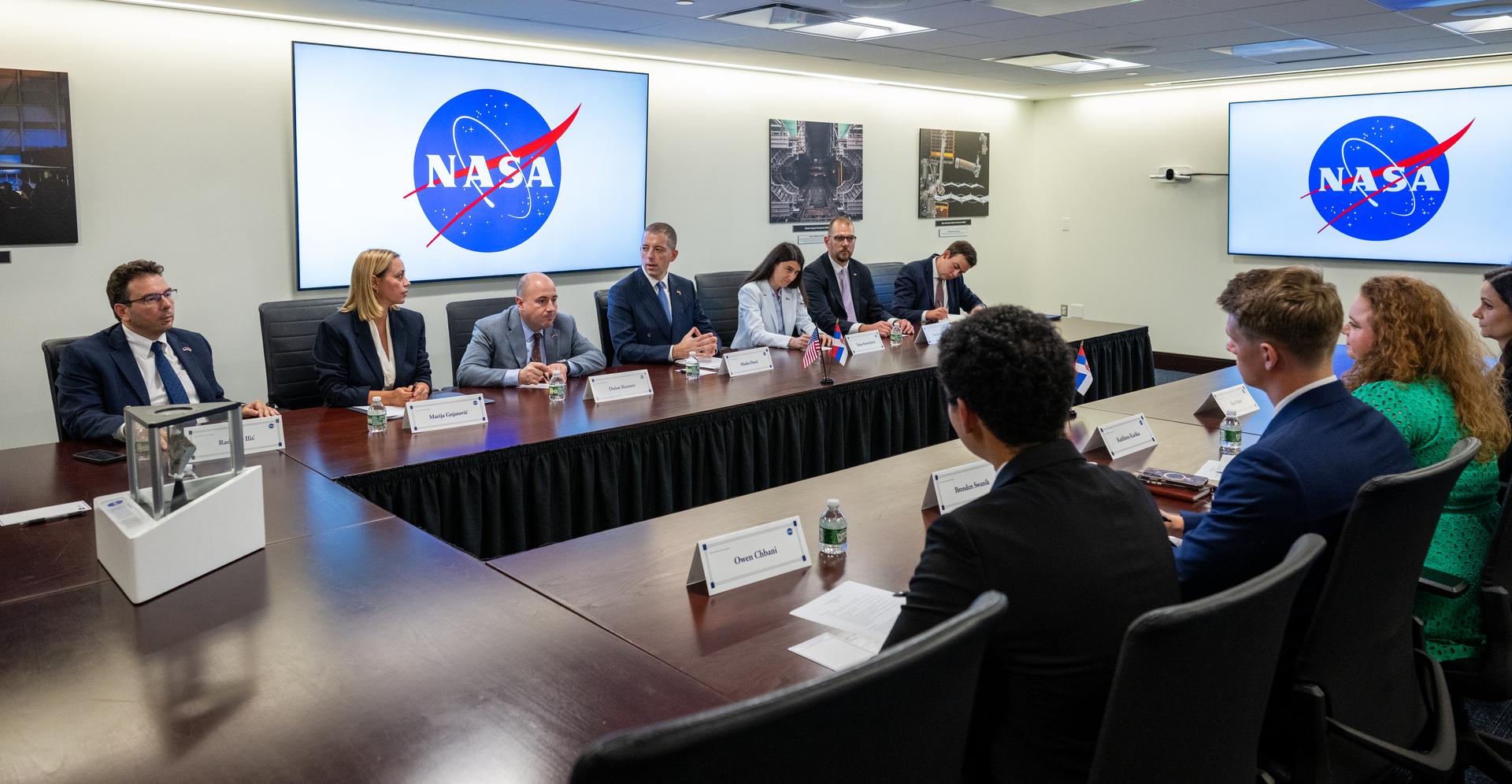
The Artemis Accords gained another member on Monday, Oct. 19, and this one signed during a diplomatic visit rather than at a space conference. In a ceremony in Samarkand, Uzbekistan's Foreign Minister Bakhtiyor Saidov signed the Accords while US Secretary of State Marco Rubio was in the country. NASA says this makes Uzbekistan the 77th signatory, and a US State Department statement dated the same day, reported by UzDaily, gives the same number.
NASA's account of Uzbekistan's space activity is short. It describes a national space program that is still being developed, a student CubeSat project, and a major international space event that Uzbekistan is due to host in 2028. The State Department, for its part, tied the signing to a wider push for closer ties with Tashkent. To see why this signature mattered to both agencies, it helps to look at all three.
A Signing Built Into a Foreign-Ministers Meeting
The ceremony was part of Rubio's official visit. According to Kun.uz, Rubio and Saidov signed after bilateral talks. UzDaily's account of the State Department statement also places the ceremony after a bilateral meeting of foreign ministers. The statement says Washington hopes for a stronger and expanded strategic partnership with Uzbekistan ahead of the upcoming G20 summit.
That setting fits how the Accords work. They were established in 2020 by NASA, the State Department and seven other founding nations, and both agencies remain involved. As UzDaily summarizes the State Department's description, accession is voluntary and is formalised through bilateral arrangements, with State and NASA coordinating international cooperation under the Accords on behalf of the United States. NASA describes signing as a commitment to explore peaceably and transparently, to render aid to those in need, to enable access to scientific data, to avoid interfering with the activities of others, and to preserve historically significant sites and artifacts.
What the Accords Actually Cover
Kun.uz describes the Accords as setting principles for international cooperation in the peaceful exploration and use of the Moon, Mars, comets, asteroids and other celestial bodies. Eight countries signed at the start in 2020, a group that included the United States, the United Kingdom, Japan, Canada and the United Arab Emirates. Six years later the membership has reached 77, and NASA says more countries are expected to sign in the months and years ahead.
NASA tied the signing directly to its lunar plans. "Uzbekistan joins the Artemis Accords at a pivotal moment," NASA Deputy Administrator Matt Anderson said in the agency's release, adding that President Trump has directed NASA to build a Moon Base and establish an enduring presence on the lunar surface. Anderson said the agency is expanding opportunities for like-minded nations to contribute to humanity's return to the Moon, and called Uzbekistan a welcome addition to the growing coalition.
Uzbekistan's Starting Point: A Student CubeSat
NASA's release is specific about where Uzbekistan's space work stands. It says Uzbekistan has increasingly engaged with NASA and the international space community through a national space program aimed at advancing its space industry, and that Uzbek students are working to develop and launch the country's first CubeSat, a small satellite technology demonstration, by 2028.
Saidov's stated goals point toward people and partnerships. According to Kun.uz, he said the agreement would open up opportunities for Uzbekistan to expand cooperation with NASA and the space agencies of other signatory countries, train national specialists and gain access to space technologies.
The groundwork started before the Samarkand ceremony. NASA says its officials met with representatives of Uzbekistan's Ministry of Digital Technologies and the national space agency, Uzcosmos, at the 2026 International Astronautical Congress in Antalya, Türkiye, in early October, where the two sides discussed civil space cooperation and opportunities for increased engagement. The signing came a few weeks later.
Why It Matters
The Artemis Accords grow mostly through accumulation. Each new signature adds one more government that has publicly committed to a shared set of principles for civil space exploration. Uzbekistan's signing adds to that coalition, and three things stand out.
The diplomatic channel. The signing was carried out by the foreign minister during a Secretary of State visit, and the State Department's statement placed it alongside hopes for an expanded strategic partnership. That suggests the Accords serve as a foreign-policy instrument as well as a space-policy one, and space cooperation gave the two governments something concrete to sign during a high-level visit.
The 2028 calendar. NASA notes that Uzbekistan is scheduled to host the annual global space event in 2028, following its discussions with NASA officials at this year's International Astronautical Congress. NASA also gives 2028 as the target year for the student CubeSat. If both happen on schedule, Uzbekistan will host that event in the same year its first CubeSat is due to be developed and launched, and it will do so as a member of the Accords.
The capacity question. Saidov's stated goals of specialist training and technology access are the parts of this agreement worth tracking. UzDaily's account of the State Department statement says accession is formalised through bilateral arrangements and that cooperation is coordinated by State and NASA. Whether concrete arrangements follow, such as training programs and technical exchanges, is not something the sources address, so it remains an open question rather than a given.
What to Watch
The next milestones are fairly clear. Watch for any follow-on arrangements between Uzbek agencies and NASA, the progress of the student CubeSat toward its 2028 target, and preparations for the 2028 global space event. The State Department also mentioned the upcoming G20 summit in its statement, in the context of the wider US-Uzbekistan relationship.
Six years after eight countries first signed the Accords, 77 have joined. The newest signatory is developing a national space program, has a student CubeSat in the works, and has a major space gathering to host in 2028.
