
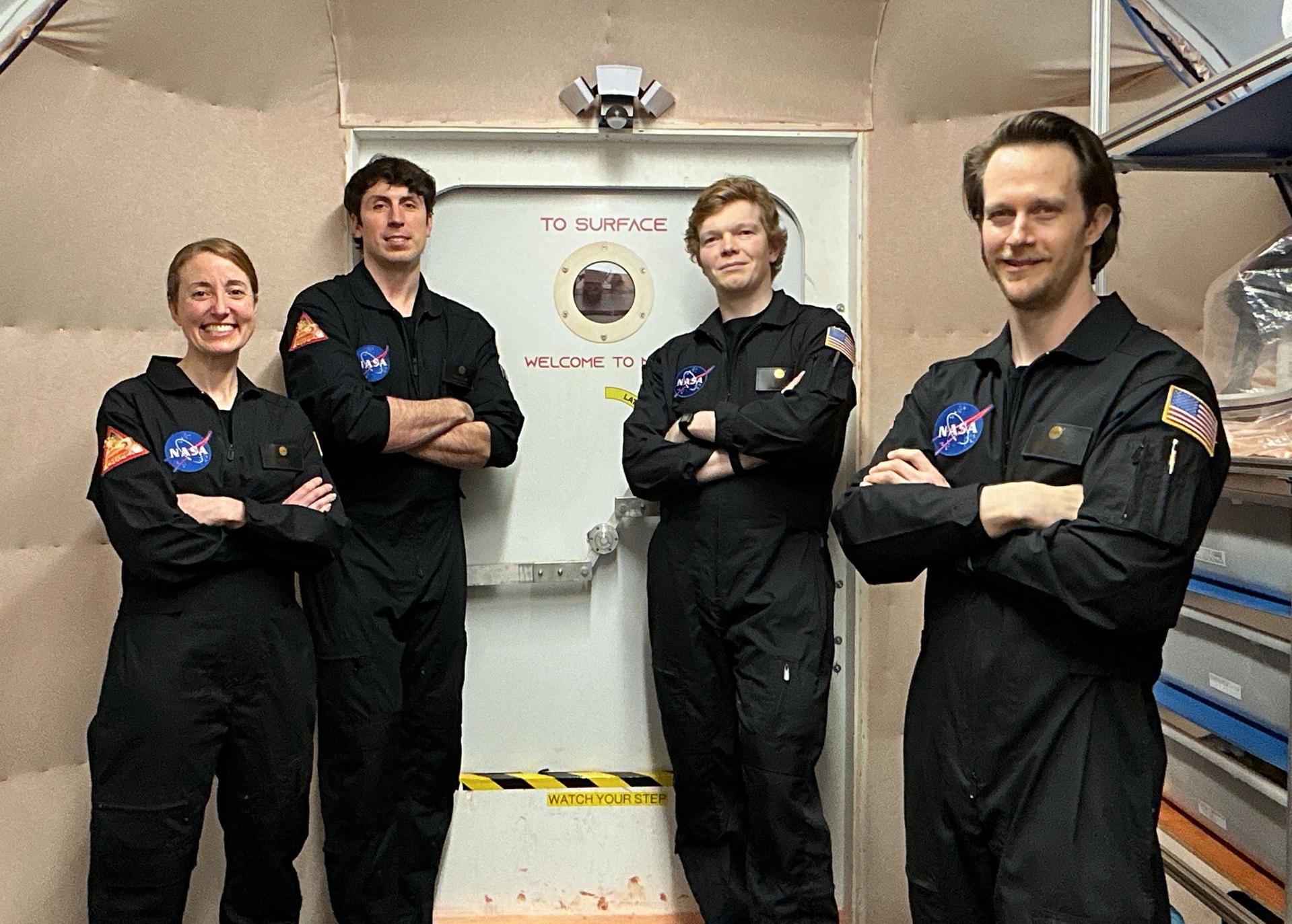
Four people in Houston have now gone a full year without leaving a fake Mars base. On 19 October 2026 the crew of NASA's second Crew Health and Performance Exploration Analog mission, known as CHAPEA, marked 365 days inside their habitat. The habitat is a 1,700-square-foot 3D-printed structure at Johnson Space Center. The mission is planned to run 378 days, and NASA says the crew will come out on Saturday, 31 October.
Nothing launches at the end of this mission. The crew have been on the ground the whole time. The point is to find out what a year of isolation, tight supplies and slow communication does to people and to how well they work, and to measure it in a controlled setting. A real Mars crew would face the same problems without the option of opening a door.
Who is inside
According to NASA's one-year announcement, the Mission 2 crew is:
- Ross Elder, commander
- Ellen Ellis, medical officer
- Matthew Montgomery, science officer
- James Spicer, flight engineer
They entered the habitat on 19 October 2025. After they come out, they begin two weeks of post-mission evaluations and debriefs with NASA scientists.
What a simulated Mars year involves
Daily life in the habitat is built to feel like a surface mission. NASA's CHAPEA Mission 2 program page lists the main activities: high-tempo simulated Marswalks, robotic operations, habitat maintenance, physical exercise and crop cultivation. The agency's one-year update mentions the same crop-growing and suited extravehicular activities on a simulated Martian surface.
The program page also lists the stressors built into the mission. These are limited access to resources, prolonged isolation, communication delays and equipment failures. The crew have to manage limited resources, deal with things breaking, and do all of it while cut off from ordinary contact with the outside world.
Communication is the hardest part to imitate and possibly the most important. Messages to and from the habitat are delayed on purpose, the way signals would be across the distance between Earth and Mars. In its anniversary release, NASA says the crew's communication delays can last up to 45 minutes each way (the program page cites 22-minute delays). That rules out a normal conversation. The crew's families have spoken with them only via email over the course of the mission, with a Mars-like communication delay.
A second run of the same experiment
CHAPEA Mission 2 is the agency's second 378-day simulated Mars mission at Johnson Space Center, according to NASA's program page. When the first mission began, Universe Today reported it as the first of three planned simulations. The first crew was Kelly Haston, Anca Selariu, Ross Brockwell and Nathan Jones. They entered the Mars Dune Alpha habitat on 25 June 2023, and they exited on 6 July 2024 after 378 days, as Live Science covered at the end of that mission.
Running the same experiment more than once is how a few anecdotes become data. One crew of four tells you how those four people coped. Several crews in the same kind of habitat, on the same timeline and with similar stressors, let researchers start to separate the effects of the environment from the personalities of one group. Mission 2 is the program's second set of measurements.
What NASA says it wants from the data
The anniversary release quotes two people on the scientific side. Grace Douglas is the CHAPEA principal investigator. Michael Stenger is chief scientist of NASA's Human Research Program. Stenger says the mission has been valuable in starting to teach NASA how to understand requirements for year-long missions, including medical and psychological care across communication delays.
NASA's release points to two uses for the data. The first is the communication delay. Some data could help NASA foster crew autonomy and build decision-making support systems for crews facing delays of up to 45 minutes each way. The second is that the findings are meant to apply beyond Mars. Stenger says the combination of a Mars-realistic analog with physiological, psychological and performance measures in a rigorously controlled environment will let NASA translate the knowledge to Moon Base and beyond. The release also says the data could shed light on how limited food and exercise systems will influence NASA's ability to achieve mission objectives, including spacewalks on the surface of Mars.
Why It Matters
A human Mars mission would mean crews living for long stretches far from Earth, with delayed contact with home. Those conditions are hard to study in orbit, where crews are close to the ground and supplies can be sent up. A habitat on the ground in Houston can deliberately recreate isolation, limited resources and communication delays together and keep them going for more than a year.
These analogs have limits. A building in Houston has Earth gravity and Earth's radiation environment, and it is next to a city. Mission 2 will not show how bodies cope with reduced gravity or deep-space radiation. It can show how a small team holds up under a year of isolation, how it handles equipment failures and limited resources, and how it works when answers from the ground arrive with a long delay. NASA says those results will help inform future long-duration missions to Mars, and Stenger says the knowledge will carry over to Moon Base and beyond.
Eleven days remain. After the exit on 31 October and two weeks of evaluations, Mission 2 will become the program's second complete set of data.
