
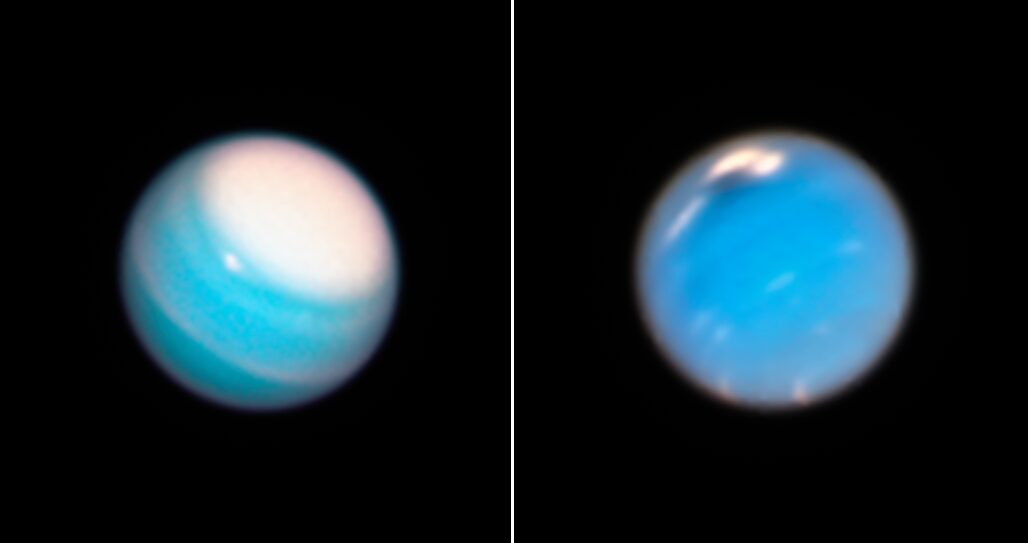
For decades, the textbook story of the outer solar system has had a tidy symmetry. Jupiter and Saturn are gas giants, vast balls of hydrogen and helium. Beyond them sit Uranus and Neptune, smaller and denser, their bulk supposedly dominated by water, ammonia and methane ices. The label stuck: ice giants. It even shaped how we imagine missions to them, how we model their churning magnetic fields, and how we slot them into the broader family of planets now turning up around other stars.
A preprint posted to arXiv on June 16, 2026, asks us to throw out the most important word in that classification. In Ice Giants Revisited: Uranus and Neptune as Magma Ocean Worlds, Edward D. Young, Sarah P. Marcum, Aaron Werlen and Paula N. Wulff argue that the two outermost giants are not icy at all. Instead, they propose, each is a "supercritical, hydrogen-rich magma ocean" overlain by a hydrogen-dominated envelope. The 26-page paper, with 10 figures, has been submitted to The Astrophysical Journal and was picked up across science media in late June.
The trick is in the density
The case for ice was always circumstantial. We cannot drill into Uranus. What we have instead is a set of remote measurements — a planet's radius, its bulk density, the lumps and bumps in its gravitational field (the so-called gravitational harmonics), how mass is distributed from center to surface (the normalized moment of inertia), how much heat it leaks to space, and what its atmosphere is made of. For a long time, the most economical way to reconcile those numbers was a deep interior rich in water and other ices, which have just the right density to split the difference between rock and gas.
Young and colleagues point out that ice is not the only material that lands in that density window. Their best-fit model layers each planet differently: a hydrogen-helium atmosphere on top that radiates the planet's internal heat to space; beneath it a boundary layer of hydrogen, helium, magnesium, silicon monoxide and oxygen; and below that a magma ocean of silicate, iron and hydrogen. The key move is what happens to hydrogen at the crushing pressures inside these worlds. Rather than staying separate, hydrogen dissolves into the molten silicate, producing a well-mixed fluid whose density mimics that of an ice-rich interior.
In other words, the thing we read as "water" may instead be hydrogen stirred into rock so thoroughly that the two become a single supercritical soup. Phys.org, summarizing the work, framed it bluntly: the best-fit model has a well-mixed magma ocean with dissolved hydrogen at its base and a hydrogen-dominated envelope above, and it explains the very densities that were long taken as proof of an icy interior.
Why three numbers matter
Models that explain everything are easy to build if you give yourself enough knobs to turn. The persuasive part of this paper is how few it uses. The authors report that with only three fitting parameters per planet, the magma-ocean model simultaneously reproduces each world's radius, bulk density, gravitational harmonics, normalized moment of inertia, intrinsic luminosity and atmospheric chemistry.
That is a demanding list. Those observables pull in different directions; a configuration that nails the density can easily flunk the moment of inertia or the heat budget. Matching all of them at once, without a long tail of free assumptions, is the kind of parsimony that makes planetary scientists take notice. It does not prove the model right — competing interior models have fit subsets of these data for years — but it sets a high bar for the old ice-rich picture to clear.
From "ice giants" to "rock giants"
If the interior is molten silicate and iron rather than water ice, the nickname has to change. Live Science, covering the same model, went with "rock giants," emphasizing the reframing of the core and deep interior. Universe Today and Phys.org leaned on "magma worlds." Whatever the eventual label, the shift is more than cosmetic. The composition of a planet's interior governs its thermal evolution, the dynamo that generates its tilted, off-center magnetic field, and the story of how it formed in the first place.
That last point is where the paper reaches beyond our own solar system. Young and colleagues argue the magma-ocean picture establishes continuity with the sub-Neptunes — the most common type of planet found so far around other stars — and with "gas-dwarf" formation scenarios. Sub-Neptunes are exactly the awkward, in-between worlds that hydrogen-soaked magma oceans might describe: bigger than Earth, smaller than Neptune, and everywhere.
Why It Matters
Recasting Uranus and Neptune as magma oceans does two things at once. First, it dissolves a long-standing taxonomic boundary in our own backyard. If our "ice giants" are really hydrogen-rich rock giants, then they stop being oddities and become the nearest examples of the galaxy's most abundant planet class. Instead of flying light-years to study a sub-Neptune, we have two of them parked within reach.
Second, it sharpens the case for actually going. A model this comprehensive — one that explains radius, gravity, heat and atmosphere from three numbers — is exactly the kind of claim a spacecraft can test. A Uranus orbiter could measure the gravitational harmonics and magnetic field with a precision no Earth-based observation can match, probing whether the interior really is a well-mixed magma ocean or something closer to the classic ice layers. Until then, the reclassification remains a compelling argument on paper rather than a settled fact. But it is the rare planetary-science result that reframes both the worlds we thought we knew and the thousands we are only beginning to find.
Sources
- Ice Giants Revisited: Uranus and Neptune as Magma Ocean Worlds (arXiv:2606.18219)
- Uranus, Neptune May Be Magma Worlds, Not Ice Giants — Universe Today
- Uranus, Neptune may be magma worlds, not ice giants — Phys.org
- Uranus and Neptune may be 'rock giants,' not 'ice giants,' new model suggests — Live Science
