
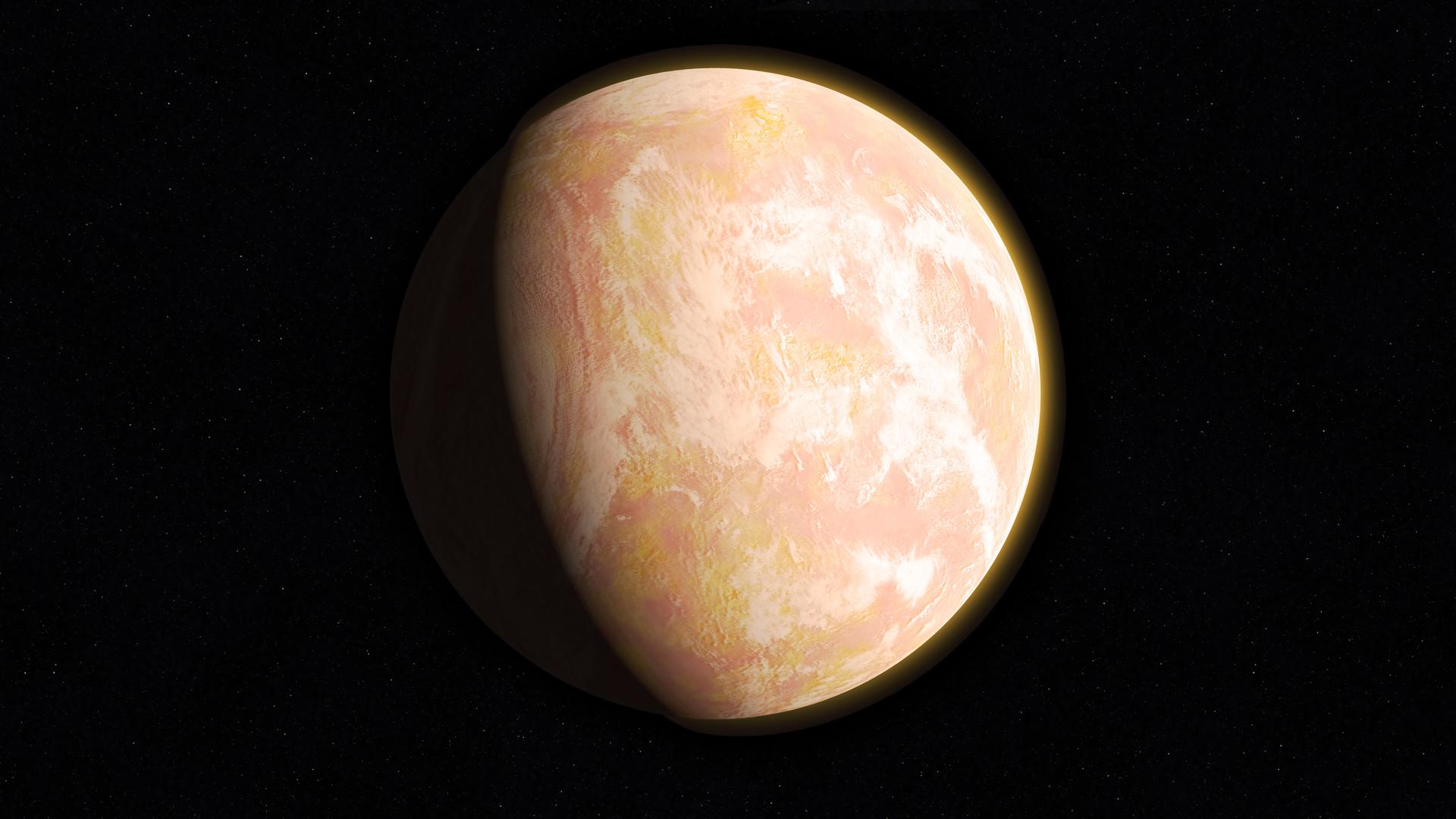
For more than a decade, sub-Neptunes have frustrated the people trying to read their skies. These worlds - bigger than Earth, smaller than Neptune, and the most common type of planet the galaxy seems to make - keep showing up with atmospheres that are stubbornly, inconveniently hazy. The light passing through them on its way to our telescopes comes out flattened and muted, the spectral fingerprints of water and methane smeared into near-featurelessness. Astronomers knew something was hanging in those atmospheres. They just couldn't agree on what.
A new study in The Astrophysical Journal Letters offers an answer that sounds less like astrophysics than like a smog alert. According to a University of Chicago team, many of these planets may be churning out the same compounds that pour from the tailpipe of a diesel truck. The haze, in this picture, is soot. The planets are factories. And the machinery driving them looks a lot like internal combustion.
"It's like you have a natural diesel engine," said lead author Jeehyun Yang, a UChicago postdoc - and the detail that makes this study unusual is the toolkit Yang brought to it. The researchers describe the work as the first time anyone has applied chemical engineering to the study of exoplanets, and that background is doing real work in the result rather than just supplying a quotable metaphor.
How a planet becomes a soot factory
The soot in question is a family of molecules called polycyclic aromatic hydrocarbons, or PAHs - honeycomb-shaped lattices of carbon atoms that are common in diesel exhaust here on Earth. Yang's team modeled the upper atmospheres of sub-Neptunes as combustion environments and found that, under the right conditions, those layers can manufacture PAHs in bulk. The molecules form deep in the atmosphere and are then lofted upward, where they accumulate as the kind of high-altitude aerosol haze that has been confounding observers all along.
Crucially, the process is not a free-for-all. The model predicts that PAH production depends sharply on temperature, peaking around 600 K (roughly 327 degrees Celsius) and falling off at both higher and lower temperatures. Run a planet too cool and the chemistry stalls; run it too hot and the soot breaks back down. The sweet spot for these molecular smokestacks sits in a band of equilibrium temperatures stretching from about 500 to 800 K.
That temperature dependence is where the study earns its keep, because it predicts a specific shape. Plot aerosol abundance against temperature and you should see a hump - a parabola that rises to a peak near 600 K and then declines. And that, the authors note, is exactly the pattern that observations have been quietly showing for years.
Matching the telescopes
The model's predictions line up with existing aerosol measurements collected by the James Webb Space Telescope and the Hubble Space Telescope. The much-discussed parabolic trend in how cloudy or clear these atmospheres appear - long noted, long unexplained - drops neatly out of the soot-factory chemistry. Rather than inventing a bespoke explanation for each hazy world, the framework offers one underlying mechanism whose temperature curve reproduces the population-wide behavior. The independent coverage of the result emphasizes the same point: the PAH picture agrees with what JWST and Hubble already see.
From that, the team assembled a roster of the most promising places to go looking. Their candidate soot-producing sub-Neptunes include GJ 1214 b, GJ 436 b, GJ 3090 b, HD 97658 b, LP 791-18 c, TOI-836 c, GJ 9827 d, GJ 3470 b, and TOI-674 b - worlds whose equilibrium temperatures land in the productive zone.
At the top of the list is GJ 1214 b, flagged as the most promising target of the bunch. It is a well-studied world for good reason: at 6.26 Earth masses and 2.74 Earth radii, whipping around its star every 1.58 days, it sits just 48 light-years away. GJ 1214 b has been a poster child for impenetrably hazy atmospheres since long before anyone proposed it might be running a combustion engine, which makes it a natural place to test whether the soot is really there.
Why It Matters
Sub-Neptunes are the galaxy's default planet, and their hazes are the single biggest obstacle to reading their atmospheres. Every smeared spectrum is a measurement we cannot fully make - a missing water line, an obscured carbon budget, a question about whether a given world could be a steam-shrouded ocean or a thick-skied gas dwarf. If the haze is PAH soot governed by a clean temperature law, then astronomers gain something they have badly lacked: a predictive rule for which planets will be murky and which might offer a clearer view. That turns target selection from guesswork into something closer to triage, telling observers where to point JWST for the best odds of a usable spectrum.
There is a deeper resonance, too. PAHs are not just pollutants; they are carbon chemistry, the same broad family of organic molecules that show up in discussions of how the raw ingredients of life get distributed through space. Finding them mass-produced in the atmospheres of the most common planets in the galaxy reframes those worlds as active organic chemistry labs rather than inert balls of gas. And the study's origin story - a chemical engineer recognizing a diesel engine where astronomers saw only fog - is a reminder that some of the most stubborn problems in one field yield fastest to an outsider carrying the right toolkit.
The hypothesis still has to survive direct testing. JWST can detect PAHs, and the candidate list gives observers a concrete place to start. If the spectra of GJ 1214 b and its cousins come back carrying the signature of aromatic soot, the sub-Neptune haze problem will have gone from a decade-long mystery to a solved piece of atmospheric chemistry - and a rather unflattering new label for the most abundant planets we know.
