
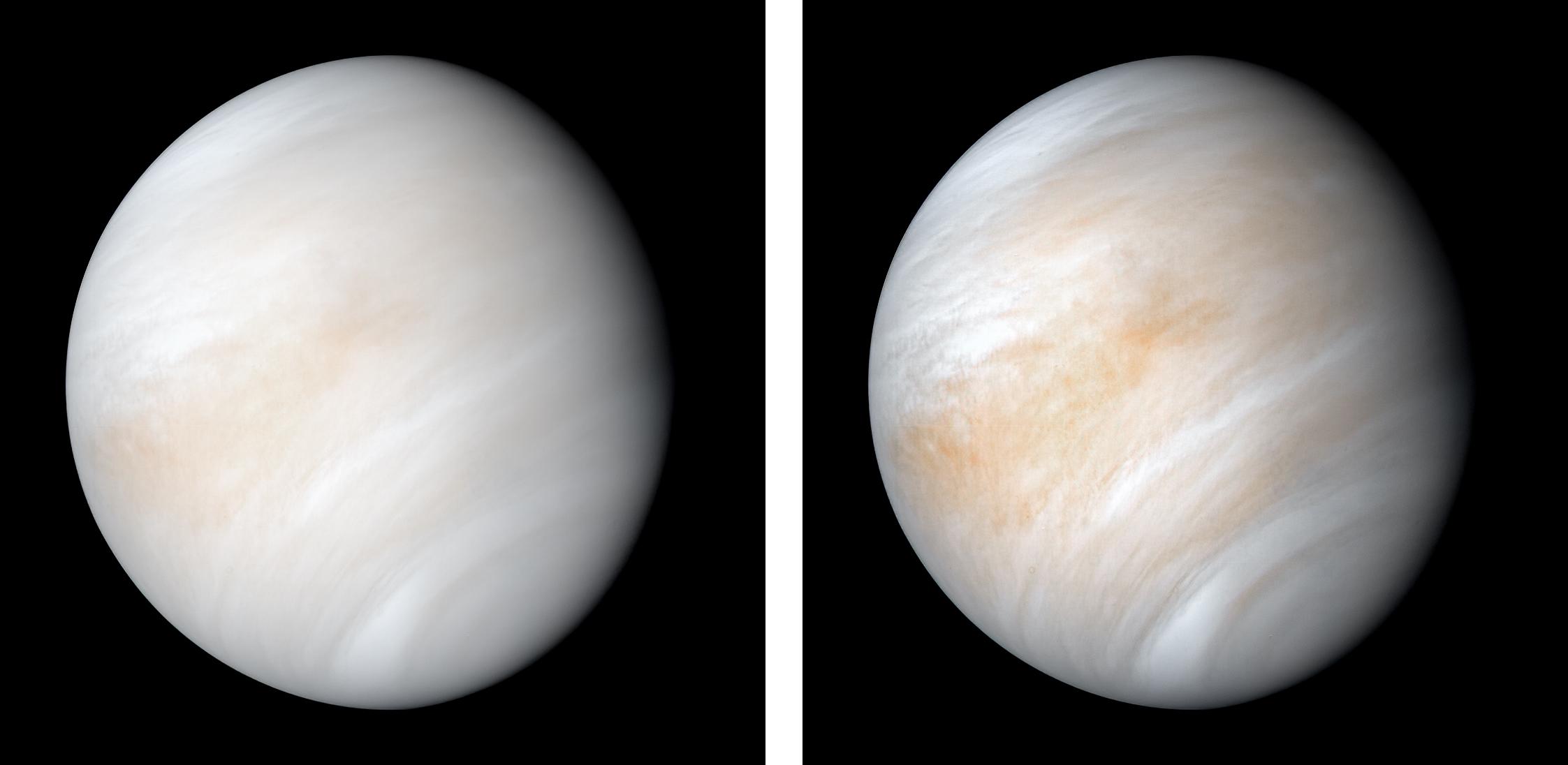
Venus is the solar system's great contrarian. While nearly everything else in the neighborhood spins counterclockwise when viewed from above the Sun's north pole, Venus turns the other way — and it does so with almost comical sluggishness, taking about 248 days to complete a single rotation. A Venusian day, in other words, is longer than a Venusian year. The Sun, for anyone standing on that broiling surface, would rise in the west and set in the east. Why a planet roughly Earth's twin in size and mass should rotate backward and so slowly has been one of the more stubborn puzzles in planetary science.
At the European Geosciences Union (EGU) General Assembly in Vienna, planetary scientist Cedric Gillmann of ETH Zurich and colleagues offered a pointed answer: a single violent collision near the very beginning of Venus's life. In work reported on June 15, 2026, the team argues that a high-velocity, moon-sized impactor striking the young planet at a steep angle could have braked its spin and tipped it into its present backward rotation. The result, they suggest, resolves a long-standing question about how a world so like Earth ended up spinning the wrong way.
One big hit, not a slow grind
For decades, the leading explanations for Venus's strange rotation leaned on gradual processes: the gravitational tug of the Sun on the planet's thick atmosphere, internal tidal friction, and the slow torque of solar tides acting over billions of years. Those mechanisms can, in principle, despin a planet and even reverse it given enough time. Gillmann and colleagues take a different tack, returning to the chaotic first chapter of the solar system, when newly formed planets were still absorbing the leftover debris of their construction.
Their scenario places the decisive event within the first roughly 50 million years of Venus's existence — a blink, geologically speaking. The culprit is an object with about 10 percent of Venus's mass, comparable in scale to a moon, arriving fast and at a high angle. The geometry matters enormously. Depending on exactly how the impactor struck, the team's modeling shows two outcomes: the collision could have sharply slowed a young planet that was initially spinning fast, gradually bringing it to its torpid present-day pace, or it could have delivered a more energetic blow that put the planet into retrograde rotation outright.
Simulating a planetary collision
The argument rests on computer simulations of a giant impact, a workhorse technique for modeling planetary collisions in which the colliding bodies are tracked as their material, pressures, temperatures, and trajectories evolve under gravity. By varying the impact parameters — the speed, angle, and mass of the incoming body — the team explored which collisions could leave a planet spinning slowly backward rather than rapidly forward. The specific combination of a steep, high-velocity strike from a roughly moon-mass object emerged as a way to reproduce Venus's present-day spin from a fast-rotating early world.
An ocean of magma
A collision energetic enough to halt and reverse a planet's spin does not leave the rest of the world untouched. The simulations indicate that such an impact would have melted Venus on a staggering scale — anywhere from a melt layer on the order of 100 kilometers thick to near-total melting, with roughly 99 percent of the mantle turned to liquid rock. In the most extreme case, the young planet would have been very nearly a global magma ocean.
That detail is more than a vivid aside. A deep magma ocean would have reset Venus's thermal and chemical state early on, governing how the planet outgassed, how it cooled, and how its interior layered itself into the configuration that drives volcanism today. In the researchers' framing, the same blow that gave Venus its backward day may also have set the initial conditions for its long-term thermal and volcanic evolution — making the impact not just a curiosity about rotation but a potential origin point for the planet Venus became.
Why It Matters
Venus is the planet we keep comparing Earth to and the one we understand least well. Two worlds began with similar sizes and bulk compositions, yet one became a temperate, life-bearing planet and the other a runaway-greenhouse furnace with a backward, glacially slow day. Pinning down whether a single early collision set Venus on its divergent path speaks directly to how contingent planetary outcomes are — how much a world's fate hinges on the random violence of its first 50 million years rather than on tidy, predictable physics.
The work also matters for interpretation closer to home and farther afield. If a single giant impact both despun Venus and flipped it into retrograde, that ties one of the planet's defining traits to a single violent early event and offers testable predictions for upcoming Venus missions probing the planet's interior and surface history. More broadly, it sharpens how astronomers read the rotation states of the rocky exoplanets now being catalogued by the thousands: a slow or retrograde spin may be less a sign of leisurely tidal evolution than a fossil of an ancient, world-altering collision. As a presentation rather than a final word, the result will face scrutiny — but it reframes Venus's weirdest feature as a clue to its origin instead of merely a riddle.
