
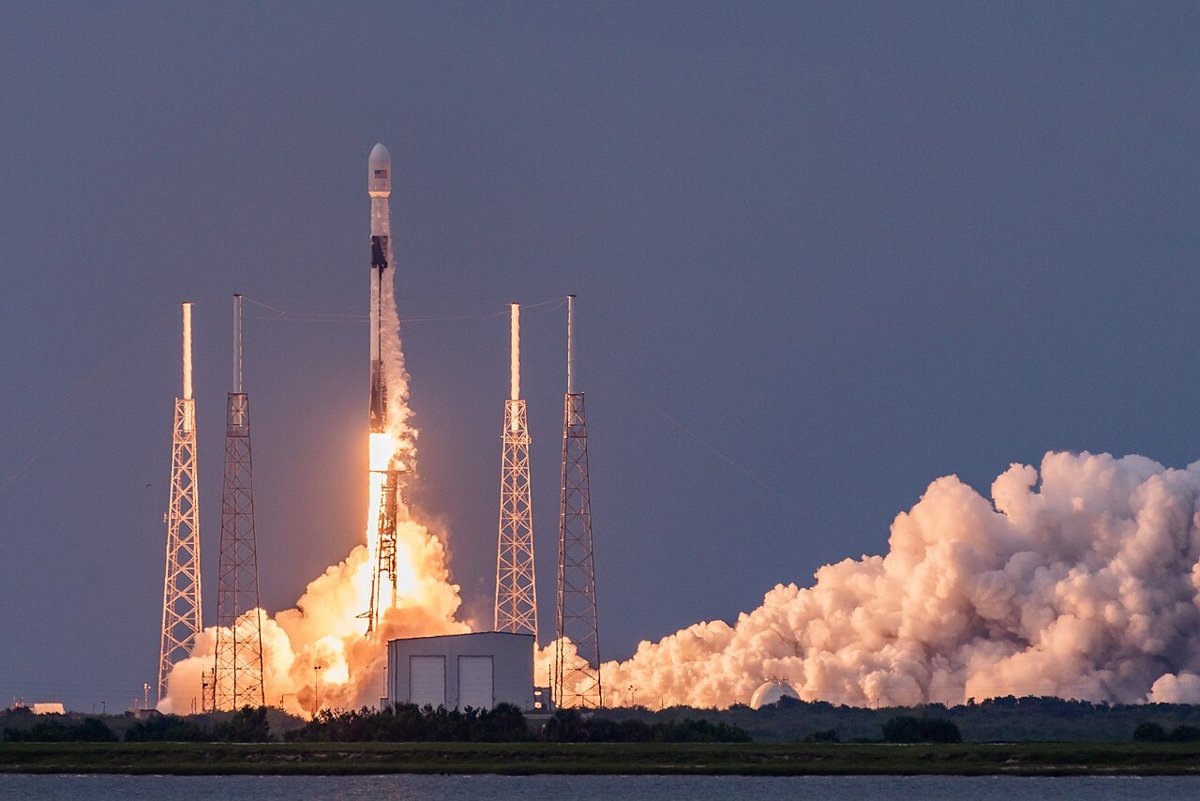
When a launch company files a mission manifest with almost nothing on it, that restraint is itself a message. SpaceX launched a mission called Starfall on a Falcon 9 rocket with a description that could fit on a sticky note: a reentry capsule demonstration. The company has said almost nothing else publicly — no payload specifications, no customer name, no orbital parameters, no timeline for what follows. Just a name, a rocket, and a mission type.
In an industry that has grown accustomed to detailed pre-flight coverage from even the most secretive launch providers, the operational security surrounding Starfall stands out. The mission flew, the capsule demonstrated whatever it was built to demonstrate, and SpaceX's public communications remain near zero. For observers who track commercial space programs closely, that level of deliberate opacity usually means something is worth protecting.
What SpaceX Has — and Hasn't — Said
The public record on Starfall is thin by design. SpaceX flew the mission on its Falcon 9 rocket and described it as a reentry capsule demonstration. No launch customer was named. No orbital destination was disclosed. No mission profile was published. No payload mass, no recovery plan, no timeline for program milestones.
That is the full public disclosure SpaceX has provided for a mission it chose to name Starfall.
The name is doing some work here. Naming a mission — rather than leaving it as an internal technical designation — is a deliberate choice. “Starfall” is evocative rather than descriptive: it implies something descending through the atmosphere, consistent with the reentry framing, but it doesn't point to a customer, a contract, or a purpose. The company knew it was choosing a public-facing label. It chose one that reveals almost nothing operational.
Trade publication SpaceNews described the mission as “secretive” in its own coverage — a characterization from journalists who cover this beat daily and know what standard disclosure looks like. Starfall, by that measure, doesn't look like standard disclosure.
Why Reentry Demonstrations Exist
A reentry capsule demonstration doesn't happen because someone has spare hardware sitting around. It happens because an engineering team needs to prove that a design performs under conditions that cannot be replicated in a ground facility. The thermal, mechanical, and aerodynamic forces a capsule encounters during atmospheric reentry are unique to that environment — no test chamber fully reproduces them at operational fidelity.
Capsules that survive atmospheric reentry — slowing from orbital velocities to recoverable speeds while managing heat loads, controlling descent attitude, and deploying recovery systems at the right moment — represent a specific and demanding category of aerospace capability. Not every launch vehicle operator needs this capability. The companies and programs that pursue reentry-capable hardware are doing so deliberately, because they need to recover something from orbit: cargo, scientific experiments, manufactured materials, or the capsule hardware itself for reuse.
A dedicated demonstration flight means someone needs empirical data. Terminal-phase aerodynamic performance. Heat shield behavior under real flight conditions. Guidance and control precision during hypersonic descent. Recovery system reliability from altitude. These data points feed directly into the qualification and certification process for an operational vehicle. Demonstration flights don't happen for their own sake; they happen because a program follows them.
Reading the Secrecy
Commercial launch providers regularly fly missions under non-disclosure agreements. National security payloads, intelligence community programs, and military technology demonstration missions routinely appear on manifests with minimal public detail. The operational security itself is not unusual in the modern launch industry. What makes Starfall worth examining is the specific framing as a “demonstration” — not a customer payload delivery, but a technology proving flight — combined with essentially zero public information.
Demonstrations can be classified for several reasons. A government customer developing a new reentry vehicle may want its technical approach kept quiet until the program matures to a stage where disclosure is strategically useful. An internal development program at SpaceX could be advancing technology the company isn't ready to announce. Or the capsule may belong to a commercial developer whose investors and competitors don't need to know the timing and results of its early test campaigns.
The minimal-disclosure pattern — just enough information to satisfy regulatory filing requirements, nothing more — is consistent with a program that has something to protect. Whether that something is a government contract, a commercial advantage, or a development roadmap that isn't ready for public scrutiny, the choice to say almost nothing is a choice made deliberately by people who weighed the alternatives and decided silence served them better.
The Broader Commercial Context
Starfall's launch comes as NASA continues its sustained shift toward commercial procurement for an expanding range of capabilities. The agency recently selected eight commercial providers under the On-Ramp 2 contract vehicle for its Commercial Smallsat Data Acquisition program — the latest data point in a long-running strategy of buying commercial capability rather than developing it internally. That deepening reliance creates a particular incentive structure for commercial providers who can demonstrate technically demanding capabilities ahead of formal procurement cycles.
Companies that develop reentry-capable vehicles for one application frequently find that the underlying capability addresses a broader market than initially scoped. Cargo delivery to orbital stations, return of scientific samples from microgravity research platforms, recovery of materials manufactured in the space environment, hypersonic research vehicle qualification — these applications converge on the same core requirement: a vehicle that can descend from orbit and be recovered intact. A single demonstration flight can generate qualification data across multiple potential programs simultaneously, making the economics of a “demonstration” more attractive than the label might suggest.
Whether Starfall is connected to NASA programs specifically, other government work, or an entirely commercial application remains unknown. But the market for reentry-capable commercial vehicles is demonstrably expanding, and the demand for providers who can credibly demonstrate that capability — with real flight data rather than paper analyses — is growing with it.
What Comes After a Demo
Demonstration missions are waypoints, not endpoints. When a vehicle program flies a reentry demonstration and the results are good, the program advances toward operational flights, certification, and customer delivery. When results are mixed, the program iterates with revised hardware or flight parameters. Either way, the demonstration produces data that drives the next engineering and business decision.
The silence around Starfall will likely end when there is a reason to end it. Programs that have demonstrated a core capability but haven't yet announced operational customers tend to stay quiet until publicity serves a purpose — a regulatory filing that forces disclosure, a contract announcement that needs market attention, or a product reveal timed to a competitive moment. At that point, the program that Starfall belongs to will have a name that means something specific.
Until then, the observable record consists of a launch, a capsule, a description, and an unusually short press release. In commercial space, demonstration flights without follow-on announcements rarely stay mysterious indefinitely. The information exists; it simply hasn't become useful to release yet.
Why It Matters
Reentry capsule technology represents a capability threshold that separates launch providers from full-cycle space logistics operators — entities that can not only place hardware on orbit but return it, enabling business models that pure-launch vehicles cannot support. The commercial market for recovery capability is real and expanding, driven by the growth of in-space manufacturing research, microgravity pharmaceutical development, and the proliferation of orbital platforms that require bidirectional cargo capability.
Starfall's significance isn't necessarily what it accomplished in a single flight. It's what that flight represents: a program serious enough that SpaceX and whoever is behind it chose to protect it with operational security rather than publicize it. Programs worth protecting tend to be programs with real stakes — real customers, real contracts, or real technical advantages that disclosure would compromise.
The commercial space industry has learned to pay attention to what companies don't say as much as what they do. When SpaceX launches a reentry capsule demonstration and releases almost nothing about it, that restraint is load-bearing. Whatever Starfall is the beginning of, its backers have apparently decided it isn't something they're ready to explain yet — and that decision, in a business where announcements are typically a form of marketing, may be the most telling thing about it.
