
For roughly the first billion years after the Big Bang, the universe was foggy. Neutral hydrogen filled the space between galaxies, soaking up the energetic ultraviolet light that young stars throw off and leaving the cosmos opaque to it. Then, gradually, that fog burned away: the hydrogen was stripped of its electrons — ionized — and the universe became the transparent place we observe today. This transition is called the Era of Reionization, and astronomers have spent decades arguing about exactly what powered it.
Now a team using NASA's Hubble Space Telescope says it has caught the process in the act. In a paper published June 23, 2026 in the Astrophysical Journal, researchers report detecting ionizing ultraviolet photons actually escaping a galaxy during the reionization epoch — light that, by most expectations, the surrounding hydrogen fog should have swallowed before anyone could see it.
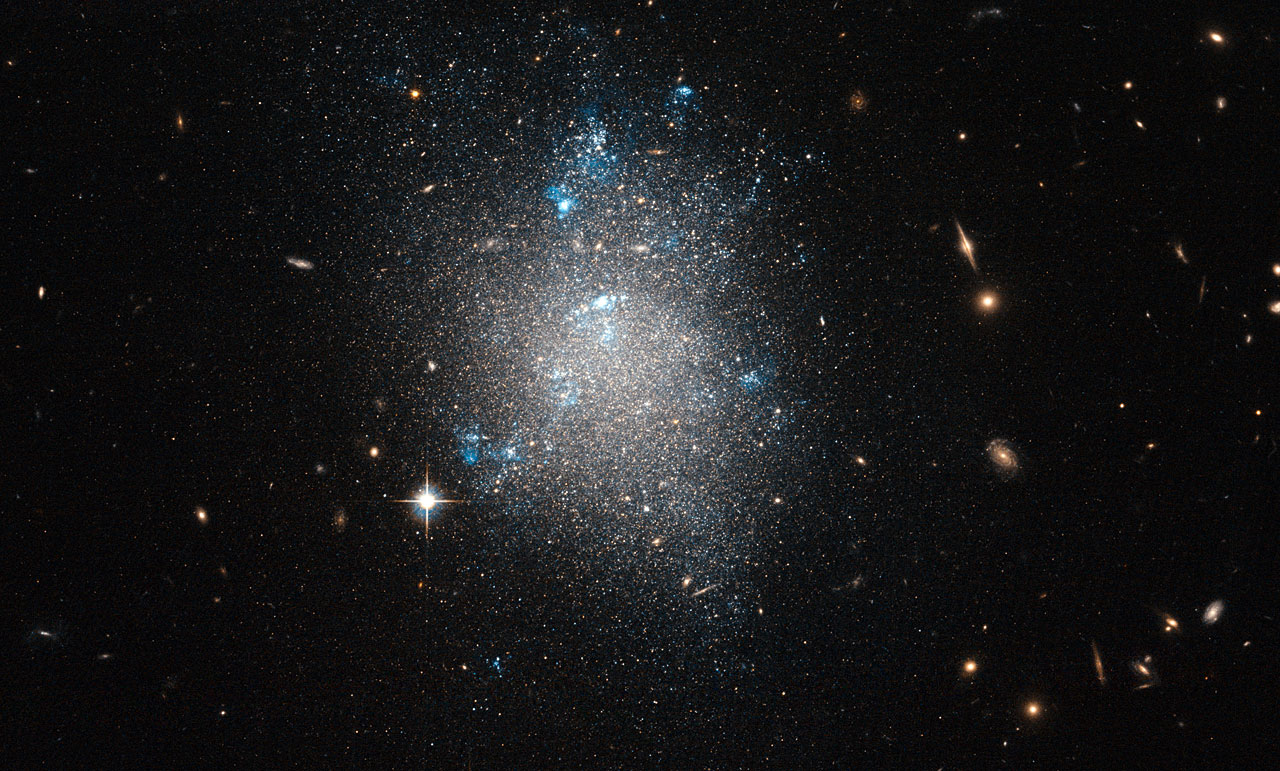
The galaxy carries the unglamorous catalog name MXDFz4.4, and it sits in the Hubble Ultra Deep Field, the patch of sky Hubble has stared into longer than almost any other. We are seeing it as it existed just 1.4 billion years after the Big Bang.
A small galaxy punching well above its weight
MXDFz4.4 is not an imposing object. By area it is roughly 100 times smaller than the Milky Way. But it is doing something the Milky Way is not: forming stars about 10 times faster than our galaxy does, all packed into that compact footprint. The result is a dense knot of young, massive, extremely hot stars — exactly the kind of stellar population that floods its surroundings with high-energy ultraviolet radiation.
That radiation is the key. Massive young stars emit ionizing photons capable of knocking electrons off hydrogen atoms. The open question for reionization has never been whether such photons get produced — it is whether they can escape their home galaxy. In most galaxies, the same gas and dust that fuels star formation also acts as a shroud, absorbing the ionizing light before it can reach intergalactic space and do any reionizing.
What Hubble's long exposures show in MXDFz4.4 is striking: somewhere between 50% and 100% of the ionizing UV light from its young massive stars is getting out. That is an enormous escape fraction. The galaxy is effectively venting its most energetic radiation into the space around it, converting the opaque neutral hydrogen in its neighborhood into transparent, ionized gas.
The detection astronomers expected to be impossible
The reason this matters as a measurement, and not just a model, comes down to the fog itself. The intervening neutral hydrogen of the early universe should absorb ionizing photons traveling across cosmic distances. Seeing that specific flavor of light pierce all the way through to Hubble, from an object this far back in time, runs against expectations.
"Observing a galaxy like this was thought to be impossible," said lead author Ilias Goovaerts of the Space Telescope Science Institute in Baltimore, describing the detection of ionizing light through the early universe's thick hydrogen. The point is not rhetorical flourish. The conventional assumption has been that the reionization-era fog would obscure exactly this signal — which is part of why astronomers had not detected ionizing photons from any galaxy at this epoch before.
Goovaerts worked with co-authors Marc Rafelski, of STScI and Johns Hopkins University, and Anton Koekemoer, also at STScI. The ESA/Hubble release describing the result emphasizes the same physical picture: a galaxy whose young, tightly packed stars converted nearby gas from opaque to clear, and did so when the universe was only 1.4 billion years old.
Why small galaxies were the prime suspects
For years, the leading hypothesis has been that reionization was driven not by rare, giant galaxies but by a vast population of small, vigorously star-forming ones — galaxies dense with hot young stars and, crucially, leaky enough to let ionizing light escape. The trouble has been turning that plausible story into a confirmed one. You can model how such a galaxy ought to behave; catching a real example caught in the act of leaking ionizing radiation is much harder.
MXDFz4.4 fits the profile almost too neatly. It is small. It is forming stars at a furious clip relative to its size. And it is bleeding ionizing photons into its surroundings at a rate high enough to clear the fog around it. That combination is precisely what the small-galaxy theory of reionization predicts the drivers of the process should look like.
Why It Matters
Reionization is one of the major chapters in the history of the universe — the transition from a neutral, opaque cosmos to the transparent one galaxies and telescopes inhabit today. Pinning down what caused it has been a central, stubborn problem in early-universe astronomy, in large part because the obvious way to test the leading theory seemed blocked: the very fog you want to study should hide the light that would prove how it was cleared.
A direct detection of ionizing photons escaping a reionization-era galaxy changes that. It turns a well-motivated hypothesis — that small, intensely star-forming galaxies did the heavy lifting — into something with an observed example attached. MXDFz4.4 is a single object, and one detection does not settle a cosmic-scale process. But it demonstrates that the signal is observable at all, against expectations, and it shows what the responsible galaxies look like. That gives astronomers both a proof of concept and a template to hunt for more, including with instruments better suited than Hubble to peering into the first billion years.
