
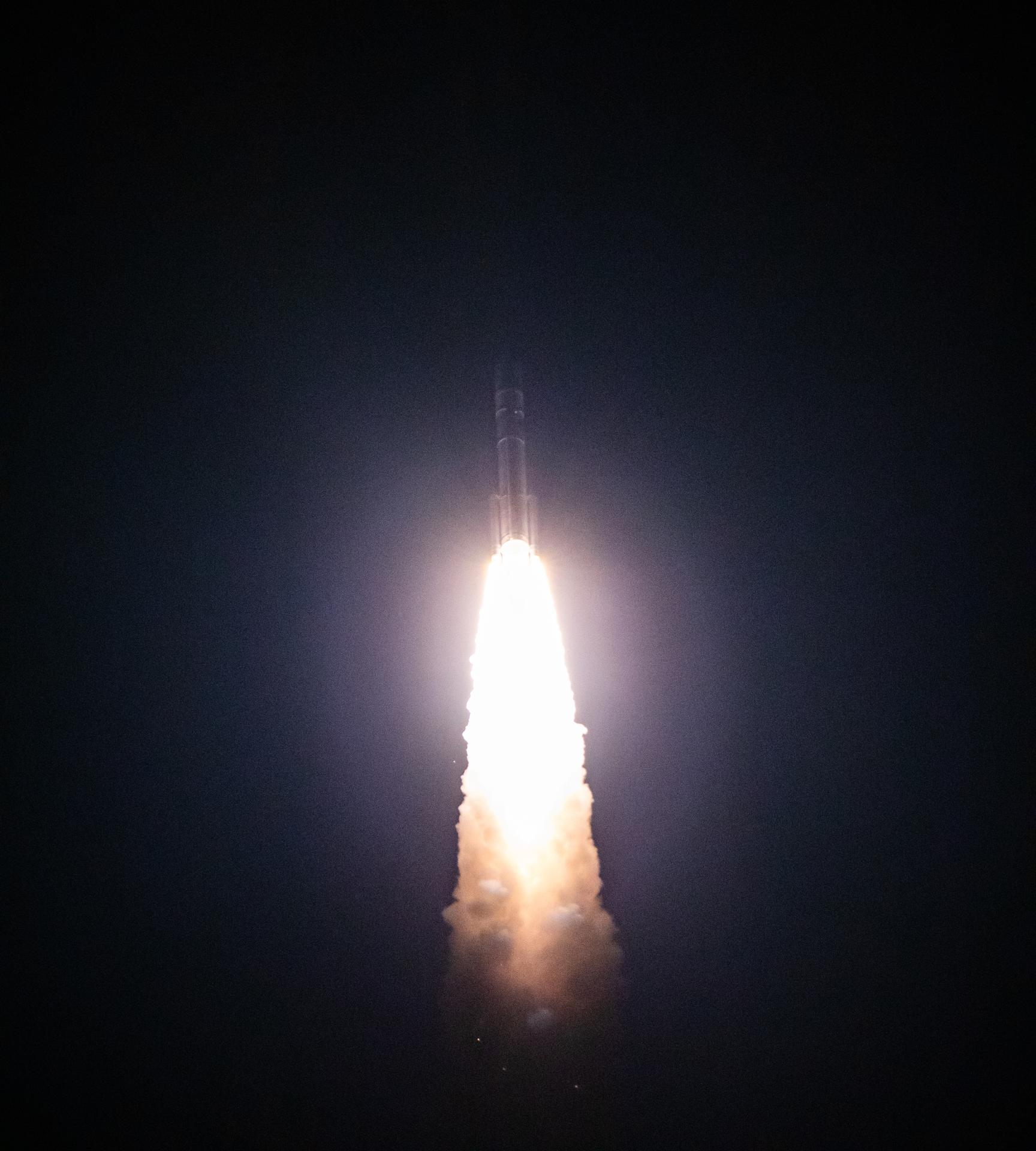
United Launch Alliance has set a date to fly Vulcan again. The company is targeting Friday, Nov. 13, for the rocket's return to flight, ending a nine-month grounding caused by repeated problems with the nozzles on its Northrop Grumman solid rocket boosters. The mission, called Leo-Vulcan 1 (LV-01), will carry 40 satellites for Amazon's Leo broadband constellation from Space Launch Complex 41 at Cape Canaveral. Amazon says that is the largest Leo payload yet.
There is more than one first on this flight. It will be Vulcan's fifth launch and the first to use six strap-on solid boosters, in the configuration ULA calls VC6L. So the vehicle coming back after a booster problem will also be carrying more of those boosters than any Vulcan before it.
What went wrong?
Vulcan's side boosters are Northrop Grumman GEM 63XL solid rocket motors. According to Spaceflight Now, a booster nozzle failed on Vulcan's second flight, and the same thing happened again on the USSF-87 national security mission in February 2026. Both times the rocket made up for the anomaly and still put its payload into the intended orbit. That suggests the methane-fueled first stage and hydrogen-fueled upper stage had room to compensate for the reduced and asymmetric thrust. A launch provider that has lost a nozzle twice, though, can't keep flying and hope the third one holds.
ULA has not published specific findings or a single root cause. Its statement says engineers identified "several potential contributors" and mitigated them through design and process improvements to the nozzle, with more testing continuing in parallel. Amazon's mission update says the solid boosters on LV-01 use the improved nozzle design.
That wording matters. "Several potential contributors" plus "testing in parallel" describes a fix that the company thinks covers the plausible failure modes, while work to close out the investigation is still going on. It still means the Nov. 13 launch is part of the evidence that the fix works, not just a celebration that it does.
What exactly is flying?
According to ULA's mission page, the VC6L stack combines:
- A Vulcan first stage powered by two Blue Origin BE-4 engines, each producing 550,000 lbf of thrust.
- Six GEM 63XL solid rocket boosters, each rated at 459,600 lbf.
- A Centaur V upper stage optimized for low Earth orbit, with two RL10C-1-1A engines.
- A 70-foot payload fairing.
Adding up those published figures gives about 3.86 million pounds of thrust at liftoff, and more than 70 percent of that comes from the solids. That is why the nozzle fix gets so much attention on this flight. The solids supply most of the thrust at liftoff, and this is the first time Vulcan has used six of them at once.
Preparations are well along. The payload fairing left Amazon's facility on Oct. 21, according to Spaceflight Now, and Amazon says the launch date still depends on range approval.
Why Amazon is the right customer for this flight
Amazon has booked 38 Vulcan launches, and LV-01 is the first of them. Before this, Amazon flew eight Leo missions on ULA's Atlas V. Across all providers, Amazon Leo has now launched nearly 400 satellites over 14 missions. The company says that makes it the third-largest satellite constellation. The initial constellation is planned at more than 3,000 satellites, so Amazon is still a long way from its target and needs steady, frequent launches to get there.
That puts both companies under pressure. Amazon needs Vulcan's large fairing and heavy-lift capacity to deploy satellites quickly, and a 38-launch contract means little if the rocket isn't flying. ULA needs to show that Vulcan can launch regularly and not just occasionally. The two companies are already planning the next mission: a second vehicle is assembled for Vulcan Leo 2, and Amazon says that mission is being readied in parallel in a facility it calls VIF-G.
Amazon isn't relying on one rocket. Its next mission after LV-01 is Arianespace's LE-04, which will carry 36 Leo satellites on Ariane 6 from French Guiana, no earlier than Nov. 23. If both launches happen on schedule, 76 satellites could reach orbit within about 10 days.
Why It Matters
Vulcan is ULA's newer heavy-lift rocket, and the U.S. Space Force is part of the industry-government team that investigated the most recent nozzle failure, which came on a national security mission. The grounding has also held up Amazon, which had hoped to use Vulcan earlier because it can launch more Leo satellites than any rocket other than Blue Origin's New Glenn.
That is why the Space Force question is still open. Spaceflight Now asked the service what remains before national security payloads can fly on Vulcan again. As of Spaceflight Now's Oct. 28 report, no answer had been published. LV-01 is first a test of the nozzle fix on the most booster-heavy Vulcan yet, flown for a customer that has 37 more Vulcan launches booked after this one and a constellation to build.
If the six boosters perform cleanly, ULA gets a successful return to flight and a demonstration of a new configuration in one launch. It also gets the start of a long series of Amazon missions that could finally give Vulcan the launch rate it was designed for. If any nozzle misbehaves again, even on a flight that still reaches orbit, the nine-month grounding will look less like a fix and more like a delay.
