
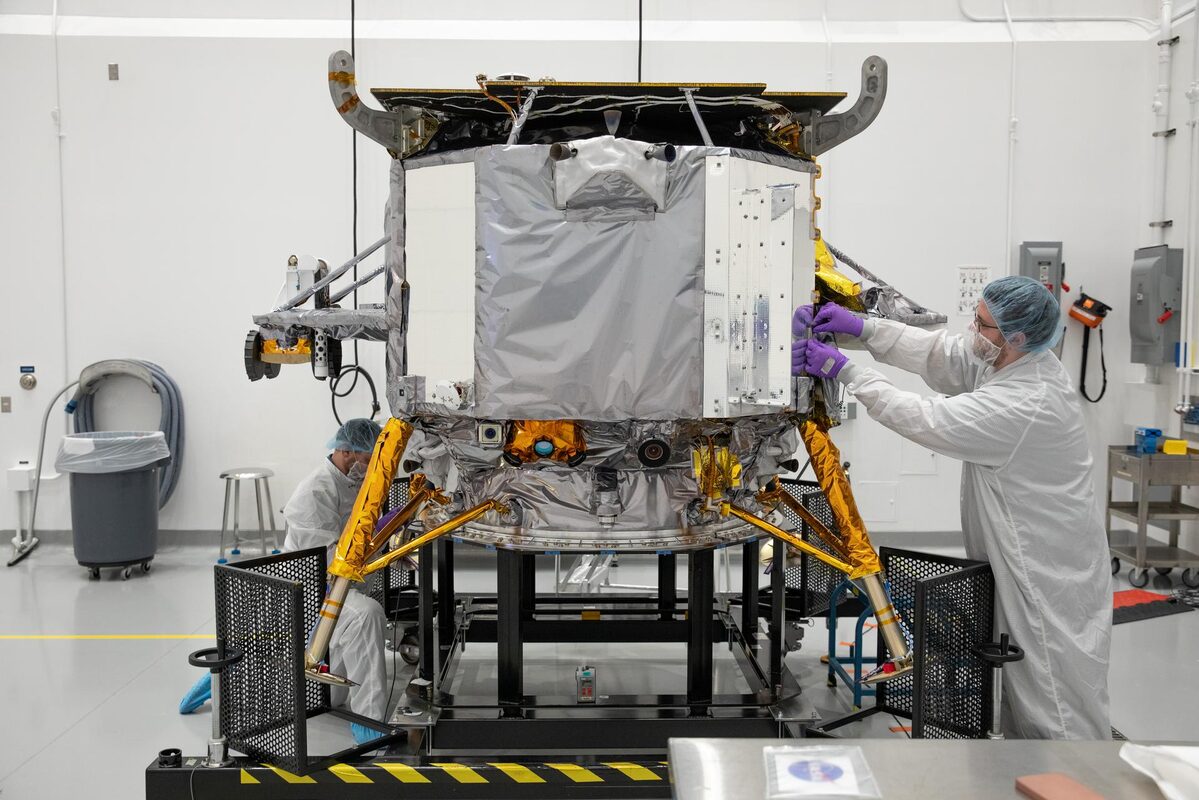
Before a spacecraft gets anywhere near the Moon, it has to survive Earth, specifically the parts of Earth that engineers build to imitate launch and space as unkindly as they can. The Griffin-1 lunar lander has now done that. NASA's Jet Propulsion Laboratory in Southern California says the lander has finished environmental testing there. The roughly three-month campaign began in July and ended in late September 2026, and it clears the vehicle for the next step: final assembly and launch-readiness operations, then shipment to Cape Canaveral.
NASA announced the result on Oct. 13, 2026. The agency's release names Voyager Technologies as the lander's owner, and the hardware has gone back to Voyager Lunar Systems. That is the same lander that Astrobotic showed off in June before it was trucked to California.
What the lander went through
Environmental testing is mostly about being boring on purpose. Engineers would much rather find a loose bracket, a cracked solder joint or a thermal problem in a test chamber than at the Moon. According to NASA, the Griffin-1 that arrived at JPL weighed 2,789 pounds (1,265 kilograms). It faced several of the classic checks.
Acoustics. At liftoff, a rocket's sound pressure is a structural load in its own right, strong enough to shake loose anything that wasn't built properly. JPL's acoustic test used giant horns powered by compressed nitrogen gas to expose Griffin-1 to noise levels of up to 153 decibels inside a sealed chamber.
Vibration. Hundreds of sensors monitored the spacecraft as a shaker table rattled it in three directions, with increasingly intense force, to simulate the ride out of Earth's atmosphere on a rocket.
Thermal vacuum. This was the long one. On Aug. 31 engineers and technicians used a crane to position the lander in JPL's 25-Foot Space Simulator, according to the NASA Photojournal entry that documents the campaign. For about two weeks inside the chamber, the spacecraft alternately baked at up to 167 degrees Fahrenheit (75 degrees Celsius) and froze at temperatures as low as minus 148 F (minus 100 C). The test simulates the temperature extremes the lander will experience on its journey through the vacuum of space and during operations on the lunar surface, where there is no air to carry heat away.
NASA's account says the results show the spacecraft is ready to survive the rigors of space exploration. Voyager executive vice president John Thornton is quoted in the agency's release as calling the completed testing a major milestone. Griffin-1 is now back at Voyager Lunar Systems' facility for final assembly, followed by launch-readiness operations before it ships to Cape Canaveral.
Where it's going, and what it's carrying
The mission flies under NASA's Commercial Lunar Payload Services (CLPS) initiative, which sits inside the agency's Moon Base Program. Space.com reported in June that Griffin was picked for NASA's Moon Base II mission under CLPS. The outlet quoted Astrobotic CEO John Thornton calling it the first infrastructure-class lander going to the lunar surface.
The destination is Nobile Crater near the Moon's south pole. NASA says Griffin-1 will deliver more than 1,100 pounds (455 kilograms) of cargo there. That cargo is 10 science and technology demonstrations from six countries, including what NASA calls the largest commercial payload ever delivered to the Moon, Astrolab's FLIP rover. Other payloads listed by Space.com include the BEACON CubeRover and the European Space Agency's LandCam-X.
The 455-kilogram figure is what this mission is actually carrying. It is not the lander's ceiling. Spaceflight Now put Griffin's payload capacity at 650 kilograms when Astrobotic showed the vehicle in mid-June. The outlet also reported that FLIP would be integrated with the lander at Cape Canaveral rather than before the trip to JPL. NASA's photojournal says a yellow-striped box atop the lander stood in for the rover during testing.
The ride is a SpaceX Falcon Heavy, which NASA says will launch later this year.
The Peregrine shadow
Any Griffin story has to deal with what came first. Griffin-1 follows Peregrine-1, the company's January 2024 lander mission, which encountered a helium valve issue early in flight that prevented a landing attempt, according to Spaceflight Now. That history is why a clean environmental test campaign draws attention here.
Thornton spoke to that directly in June. Spaceflight Now reported that he said Griffin has a dual redundant valve system, with two dissimilar valves that both have to fail to produce the same outcome, and that the company's failure review board had closed its loops. JPL's chambers don't re-run Peregrine's exact failure, and a thermal vacuum test isn't a flight. Still, a passed campaign is evidence that the integrated vehicle held up through the thermal swings, vibration and acoustic loads it will face.
Why It Matters
CLPS has NASA partnering with commercial companies to deliver technology demonstrations and other payloads to the lunar surface. Peregrine-1, the first CLPS flight, never reached a landing. Griffin-1 is the same company's second try, and it is a much bigger vehicle: Space.com says it is nearly twice as wide as Peregrine, at nearly 15 feet (4.5 meters) across. It carries an international set of payloads and a rover to the Moon's south polar region.
That region is where NASA's Moon Base planning points. Spaceflight Now quoted NASA's Moon Base program executive, Carlos García-Galán, calling the mission a crucial stepping stone toward the permanent infrastructure the agency will eventually need at the south pole. Getting 455 kilograms of instruments and hardware to Nobile Crater would be an early test of whether commercial landers can do that kind of work. A large lander that works would also widen what payload builders can put on the surface, as FLIP's place on the manifest shows.
Passing environmental testing doesn't guarantee any of that. Launch, the cruise, and most of all the final descent are where lunar missions have tended to go wrong. What the JPL campaign does is remove one category of risk: the possibility that the vehicle couldn't survive the ride and the environment before it ever had to land. Final assembly comes next, then the Cape, then Falcon Heavy.
Sources
- NASA JPL Testing Readies Voyager Technologies Lander for Moon Mission (NASA/JPL)
- Voyager Technologies' Griffin-1 Completes Environmental Testing at NASA JPL (NASA Photojournal PIA26708)
- Astrobotic showcases Griffin-1 lander ahead of environmental testing in California (Spaceflight Now)
- Astrobotic unveils Griffin-1 lunar lander for NASA Moon Base mission (Space.com)
