
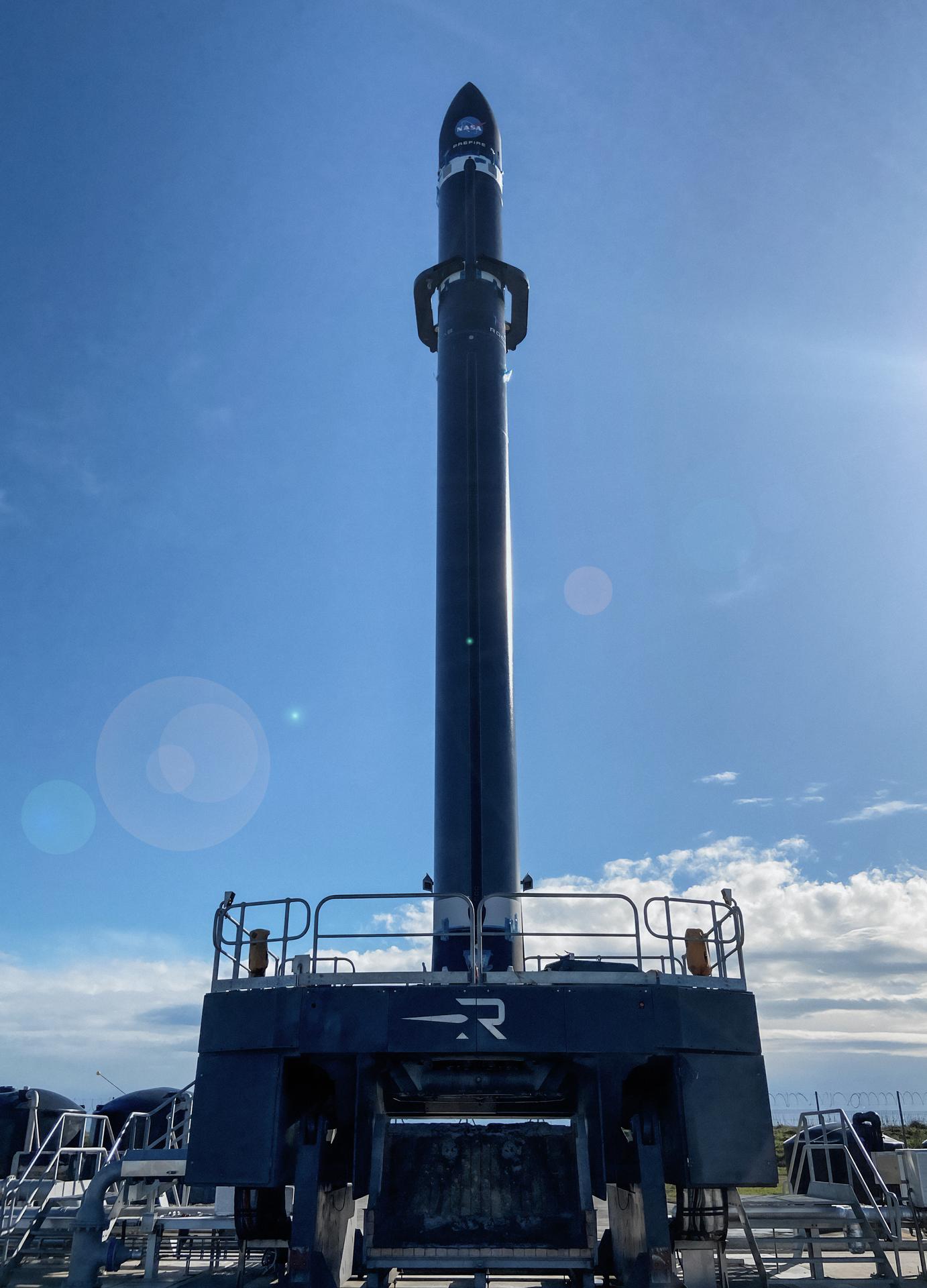
At 8:11 p.m. local time on Oct. 23, a Rocket Lab Electron lifted off from the company's New Zealand launch site with three small satellites that are built to listen, not to take pictures. The payload was a trio of "Hawk" spacecraft for Virginia-based HawkEye 360, which makes its money by picking up radio-frequency emissions from Earth's surface and turning them into intelligence. Liftoff came at 3:11 a.m. EDT (0711 GMT), and the satellites were slated for deployment into low Earth orbit at an altitude of 323 miles (520 kilometers), Space.com reported.
Rocket Lab named the mission "We're Not Hawking Around," keeping up its habit of pun-heavy mission names. Its newsroom posted the result the same day under the headline "MISSION SUCCESS: Rocket Lab Launches 98th Electron Mission."
Satellites that work in threes
HawkEye 360's business is built on formation flying. According to Rocket Lab's mission description, as reported by Space.com, the Hawk satellites operate in clusters of three. Each cluster collects signal data from across the radio-frequency spectrum for maritime tracking, GNSS (satellite navigation) jamming detection, radar monitoring, communications mapping and space defense.
The formation is what makes the system work. A single satellite can tell that a transmitter is switched on somewhere below it. In principle, three satellites in a coordinated group can compare when and how the same signal reaches each of them, and that comparison is what lets an operator estimate where the transmitter is. A summary of the company's press release from Quiver Quantitative describes the new spacecraft as flying in a "tri-satellite formation," which fits that cluster-of-three design.
The applications in the mission description show who the customers are. A ship that switches off its transponder can still give itself away if its radar or radios are transmitting. GPS jamming has become a regular feature of conflict zones and contested waters, and finding the jammer is a practical problem for navies, airlines and governments. HawkEye 360 provides its data to the U.S. government and its allies, Space.com noted.
A constellation filling in quickly
This launch was the second batch of Hawks to reach orbit in a single week. Two days before the Electron flight, three more Hawk satellites went up as rideshare payloads on SpaceX's Bandwagon-5 mission. That puts six new HawkEye 360 spacecraft in orbit within about 48 hours.
The company's first satellites launched in 2018. Space.com puts the number it has sent to low Earth orbit at nearly 50. The Quiver Quantitative summary of the release says this flight was the third Electron launch dedicated to deploying HawkEye 360's satellites. That makes the company a repeat customer of Rocket Lab's small-launch service, in addition to flying on larger rideshare missions such as Bandwagon-5.
Using both kinds of launch plausibly reflects a trade-off, though neither source spells out HawkEye 360's reasoning. A rideshare generally sends satellites where the primary mission goes, on the primary mission's schedule. A dedicated Electron lets the customer shape the orbit and timing. For a constellation that has to keep specific clusters in specific orbits, that control can be worth having.
The numbers behind Rocket Lab's year
The flight was Rocket Lab's 98th Electron launch and its 19th launch of 2026. Space.com breaks the 19 down as 16 flights of the two-stage, 59-foot-tall (18 meters) Electron and three flights of HASTE, a suborbital variant of Electron that allows customers to test technologies in a hypersonic flight environment.
The 98th flight also means Electron's 100th launch is close, two flights away. Rocket Lab's release describes the vehicle as the most prolific launcher globally dedicated to small satellites, and says 19 successful missions in 2026 alone show the turnaround speed, high production rate and schedule assurance that commercial satellite customers demand. Whether the 100th arrives before the end of the year will depend on the company's manifest, which the sources do not lay out.
Why It Matters
Signals intelligence from orbit has long been associated with government satellites. HawkEye 360 is an example of a commercial company doing similar work. It builds and operates its own satellites, gathers RF data, and provides what it learns to the U.S. government and its allies. Two batches of Hawks launched in one week, on two different providers' rockets, suggest that the company is adding capacity at a steady clip.
For Rocket Lab, the mission is less dramatic but still important: another repeat customer, a mission-success announcement, and another step toward 100 Electron flights. In small launch, the bar is not one spectacular mission. It is doing ordinary missions reliably, again and again, and "We're Not Hawking Around" was one more of those.
A caveat on sourcing: Rocket Lab's own release page could not be read directly, only its newsroom listing, and the Quiver Quantitative piece is an AI-generated summary of the company's press release. Launch figures in this article were checked against Space.com's reporting.
