
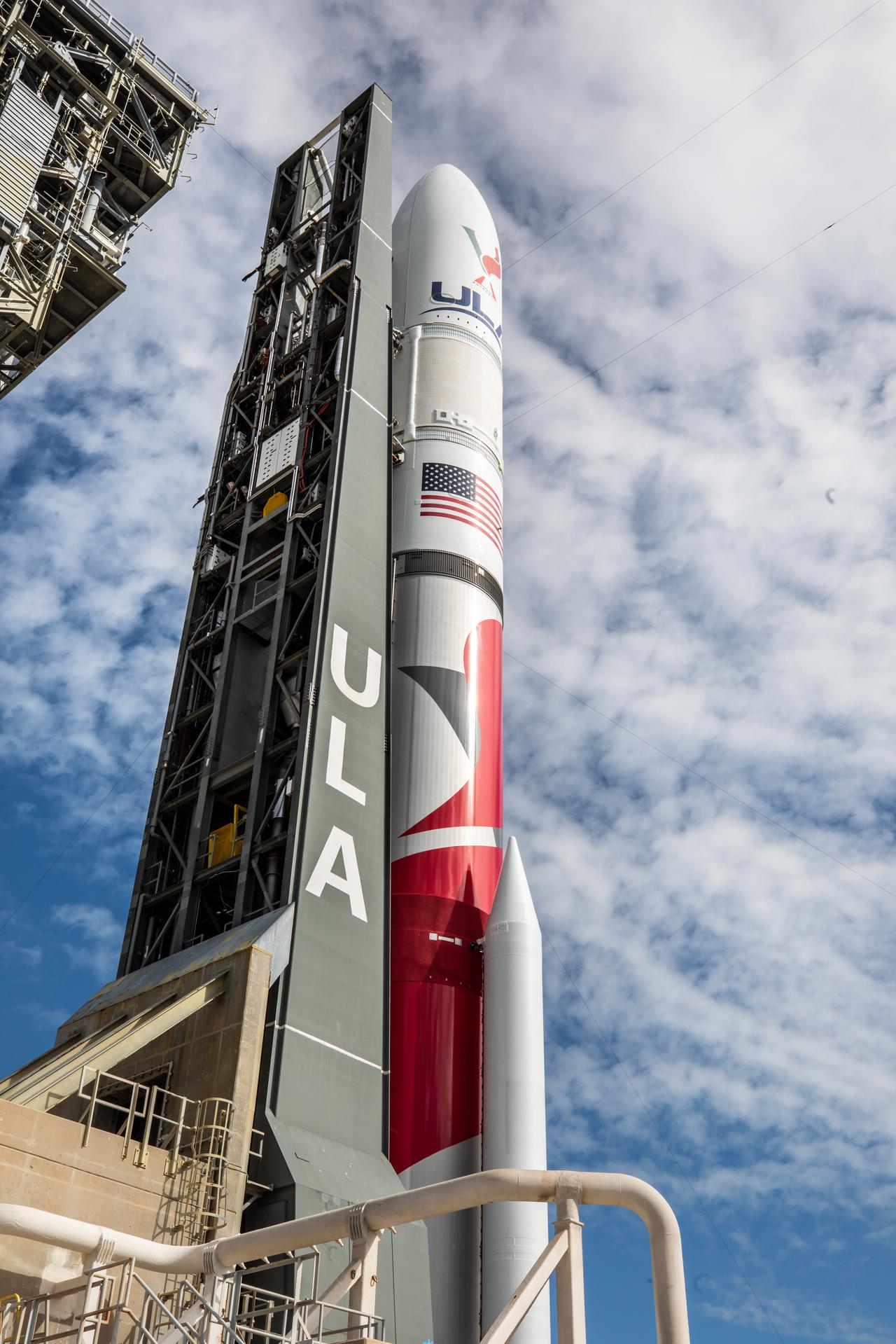
Three days after a Vulcan Centaur rocket failed to put 40 Amazon Leo satellites in orbit, United Launch Alliance has narrowed down where things went wrong. The answer is more specific than "the first stage," and it may be better news for the engines than many observers expected.
In a Nov. 18 update posted at 11 a.m. EST, ULA said it had finished an initial integrated review of the flight data. Its preliminary finding is that "the low booster thrust was the result of inadequate fuel supply from the vehicle to the BE-4 engines, not from the performance of the engines."
That wording separates two things. The two Blue Origin BE-4 engines on Vulcan's first stage appear to have done what they were asked to do. The vehicle did not give them enough fuel to do more. ULA has not said which part of the fuel delivery path was at fault, and it describes the findings as preliminary.
What happened on Nov. 15
Vulcan lifted off on Sunday, Nov. 15, from Space Launch Complex 41 on Florida's Space Coast, on the mission ULA calls Leo 1. ULA's Nov. 17 update said the vehicle showed low booster performance just after liftoff. Because the first stage was underperforming from the start, stage separation happened at too low an altitude and below the minimum velocity needed to reach orbit.
The Centaur V upper stage did its part. According to ULA, the second stage started normally and its RL10 engines ran as planned, but they "could not recover the performance loss," and the mission was lost. Telemetry ended about 10 minutes into the flight. That gap between a problem that began at liftoff and a loss confirmed minutes later is why early accounts of the failure were confusing.
ULA also said the six Northrop Grumman GEM 63XL solid rocket boosters performed nominally "following nozzle improvements implemented for this launch." That detail matters given Vulcan's recent history. Space.com reports that SRB nozzle problems occurred on the rocket's second and fourth flights. This was Vulcan's fifth flight, and it came after roughly nine months of grounding that followed a February 2026 solid rocket booster issue. The nozzle fix appears to have worked. The rocket failed anyway, for a different reason.
Who is running the investigation
ULA is leading the investigation, with the Federal Aviation Administration overseeing it. The FAA will have to approve the final report and any corrective actions before Vulcan flies again, according to ULA's Nov. 17 update.
Speaking before the Nov. 18 update, ULA CEO Mark Peller described the problem only in broad terms. "We do know that we had a significant shortfall in booster, or first-stage performance," he said, according to Breaking Defense. The new data review gives a more specific location for that shortfall: fuel delivery upstream of the engines.
Why the engine distinction matters beyond ULA
If the BE-4s had underperformed on their own, the question would immediately have extended to Blue Origin's New Glenn. Space.com notes that New Glenn uses BE-4 engines too, seven or nine per stage depending on the stage. A problem inside the engine would have hit two heavy-lift programs at the same time.
ULA's preliminary finding points away from that. A fuel feed problem on the vehicle side would be specific to Vulcan's first stage, not to the engine design, if the investigation confirms it. That does not put New Glenn back in service. Space.com reports it is still grounded after a test explosion on May 28. It does mean Vulcan's failure is less likely to add a second problem to Blue Origin's list.
The finding has limits. "Preliminary indications" are what they sound like, and investigations often change direction as engineers rebuild the timeline from telemetry. Until ULA identifies the specific hardware or process behind the fuel shortfall and the FAA signs off on the fix, nobody can say how long Vulcan will be grounded.
Why It Matters
The failure lands on two customers who were already short of launch capacity.
The first is the U.S. Space Force. Breaking Defense reports that by Oct. 1 the Space Force had already moved six National Security Space Launch missions from Vulcan to SpaceX. SpaceX's Falcon 9 and Falcon Heavy are currently the only rockets certified for the most critical NSSL Phase 3 Lane 2 payloads. With Vulcan grounded again and New Glenn also grounded, national security launch depends on one provider even more than before. "The launch bottleneck is real and set to get worse," Clayton Swope of the Center for Strategic and International Studies told Breaking Defense.
The second is Amazon. According to Space.com, Amazon Leo has about 400 operational satellites in orbit from 14 launches, not counting the 40 lost on Nov. 15. The company plans a constellation of more than 3,200 satellites and has about 100 launches booked, 38 of them on Vulcan. Losing a full batch of satellites is expensive, but the bigger problem is the pause. Vulcan carries a large share of Amazon's remaining deployment schedule, and every month it stays grounded pushes back the date the constellation is complete.
For ULA, the engine finding is a partial relief. The cause appears to sit in hardware ULA designs and controls, so ULA can fix it without waiting on an engine supplier. But it is also ULA's responsibility. After the nozzle problems and a long stand-down, Vulcan has now failed in a new way. The company will need to show the Space Force, Amazon and the FAA that it understands its fuel feed system as well as it now seems to understand its solid boosters.
