
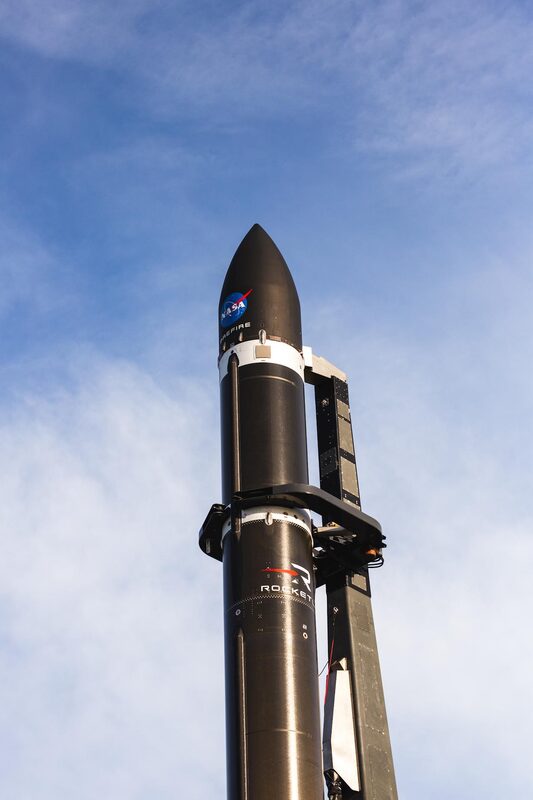
Rocket Lab's 100th launch is scheduled for a Saturday evening in New Zealand. The launch window opens at 6:30 p.m. local time on Nov. 14, which is 12:30 a.m. EST (0530 GMT). The company's 59-foot (18-meter) Electron rocket is set to lift off carrying a privately owned Japanese Earth-observation satellite. The mission is called "The Mountain God Rises," and the rocket will wear a special black-and-gold livery for the occasion. Space.com reports that the satellite is a radar imaging spacecraft for the Tokyo-based operator iQPS, which is building a constellation of three dozen radar satellites. As of this writing the launch has not yet happened, and this article treats it as scheduled.
The milestone comes at a busy point for the company. Days before the launch, the Pentagon's Office of Strategic Capital offered Rocket Lab a $150 million conditional loan to help its much larger Neutron rocket fly more often once it debuts. Rocket Lab is still running Electron as its main business while it tries to get Neutron onto the pad.
Getting to 100
Electron did not start well. Its first flight, in May 2017, failed. The second, in January 2018, reached orbit, and the rocket has flown steadily since then. Speaking on the company's Nov. 9 earnings call, CEO Peter Beck said no commercially developed rocket had reached 100 launches faster, "not even Falcon 9." He put Electron's reliability at 96% across 99 launches.
The claim depends on how you count. "Commercially developed" leaves out government-built launchers with long flight records, and Electron is a small-lift rocket, so each launch carries far less than a Falcon 9. Even so, the number is notable for a small launcher. Small rockets have often struggled to find enough customers to fly regularly, and Electron has. Air & Space Forces Magazine counts 18 Electron launches so far in 2026, trailing only SpaceX's Falcon family and China's Long March family. Separately, Rocket Lab has flown nine missions of HASTE, a suborbital version of Electron.
The payload fits the pattern. Commercial radar constellations like iQPS's need to launch many small satellites to specific orbits on a schedule, and this will be Rocket Lab's 11th launch for the company. A rocket that carries one dedicated spacecraft is well suited to that kind of customer.
The Loan and What It Pays For
The Office of Strategic Capital is part of the Pentagon and makes loans to companies it considers important. Its offer to Rocket Lab is conditional. According to Air & Space Forces Magazine, the loans depend on the companies clearing financial, legal and technical requirements. Defense Daily separately reported the commitment, quoting the Pentagon as saying the loan would support efforts to increase Neutron's flight rate beyond its first launch.
The planned uses are specific. The loan would pay for:
- faster delivery and processing of vehicles
- more maritime vessels, with equipment for Neutron recovery and transport
- manufacturing upgrades to increase production of composite structures and engines
- infrastructure to reduce turnaround time between launches
All of these are about launch rate, not about finishing development. The Pentagon's stated aim is to support the factory and recovery operation Neutron will need to fly often once it reaches operational service. Getting it to fly the first time is not part of the stated purpose.
Rocket Lab is not the only recipient. This is the third $150 million OSC loan to a space company in three weeks. Stoke Space received one for a second launch pad at Cape Canaveral Space Force Station, and LeoLabs received one to expand manufacturing and add dozens of radars to its network. Taken together, the loans suggest the Defense Department wants more launch capacity and better space surveillance, and Air & Space Forces Magazine ties them to its effort to bolster the space industrial base.
Neutron, Delayed
Neutron is a different kind of rocket from Electron. It is a medium-lift launcher with a reusable first stage. It can reach geosynchronous orbit and carry about 25 times as much as Electron. On Oct. 14, Rocket Lab said a manufacturing issue had pushed Neutron's first launch from late 2026 into 2027. The company's third-quarter results filing now says the first flight is targeted for no earlier than 2027.
The delay has not driven customers away. Rocket Lab says it signed more than $515 million in Neutron contracts in the third quarter. It has now booked 16 Neutron missions before the rocket's first flight, and it lifted the base launch price to $70 million for several of them. Air & Space Forces Magazine reports that those first 16 missions include one for the Space Force's Airborne Moving Target Indicator program, and that the next available slots fall in the 2030s.
That puts Rocket Lab in an unusual position. It is selling launches years in advance on a rocket that has not flown, at a price it has just raised, with open slots only in the next decade. Customers appear to believe Neutron will work. The open question is how many times a year it can fly, and that is the question the OSC loan is meant to address.
The Numbers Behind It
Rocket Lab's Nov. 9 earnings release helps explain why a lender might take the risk. Third-quarter revenue hit a record $268 million, up 73% from a year earlier. The company's backlog is about $3.6 billion, up 52% since the end of the second quarter. That includes approximately $1 billion in new launch contracts across Electron, HASTE and Neutron, and the total launch backlog now stands at 117 launches. Rocket Lab also builds satellites, and the release says 12 spacecraft launched during the quarter. Its fourth-quarter revenue guidance is $270 million to $290 million. The filing also says the company has fully funded its pending acquisition of Iridium Communications and that Iridium's shareholders have approved it.
A backlog is not revenue, and a large share of this one is tied to a rocket that has slipped into 2027. Launch delays tend to grow. Every Neutron mission booked before the first flight assumes the schedule will hold well enough to meet those commitments. A 117-launch backlog depends on actually flying those launches.
Why It Matters
The 100th Electron launch shows that a privately developed small launcher can fly regularly and earn money doing it. Many small-launch companies have struggled to reach that point. The Neutron loan is about the next step: whether Rocket Lab can repeat the same results with a reusable medium-lift rocket.
For the Pentagon, the logic appears straightforward. Air & Space Forces Magazine notes broader concern in the space industry about a looming launch bottleneck, and more medium-lift providers would mean less reliance on any single company. Lending money for recovery vessels and engine production looks like a fairly cheap way to help a second option fly often, not just occasionally. With three space loans in three weeks, the OSC is now an active financier in the launch industry.
For Rocket Lab, the plan is to keep Electron flying to fund the business while Neutron works through its delay. If the 100th launch succeeds, it will come about nine and a half years after the failed first flight in May 2017. Neutron's first launch is now targeted for no earlier than 2027.
Sources
- Rocket Lab launching 100th space mission early on Nov. 14: Watch it live (Space.com)
- Rocket Lab Announces Third Quarter 2026 Financial Results (Exhibit 99.1 to Form 8-K, SEC)
- Pentagon Gives $150M Loan to Rocket Lab to Boost New Vehicle's Launch Cadence (Air & Space Forces Magazine)
- Rocket Lab Gets $150 Million Conditional Loan Commitment From Pentagon OSC for Neutron (Defense Daily)
