
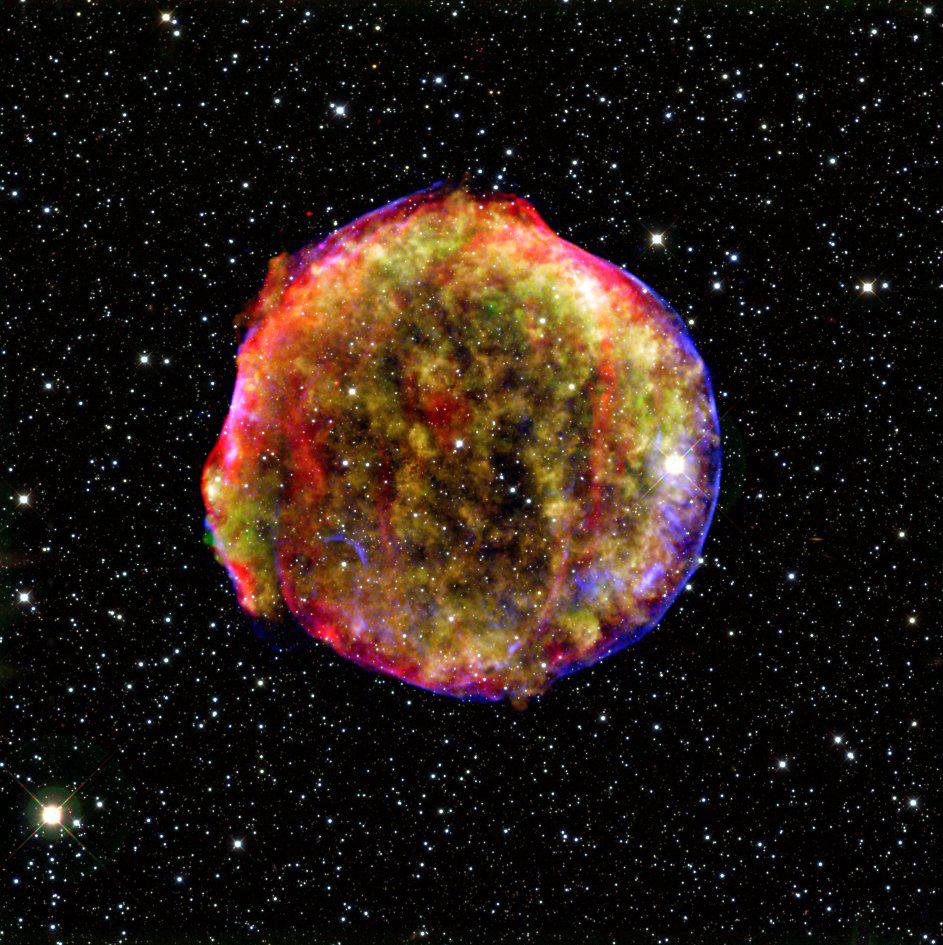
Some of the oldest stars in and around the Milky Way carry chemical fingerprints that have long seemed to call for an extreme explanation. Their ratios of elements are odd enough that astronomers concluded they formed from the debris of hypernovae, explosions at least ten times more energetic than a typical supernova. A pair of new papers from University College London argues that the extreme explanation may not be needed. The authors say ordinary supernovae can produce the same fingerprints, as long as you stop assuming that the ejected material gets mixed evenly into the gas that forms the next generation of stars.
"All the evidence we see for hypernovae is suddenly gone," Anmol Aggarwal of UCL's Mullard Space Science Laboratory said in a UCL press release, a quote repeated by Universe Today, which covered the work on October 13. UCL published its own release on the research on October 5.
The case for hypernovae
Hypernovae are a proposed extreme class of core-collapse supernova. According to Universe Today's summary, they need stars above roughly 30 solar masses and are about ten times more luminous than other core-collapse events. In energy terms, the first of the new papers describes a hypernova as an explosion releasing more than about 1052 erg. The second paper puts a normal core-collapse supernova at around 1051 erg.
Much of the evidence for these events comes from archaeology, not direct observation. Stars with extremely low metallicity (very small amounts of elements heavier than helium) are widely assumed to have formed from gas enriched by just one dying massive star. If that is true, a star's chemical makeup is effectively a record of a single explosion. When some of these stars turned up with abnormal element ratios, those ratios were taken as the signature of a hypernova. The UCL release notes that previous work concluded unusual stars in the Milky Way's halo and in a neighbouring dwarf galaxy could only have formed from an explosion at least ten times more energetic than a typical supernova.
The overlooked variable: mixing
Aggarwal and co-author Ralph Schoenrich, also at the Mullard Space Science Laboratory, focused on an assumption built into that reasoning. Matching a star's abundances to a single explosion's predicted yields implicitly treats the ejected material as well blended before it collapses into new stars. If the ejecta are distributed unevenly, some pockets of gas will be richer in some elements than others, and a star born in one of those pockets will show ratios that differ from the explosion's overall average. As Aggarwal put it in the UCL release, oxygen might predominantly fly in one direction and sulphur in another, so new stars might form from a mix of pieces of the supernova rather than its overall mix of elements.
Their first paper, "An unexplored enrichment stochasticity and its implications for stellar abundance patterns", models that randomness, which the authors call stochasticity. Submitted to arXiv in March and accepted by Monthly Notices of the Royal Astronomical Society, it remodels three stars whose abundances had been attributed to hypernovae. In each case, the authors report that the star's chemistry is better explained by a normal, less energetic supernova once the inhomogeneous distribution of its ejecta is taken into account.
"We still don't know how well the supernova material gets mixed before it forms new stars," Schoenrich said in the UCL release. "Our research suggests some mixing goes on, but incomplete mixing."
The hardest case
The second paper takes on a more demanding target. Its title is direct: "Mixing stochasticity relinquishes evidence for magnetorotational hypernovae". The paper was submitted to arXiv in August and accepted as an MNRAS Letter. It looks at a single peculiar red giant in the Galactic halo. The UCL release says the star is rich in heavy elements such as silver and uranium, which come from neutron star mergers or, in theory, from the hypernova of a highly magnetised massive star. A recent earlier analysis had read the abundance pattern as evidence for a magnetorotational hypernova.
Aggarwal and Schoenrich tried a different combination. They modelled the star as forming from stochastically mixed material from two sources: a normal core-collapse supernova of about 1051 erg, and a neutron star merger. The comparison comes down to fit quality. The root-mean-square deviation of the mixing model from the observed abundances was 0.24. The hypernova fit came in at 0.44, so the ordinary explanation tracks the data noticeably more closely.
The earlier objection to a neutron star merger was one of timing: the Milky Way model used in that work enriched its gas so quickly that not enough time would have passed for neutron stars to form and collide. The UCL team pointed to the star's exceptional speed and to the fact that it orbits the Galaxy in the opposite direction to most stars. They argued it was born in a small dwarf galaxy, where metal-poor stars can form much later, and was only later pulled into the Milky Way.
Taken together, the two studies cover four stars that had been judged hypernova-enriched: three in the first paper and the red giant in the second. For all four, the authors find the data are better fitted by ordinary events with mixing accounted for. For the red giant, that means an ordinary supernova combined with a neutron star merger.
What the papers don't claim
The provocative framing invites some care. In the second paper, the authors write that while their statistics favour the supernova and neutron star merger combination over the hypernova case, they "do not preclude other scenarios." The papers show that the specific stellar evidence offered for hypernovae can be explained without them. They do not show that no star ever exploded with 1052 erg. Losing the evidence is not the same as disproving the phenomenon, although Universe Today goes so far as to say the papers suggest hypernovae may not exist at all.
The argument also rests on a parameter that nobody has pinned down. As Schoenrich acknowledges, how thoroughly supernova debris mixes before new stars form is still an open question, despite decades of work. The UCL team's results point to partial mixing, but a different picture of interstellar mixing would change how much the stochastic model can explain. The r.m.s. comparison for the red giant is a meaningful result, but it compares two models and is not a direct measurement of what actually happened.
Why It Matters
Extremely metal-poor stars are the closest observers can come to the first generations of stars, so the way their chemistry is read shapes what astronomers conclude about early massive stars. If a whole category of explosion was inferred from those stars by treating their chemistry as an unmixed snapshot of one event, then other conclusions drawn the same way could also be affected. The first paper says as much: it describes itself as a template for a required reassessment of all metal-poor and peculiar stars, and calls for quantifying the inhomogeneity of supernova ejecta in both theory and observation.
Schoenrich says the mixing question needs to be built into models of how chemicals evolve in galaxies and of how the interstellar medium works. It is reasonable to infer that any estimate resting on these abundance interpretations, such as how often extreme explosions occurred, would need revisiting if the UCL approach holds up under scrutiny from other groups. Some of the strangest stars in the halo may turn out to be ordinary supernova debris that was simply mixed unevenly.
For now, the hypernova has lost four of the stars that had been cited as evidence for it. Whether the phenomenon survives without them depends on what the rest of the metal-poor sample shows when it is reanalysed with mixing taken into account.
Sources
- Hypernovae May Be All Hype, No Nova (Universe Today, Oct 13, 2026)
- An unexplored enrichment stochasticity and its implications for stellar abundance patterns (Aggarwal & Schoenrich, arXiv:2603.26873 / MNRAS)
- Mixing stochasticity relinquishes evidence for magnetorotational hypernovae (Aggarwal & Schoenrich, arXiv:2608.14788 / MNRAS Letters)
- Ultra-powerful star explosions might not have occurred after all (UCL News, 5 Oct 2026, via Wayback Machine snapshot)
