
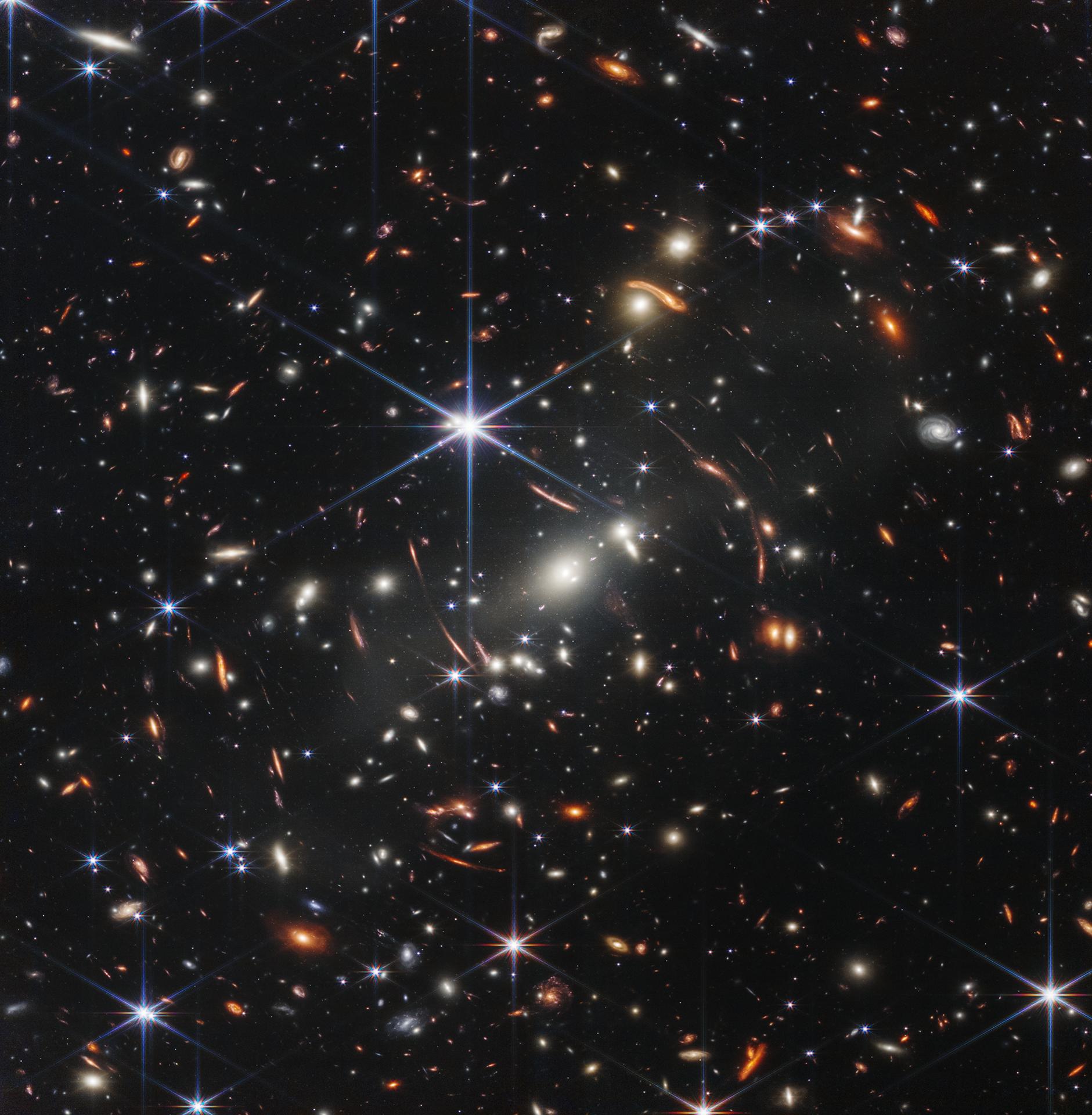
On March 4, 2024, the MeerKAT radio telescope in South Africa recorded a fast radio burst that would turn out to be the most distant one ever traced to its home galaxy. For a long time nobody could find that galaxy. Ground-based telescopes looked at the patch of sky where the burst came from and saw nothing that could be its host. It took the James Webb Space Telescope to find the source, and it turned out to be a small, surprisingly young galaxy that cuts against one of the main ideas about what causes these signals.
The burst is catalogued as FRB 20240304B. The findings were published Thursday, Oct. 8, 2026, in Science. The study is led by Manisha Caleb of the University of Sydney. Webb puts the source at redshift 2.148, which means the signal left its galaxy about 3 billion years after the Big Bang.
A signal with no visible source
The detection came from the MeerTRAP team, which used MeerKAT to find the burst. Spotting a burst is one job. Working out where it came from is harder, and you have to know the host galaxy before you can say how far away the burst is or what kind of place produced it.
That is where the search stalled. Universe Today reports that searches for the host from ground-based observatories came up empty. The burst carried one clue that it came from very far away: a dispersion measure of about 2,330 pc cm-3. Dispersion measure tracks how much ionized gas a radio signal passed through on its way to Earth, so a value that high suggested a very long path.
Webb settled it with two instruments. NIRCam took the images that revealed a galaxy at the burst's location. NIRSpec then measured that galaxy's spectrum, which gave a redshift of 2.148. The preprint of the paper gives the value as z = 2.148 ± 0.001. In terms of light travel time, the burst's light was on its way for more than 11 billion years before it reached MeerKAT.
The host galaxy doesn't fit the merger theory
The distance is the headline number, but the galaxy itself is the more important result. According to NASA's summary, the host is about 1,000 times less massive than the team expected, and it is actively forming stars. The preprint describes it as a low-mass, clumpy, star-forming galaxy. The NASA release adds that most of its stars may have formed within just 30 million years, which is very young by galactic standards.
That age matters because it bears on the two leading explanations for FRBs:
- Neutron-star mergers. In this scenario, two compact stellar remnants collide. NASA notes that the process of orbiting neutron stars spiraling closer until they collide is expected to take billions of years.
- Magnetars. In this scenario, a single, young, highly magnetic neutron star produces the burst. NASA says that once a massive star explodes and leaves behind a magnetar, an FRB might occur relatively quickly, so such bursts would also be expected in younger galaxies like this host.
A galaxy that built most of its stars in a few tens of millions of years has not had billions of years for that slow merger process. "Our work suggests that it's very unlikely that this FRB was produced by a merger," Caleb said in the NASA release. University of Manchester astronomer Ben Stappers is a co-author on the study.
The careful reading is that the merger explanation is disfavored, not ruled out. The evidence comes from one burst and one host. It is still a strong data point, because the host sticks out from the other FRB galaxies the team has studied. As Stappers put it, "it definitely was not what we were expecting."
Twice as far as before
The preprint says FRB 20240304B doubles the redshift reach of localized fast radio bursts. Universe Today notes that previous FRB detections had only reached back about halfway through cosmic time, and NASA says the vast majority of FRBs detected to date occurred billions of years later in cosmic history. This one has a confirmed host with a measured spectroscopic redshift, which is far more useful than a distance inferred from the signal alone.
It also places the burst at an interesting point in cosmic history. The authors write that the detection establishes FRB activity during the peak era of cosmic star formation, when the universe was forming stars much faster than it does today. NASA calls this period "cosmic noon." If young, rapidly star-forming galaxies are good at producing FRB sources, as the magnetar picture suggests, then that era may have been full of bursts that are only now becoming detectable.
Why It Matters
FRBs are useful well beyond the question of what causes them. Because a burst's signal is dispersed by the ionized gas it passes through, each localized burst measures the matter along its path. The preprint notes that FRB 20240304B probes ionized baryons, the ordinary matter that is hard to see directly, across about 80% of cosmic history.
The path to Earth is also rich in structure. The preprint says the sightline intersects the Virgo Cluster and a foreground group, and NASA reports that the team found the imprint of two cosmic structures on the signal: a previously unknown galaxy cluster at a redshift of 0.3 and the nearby Virgo Cluster. As co-author J. Xavier Prochaska put it in the NASA release, a burst "carries an imprint of everything that it travels through."
The method may matter as much as the result. The world's largest ground-based telescopes could not see a galaxy at the burst's position, and Webb could. NASA says the team estimates MeerKAT may be able to detect and localize several FRBs per year at a redshift greater than 1.0, and that Webb will be essential for characterizing those distant host galaxies. If more of those hosts turn out to be small and young, the case for magnetars would get stronger.
The paper has 28 authors, Caleb and 27 colleagues according to the arXiv listing. A burst from the first 3 billion years of the universe, coming from a dwarf galaxy whose stars mostly formed within about 30 million years, is hard to explain with a process that needs billions of years.
