
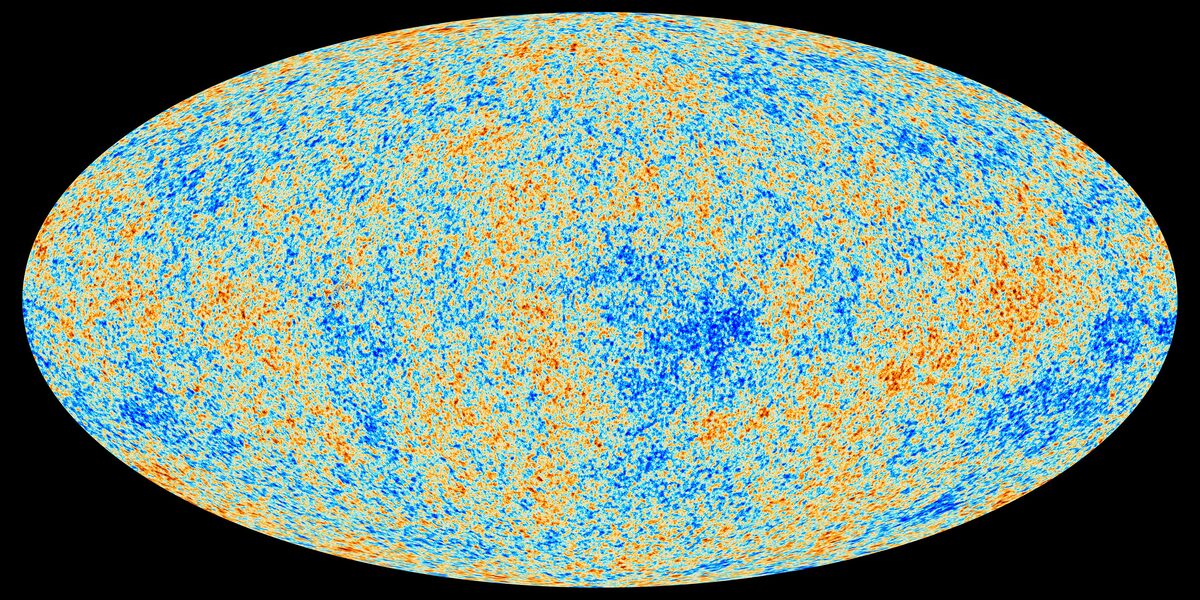
The early universe was mostly hydrogen, with roughly three parts hydrogen to one part helium. That ratio comes from the first moments after the Big Bang, and it is one of the strongest checks on whether cosmologists understand those moments. Astronomers working with the Large Binocular Telescope (LBT) have now measured it more precisely than before. Their result lines up closely with a value derived from Planck observations of the cosmic microwave background.
The LBT Yp Project published its value in The Astrophysical Journal on September 9, 2026. Primordial helium made up 24.58 percent of the universe's initial matter by mass, with a quoted precision of 0.5 percent. Universe Today covered the work on October 12, and the number is already being used elsewhere. A separate team has fed it into what it calls the tightest constraint to date on light particles in the early universe.
Measuring old helium in a universe full of new helium
The difficulty is that helium does not stay primordial. Stars fuse hydrogen into helium for their entire lives, so the helium in the universe today is a mix of what the Big Bang made and what stars have added since. A naive census would overcount.
The team handled this by looking at metal-poor galaxies. In astronomy, "metals" are elements heavier than helium, and they build up as generations of stars live and die. A galaxy with few metals has had relatively little stellar processing, so its gas should be close to the universe's original mix. The researchers targeted H II regions in these galaxies. These are clouds of ionized interstellar gas whose emission lines can be read for chemical composition.
According to the paper, the fourth in the LBT Yp Project series (read here as its arXiv preprint), the analysis uses new, high-quality LBT observations of 54 metal-poor H II regions. Not all of them were used. Forty-seven of the 54 (87 percent) passed the team's 95 percent confidence chi-squared cut, and further screening for quality and reliability reduced the sample to 41 targets. That dataset includes 15 high signal-to-noise, low-metallicity objects, and the final value comes from a weighted average of those 15, which matter most when estimating what the gas looked like before stars changed it.
The result is a primordial helium mass fraction, written Yp, of 0.2458 ± 0.0013. The authors describe this as being in good agreement with the Big Bang nucleosynthesis result, the theory of how the first light nuclei formed, when it is calculated using the baryon density that Planck determined.
Two routes, one answer
What makes the number persuasive is that a different method gives nearly the same answer. The Big Bang nucleosynthesis calculation based on the Planck satellite's measurement of the cosmic microwave background, the leftover radiation from the young universe, gives a primordial helium fraction of 24.67 percent. The LBT value of 24.58 percent differs from that by 0.09 percentage points. That gap is smaller than the LBT measurement's own stated uncertainty of 0.13 percentage points.
These are very different measurements. One reads emission lines from gas clouds in metal-poor galaxies. The other predicts the helium fraction from the physical conditions of the early universe, using the baryon density inferred from the pattern of the oldest light in the sky. Each has its own instruments, systematics and modeling assumptions. Agreement at this level is a strong sign that neither is badly off.
The result also gives a cosmic helium budget. Universe Today reports that about 90 percent of the helium in the universe today is primordial and only about 10 percent was made by stars. Billions of years of stellar fusion have added only a small amount to what the Big Bang made.
From helium to hidden particles
The more interesting consequence may be in a companion analysis. In a preprint posted to arXiv in March 2026 and prepared for Physical Review D, Goldstein and Hill combine the LBT Yp Project helium measurements with several other datasets:
- measurements of primordial deuterium;
- cosmic microwave background data from Planck, the Atacama Cosmology Telescope (ACT) and the South Pole Telescope (SPT);
- baryon acoustic oscillation (BAO) measurements from the Dark Energy Spectroscopic Instrument (DESI).
Their target is a parameter called Neff, the effective number of relativistic species in the early universe, which captures the contribution of light particles. The Standard Model of particle physics predicts 3.044. Goldstein and Hill find Neff = 2.990 ± 0.070 at 68 percent confidence, which they describe as the tightest constraint to date. The difference from the Standard Model value is 0.054, less than one standard deviation.
They also set an upper limit on any extra contribution beyond the three neutrino species: ΔNeff < 0.107 at 95 percent confidence. That limits room for undiscovered light particles in the early universe. Any new physics of this kind now has to fit within a narrower window.
Why It Matters
Big Bang nucleosynthesis is one of the oldest quantitative predictions in cosmology. Each sharper measurement of primordial helium tests it again. A 0.5 percent value that matches the nucleosynthesis result based on Planck data leaves less room for alternative histories of the early universe.
Precision helium measurements matter beyond their own result, as the Goldstein and Hill analysis shows. Primordial abundances become a tool for particle physics. Combined with CMB and BAO data, they constrain light particles in the early universe, using the imprint those particles would have left on its early chemistry. The current result is a null one: Neff sits where the Standard Model says it should, and the limit on extras has tightened.
Some caveats apply. The helium paper went through peer review: it was received in January 2026, accepted in April and published in September. The Neff analysis is still a preprint, with a second version that makes minor changes and corrects typos. Both depend on careful handling of systematics, including which H II regions to keep and how to model their emission. The fact that the team excluded 13 of the 54 regions through cuts and screening shows how much judgment goes into these measurements. For now, the gas measurements and the CMB-based prediction give the same picture of the early universe.
Sources
- Primordial Helium Further Confirms Our Understanding Of The Big Bang (Universe Today, Oct. 12, 2026)
- The LBT Yp Project IV: A New Value of the Primordial Helium Abundance (Aver et al., arXiv:2601.22238; published in The Astrophysical Journal, Sept. 9, 2026)
- A 2% determination of N_eff from primordial element abundance, CMB, and BAO measurements (Goldstein and Hill, arXiv:2603.13226)
