
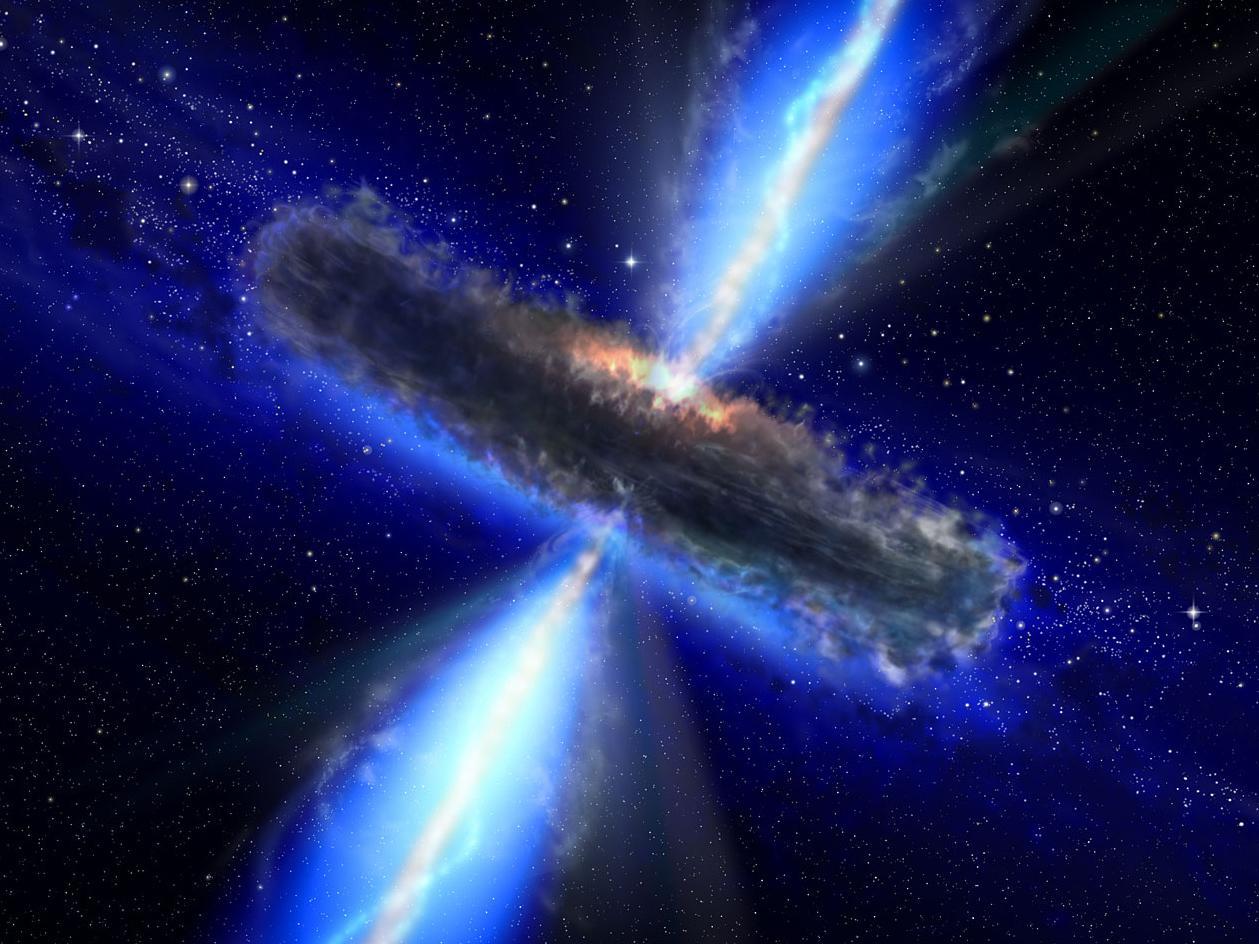
Planets are supposed to form around young stars, in the quiet disks of gas and dust left over from star birth. A study published this year in The Astrophysical Journal argues that the same process could also run in a much stranger place: the disk of material feeding a supermassive black hole. If the authors are right, an active galactic nucleus could produce planetary-mass objects in large numbers, and some of them could keep growing until they approach the mass of the Sun.
The paper, by Bhupendra Mishra, Wladimir Lyra, Barry McKernan, Mordecai-Mark Mac Low, K. E. Saavik Ford and Harrison E. Cook, first appeared on arXiv on May 19, 2026, under the title "Active Galactic Nucleus Tori: Potential Birthplace to Millions of Planets." A revised version followed on July 29. According to EarthSky, the peer-reviewed version was published in The Astrophysical Journal on June 29. The work is getting a new round of attention now: Mishra and Lyra discussed it on a SETI Live stream on Sept. 21, and EarthSky covered it on Oct. 8. Here is what the simulations actually claim, and what they do not.
Where would these planets form?
Not close to the black hole. An active galactic nucleus, or AGN, is a supermassive black hole that is actively feeding on the gas and dust around it. The study focuses on the outer regions of the AGN disk, which the authors say have temperatures similar to those of the disks around young stars. At those temperatures, dust can condense. Closer in, EarthSky notes, it is far too hot, and planets pulled there would disintegrate.
EarthSky compares the outer zone to the comet region of our own solar system. That dust is the raw material. Sci.News reports that the grains involved range from a few nanometers to a fraction of a millimeter in size.
How does dust become a planet?
The key mechanism is the streaming instability, a process in which drag on solid particles in a gas-and-dust disk makes them spontaneously clump. Sci.News describes it as concentrating dust into dense filaments that collapse under their own gravity. In the paper's model, the dust grains first stick together (coagulate) until they reach the sizes the instability needs. The authors report that, in their disk model, those sizes are "easily attained."
The choice of disk model matters. The team used a recently proposed disk model with strong magnetization, which keeps the disk gravitationally stable.
The scale is where things depart from familiar planet formation. According to the arXiv abstract, the dust filaments can contain solar masses of material, collapsing into tens of millions of planetesimals with masses ranging from that of Earth to that of a super-Jupiter.
"We're finding objects that are a thousand times the mass of the Earth, but built of pure dust," Lyra told Sci.News.
Do they stop growing there?
Apparently not. The paper finds that these planets are usually born in what the authors call the 3D Bondi regime of pebble accretion, sweeping up surrounding solids, with mass-doubling times ranging from 1,000 to 10 million years. Gas accretion happens at the same time, and the authors report that the crossover mass can be attained while the objects are still in the planetary mass range.
EarthSky describes the result this way: planets could start out near Jupiter mass and keep growing. Some could become brown dwarfs, or even stars. Sci.News reports that some objects reach or exceed the hydrogen-burning limit, the threshold at which an object is massive enough to become a star.
"Some of these objects are approaching the mass of the Sun," Lyra told Sci.News. He calls this a bottom-up route to star formation: rather than a gas cloud collapsing directly into a star, the building blocks form first, then accrete gas until the object becomes a star.
How many are we talking about?
The coverage frames the numbers slightly differently. The arXiv abstract speaks of tens of millions of planetesimals. Sci.News reports that the disks could host on the order of tens of millions of planetary-mass objects, with growth continuing over the roughly 1-to-10-million-year lifetime of an AGN episode.
EarthSky offers a more conservative estimate: about a million planets per active episode, with a typical episode lasting about 2 million years. It also points out that a black hole can go through many such episodes in its lifetime, so the total could be immense.
These are model outputs, not counts, and the sources do not reconcile "a million" with "tens of millions." Readers should treat both as order-of-magnitude figures.
Why ask the question at all?
According to EarthSky, the idea took shape when McKernan asked Lyra whether the processes that form planets around stars could also occur around an active galactic nucleus. They found that it could happen, at least theoretically, because the same physics should underlie the process in different environments. That is a reasonable thing to doubt: these disks are extreme environments, and the scales are vastly different.
The answer from these simulations is that, in the outer disk, conditions may be close enough. Temperatures permit dust, and the strongly magnetized disk model stays gravitationally stable.
What happens to them?
Not all of them survive. EarthSky notes that gravity from the black hole could move some planets inward, where temperatures are far too hot, and that they would disintegrate. This destruction would produce more dust.
Why It Matters
First, it broadens where planet formation could happen. If the conclusions hold, the disks around young stars would no longer be the only places that build planets. The authors' model suggests that AGN dust tori host the largest populations of planets in the universe.
Second, it connects to gravitational-wave astronomy. Lyra points to the "AGN channel," a theory in which low-mass black holes in the disk around a supermassive black hole migrate, collide and build heavier black holes. Sci.News reports that stars formed in these disks could themselves collapse into black holes, potentially merging into heavyweight black holes that future gravitational-wave observatories such as ESA's LISA might detect. That is a possibility the researchers raise, not a demonstrated pathway.
Third, it offers a different route to making stars. A planet that keeps accreting until it crosses the hydrogen-burning limit inverts the usual sequence, in which a star forms first and planets form around it.
Can anyone see them?
Not yet. EarthSky reports that these planets cannot currently be detected directly. The radial-velocity method, which detects the slight movement of a star caused by an orbiting planet, does not work here because the black holes are too massive. The transit method might work, EarthSky says, but the planets would be vanishingly small compared with the dusty accretion disk behind them. Gravitational microlensing could also work, but it would need several planets around the same black hole and a favorable alignment.
For now, then, this is a theoretical result. It is a careful one: the authors chose a disk model that stays gravitationally stable, quantified the conditions for the streaming instability, and followed the resulting objects through accretion. But it remains a set of simulations, and the specific model assumptions, especially the strong magnetization, set the conditions for the result. Until an observation turns up one of these objects, the tens of millions of planets around supermassive black holes exist only in the models.
Sources
- Mishra, Lyra, McKernan, Mac Low, Ford, Cook — Active Galactic Nucleus Tori: Potential Birthplace to Millions of Planets (arXiv:2605.19241)
- EarthSky — Black holes could have planets, new simulations suggest
- Sci.News — Dusty Accretion Disks around Supermassive Black Holes May Be Secret Planet Factories
