
Short gamma-ray bursts are supposed to be short. That is the whole point of the category: a spike of high-energy light lasting well under a few seconds, generally attributed to the collision of compact objects such as neutron stars. GRB 250704B fit that description, lasting about 0.4 seconds. But an instrument looking at lower energies saw something the gamma-ray picture alone would have missed: soft X-rays that kept flaring for roughly 560 seconds, more than nine minutes, after the gamma rays had faded.
The event, catalogued as EP250704a after the Einstein Probe that caught it on July 4, 2025, is described in a paper accepted in Science Bulletin. The author list runs to 78 names, including An Li, Niccolo Passaleva, Eleonora Troja, and Bing Zhang. Passaleva, who led the Very Large Telescope observations of the flash, calls it "the longest-lasting prompt X-ray flash ever observed from a neutron star merger."
What Einstein Probe actually saw
The key word is prompt. Merger-driven bursts are routinely followed by afterglows. In the textbook picture those come from an external shock, which forms when the burst's outflow slams into surrounding material and then fades smoothly over time. What Einstein Probe recorded in the 0.5 to 4 keV soft X-ray band does not behave like that.
According to the team's analysis, the X-ray activity came in three phases:
- An initial spike that coincided with the gamma-ray burst itself.
- A short tail following that spike.
- A long bump, a later and extended episode of X-ray emission that carried the total duration to about 562 seconds.
Two features of that long bump matter. First, it varied rapidly. Second, its spectrum hardened, shifting toward higher energies. The paper's abstract states that this variability and spectral behavior are "inconsistent with" the standard combination of a hard initial spike followed by an external-shock afterglow. A smooth afterglow should not flicker or harden that way. Something at the center of the explosion appears to have kept supplying energy.
The long phase also produced no comparable gamma-ray emission. An observatory watching only in gamma rays would have recorded a sub-second burst and missed most of the story. The authors say directly that the flash would not have been detected without Einstein Probe's soft X-ray coverage.
Ruling things out
Follow-up observations came from several facilities, including ESO's Very Large Telescope and the Very Large Array. A supernova was ruled out as the source, which supports the compact-object merger interpretation over the collapse of a massive star. The light from the event traveled about 6 billion years to reach Earth.
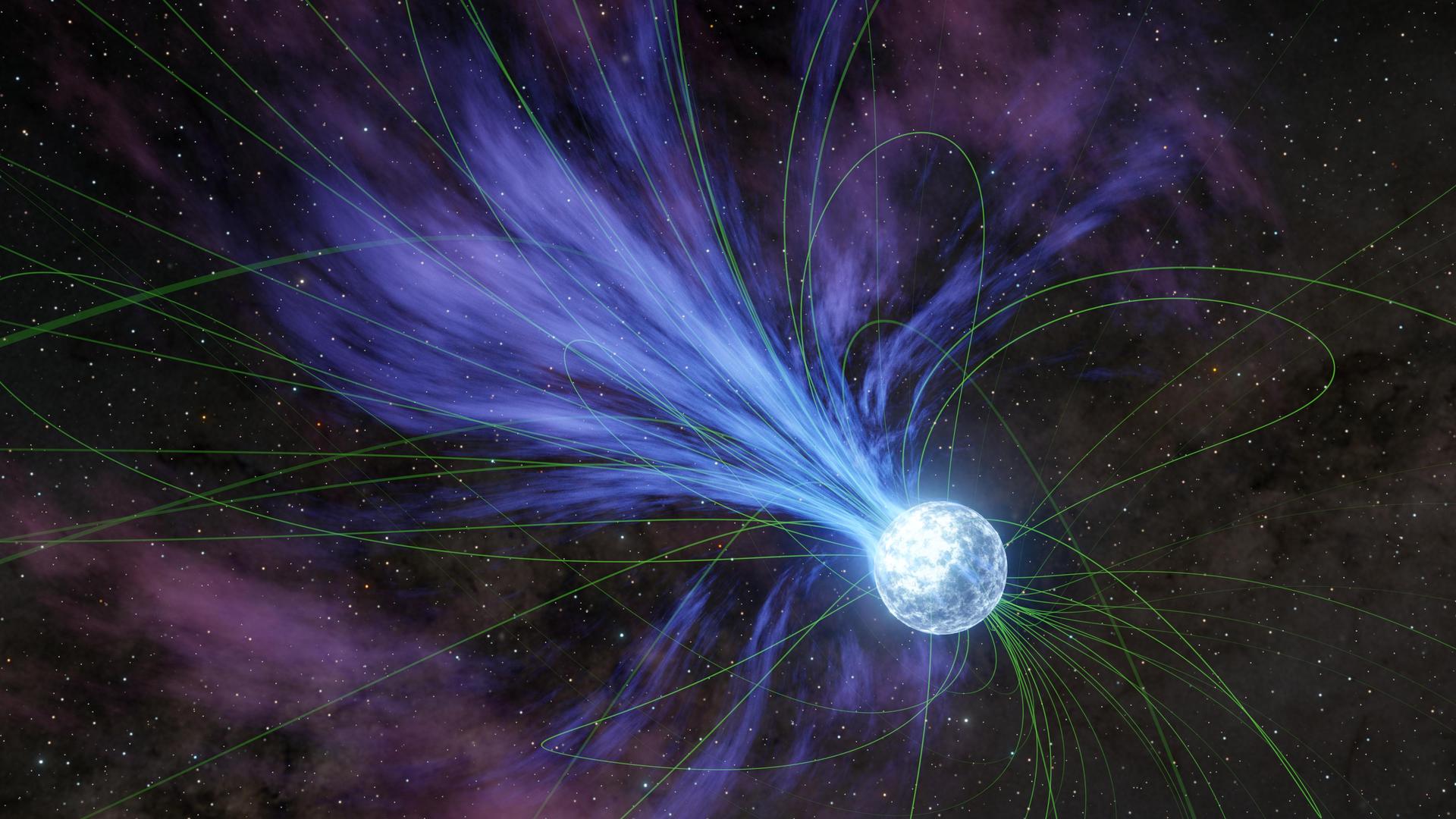
That leaves the question of what kept the engine running. The team's leading candidate is a magnetar, a rapidly spinning, highly magnetized neutron star that could survive the merger as its remnant instead of collapsing straight into a black hole. A remnant like that could keep pumping energy into its surroundings well after the initial collision, which would fit the rapid variability and spectral hardening seen in the long bump.
Troja points to a consequence: "If the remnant of the collision is a magnetar, it could keep bursting for longer."
A caution on the interpretation
The magnetar idea is offered as a suggestion, not a settled conclusion. What the data establish is narrower but still significant. There was a minutes-long, variable, spectrally evolving soft X-ray flash directly after a short GRB, and the conventional model for what follows such bursts does not explain it. The claim that a surviving central engine powered it is an inference from that behavior. Identifying the engine as a magnetar is a further step.
Why It Matters
The most consequential line in the paper may not concern this event at all. The authors conclude that long-lasting X-ray emission is likely a common feature of merger-driven bursts. Gamma-ray instruments alone would not have caught it. If they routinely miss minutes of soft X-ray activity, the standard picture of what happens after neutron stars collide may be missing a whole stage.
That has practical consequences for multi-messenger astronomy. Neutron star mergers are sources of gravitational waves, and pinning down their electromagnetic counterparts is one of the field's central goals. The authors describe this kind of long soft X-ray emission as a promising electromagnetic counterpart to gravitational-wave sources.
It also bears on a basic question about merger outcomes: what is left behind. Whether mergers collapse immediately into black holes or leave surviving neutron stars is still open, and X-ray emission like this is one of the few observable clues. Pairing a gravitational-wave detection with a soft X-ray telescope such as Einstein Probe would offer a direct test of whether a magnetar survived the collision.
For now, EP250704a is one event. If the authors are right that such flashes are common, more should turn up as soft X-ray coverage continues, and those detections will show whether this burst was typical or unusual.
Sources
- Minutes-long soft X-ray prompt emission from a compact object merger (arXiv:2601.14137)
- Mysterious 10-minute X-ray burst from a distant galaxy may have come from 2 dead stars colliding (Space.com)
- Einstein Probe catches a neutron star merger glowing far longer than expected (The Brighter Side of News)
