
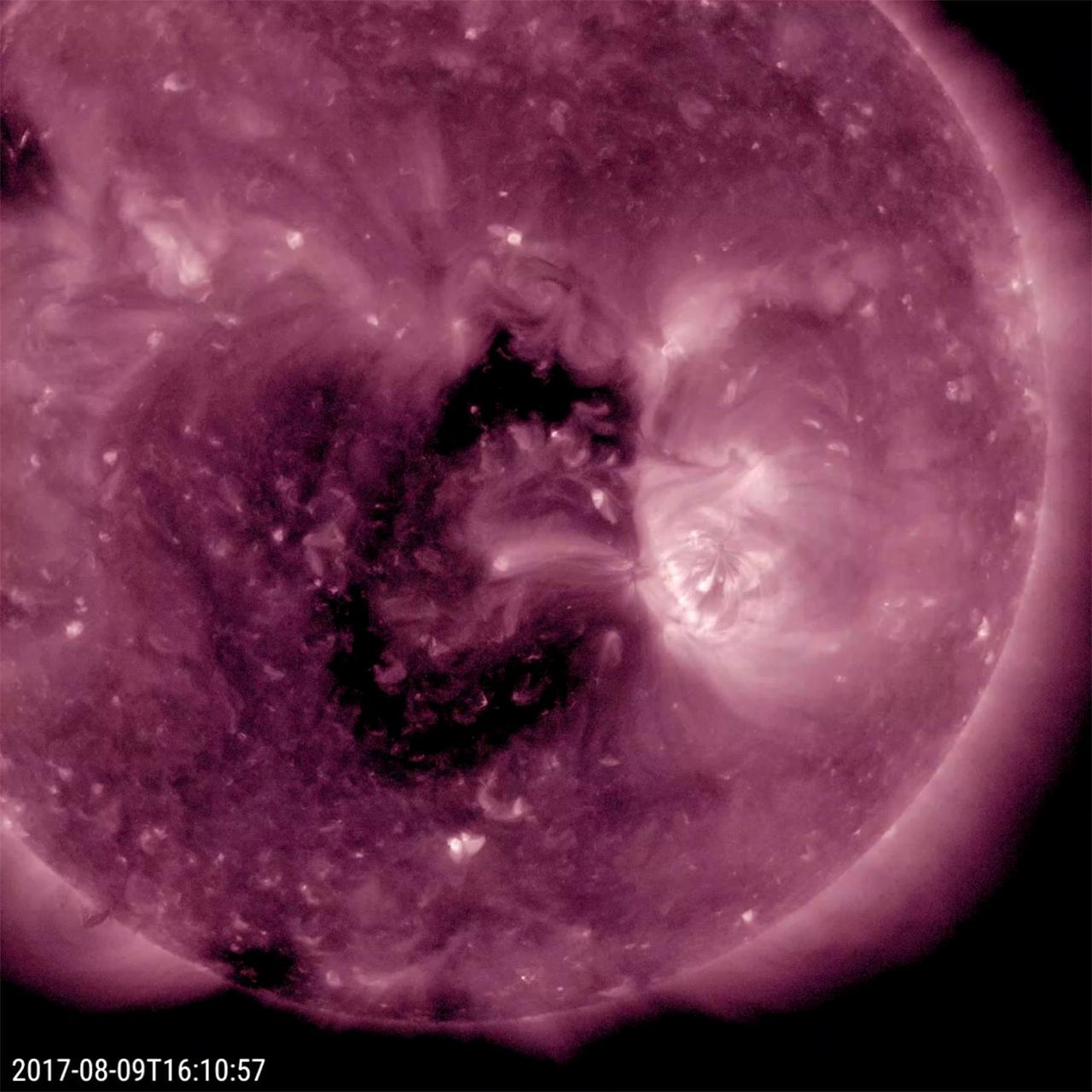
The sun doesn't need a flare to ruin — or make — your night. As of September 13, 2026, two dark patches in the corona, one sitting in each solar hemisphere, are swinging into position to point their exhaust straight at Earth. Neither is dramatic to look at. Coronal holes are cooler, lower-density regions where the sun's magnetic field opens up and lets the solar wind escape unusually fast, and in visible light they're essentially invisible. But the streams they produce are enough to rattle Earth's magnetic field, and forecasters are watching this pair closely as the September equinox approaches.
According to NOAA's Space Weather Prediction Center, the first of the two coronal-hole streams is expected to begin reaching Earth around September 14, with a second stream close behind on September 14-15. SWPC's three-day forecast, issued September 13, calls for a chance of isolated G1 (Minor) geomagnetic storming on both of those days, with peak three-hour Kp values projected at 3.33 on September 13 and 3.67 on September 14 and 15 — modest numbers, but enough to nudge the aurora oval toward mid-to-high latitudes for a few hours at a time.
Independent solar observers are tracking the same setup with a bit more color. EarthSky's daily sun-activity log reported September 13 that the southern of the two coronal holes has "rotated into a geoeffective position," meaning its fast wind stream should begin reaching Earth by September 14. The site's geomagnetic outlook for September 14-15 describes unsettled-to-active conditions with isolated Kp 5 (G1) intervals, and says aurora could become visible as far south as northern Scotland if the stronger pulses materialize.
Spaceweather.com, which updates in near real time, put numbers on the current quiet-before-the-storm conditions: sunspot number 87, a solar wind speed of 365.1 km/s, and a Kp index of just 0.33 — about as calm as space weather gets. The site's own forecast panel puts the odds of at least a minor (G1) geomagnetic storm at high latitudes at 20 percent over both the next 24 and 48 hours, with a further 15 percent chance of lower-level "active" conditions, as the two streams arrive between September 14 and 16 — and the site is already using the phrase "equinox auroras" to describe the possible payoff.
Why It Matters
Geomagnetic storms in this class aren't the kind that make headlines for grounding satellites or tripping power grids — G1 is the bottom rung of NOAA's five-step storm scale, reserved for weak fluctuations that can cause minor voltage fluctuations in power systems and a slight increase in drag on low-Earth-orbit satellites. What G1 storms are reliably good for is aurora. Even a brief Kp 5 spike can push the auroral oval equatorward enough to put a green or red glow on the horizon for skywatchers in the northern U.S., Canada, Scandinavia, and — per EarthSky's forecast — as far south as northern Scotland.
The timing adds a second layer of interest. The September equinox, coming later this month, is historically associated with a real uptick in geomagnetic activity, a phenomenon researchers have linked to the alignment of Earth's magnetic field with the interplanetary magnetic field carried by the solar wind, which makes it easier for that wind's energy to couple into Earth's magnetosphere. A pair of coronal-hole streams arriving in the days just before the equinox is close to a best-case scenario for producing low-level but visible auroral activity, even without a major flare or coronal mass ejection driving it.
And notably, that's not what's driving this event. Solar activity on the flare front has been unremarkable. EarthSky logged a C5.8 flare from sunspot region AR4521 on September 12 as the strongest of the past few days — a minor event, well below the M- or X-class flares that typically accompany the most dramatic aurora displays. Spaceweather.com's own six-hour maximum was also just C-class, with only a 10 percent chance of M-class flares and a 1 percent chance of X-class flares in the current outlook. NOAA's own forecast carries just a 10 percent chance of R1-R2 (Minor) radio blackouts through September 15 — a routine, low-probability byproduct of the region's flare activity rather than a sign of anything unusual, and no blackout had actually been observed as of this writing. In other words, this is a wind story, not an explosion story — steady coronal-hole streams doing the work that flares usually get credit for.
There's also a reminder here that the sun's northwest limb has been busier than the coronal holes alone suggest. EarthSky logged a pair of prominence eruptions from opposite solar limbs on September 10, followed by an even bigger eruption from that same northwestern region on September 11, hinting at a sun that remains active even during a stretch without major Earth-directed flares. None of that activity has been tied to the incoming aurora chance, but it underscores that solar behavior right now is a mix of the routine (rotating coronal holes) and the occasionally spectacular (limb prominences), running in parallel.
What Skywatchers Should Actually Expect
Given the numbers involved — Kp values hovering in the 3 to 5 range, storm probabilities in the 15-to-20-percent band — this isn't shaping up to be a headline-grabbing display visible from mid-latitude cities. It's a chance, not a guarantee, concentrated at high latitudes and best appreciated away from light pollution on the nights of September 14 and 15. Aurora chasers in Scotland, Scandinavia, Alaska, and northern Canada have the best odds; those farther south should treat any glow as a bonus rather than a plan. As always with space weather, the safest approach is to check NOAA's updated forecasts closer to the dates, since coronal-hole stream timing can shift by half a day or more as the holes rotate fully into view.
