
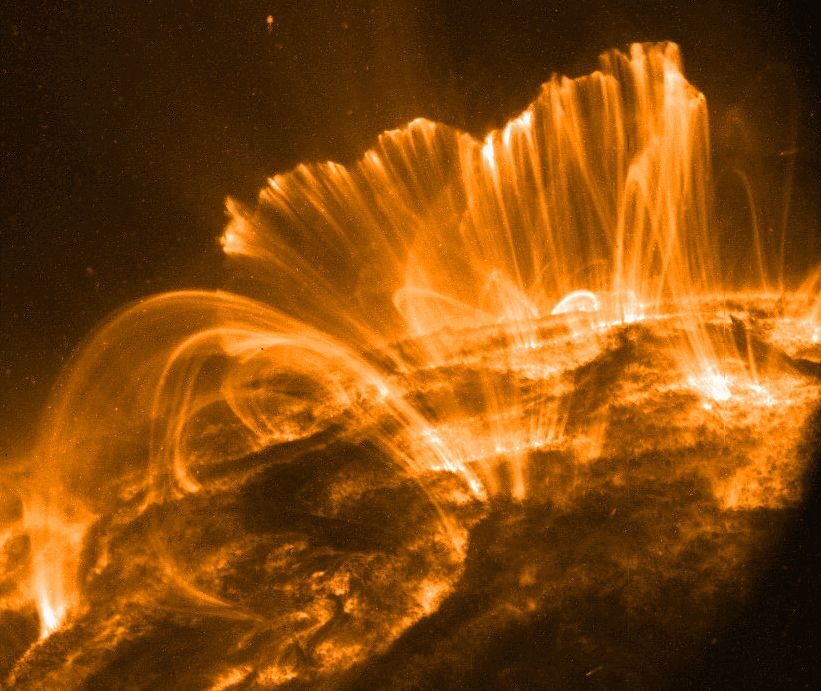
The Sun is having a quiet week. SpaceWeather.com's front page on Oct. 28 said it plainly: "NO STORMS TODAY." The face of the Sun is "almost blank," with only two tiny sunspots, no coronal mass ejections (CMEs) heading for Earth, and very low odds of a geomagnetic storm over the next 48 to 72 hours.
There is one caveat, though, and its timing is good for anyone planning to be outside on Halloween. A filament eruption on Oct. 26 threw material into space. Forecasters expect most of it to miss us, but they haven't ruled out a glancing hit late on Oct. 30 or early on Oct. 31. In the predawn sky, meanwhile, the waning Moon works its way through some of the best scenery of the autumn sky, and Mars keeps closing on Jupiter.
The Sun: low activity, one loose end
NOAA's Space Weather Prediction Center (SWPC) issued its forecast discussion at 00:30 UTC on Oct. 28 and called solar activity low. Region 4561 had rotated out of view, and Region 4562, the one numbered active region left on the Earth-facing disk, was quiet.
Low activity still means some activity. EarthSky counted eight flares in the preceding 24 hours: one C-class and seven B-class. The strongest was a C1.0 at 6:13 UTC on Oct. 28, credited to AR4561. That is the region SWPC had already listed as having rotated out of view, so this was a modest parting shot from a region at or beyond the Sun's edge. A flare that size is minor. B- and C-class events sit at the bottom of the scale and have no practical effect on Earth.
The loose end is the filament. SWPC says a filament eruption near N30E75 lifted off at about 21:42 UTC on Oct. 26. Those coordinates put the source in the Sun's northeastern quadrant, well off the center of the disk. EarthSky reports the eruption at 21 UTC on Oct. 26 and says analysts registered a CME. Both outlets reach the same conclusion. SWPC says the bulk of the material "should pass behind Earth," and that any glancing influence is most likely late on Oct. 30 into Oct. 31. EarthSky also calls a glancing blow possible in that window, late Oct. 30 to early Oct. 31.
SWPC's wider statement that no Earth-directed CMEs were observed fits the same picture. This ejection was aimed mostly away from us, and any effect would come from its outer edge brushing past.
EarthSky also flags a second, separate influence. On Oct. 30, a high-speed solar wind stream from a coronal hole could bring unsettled conditions at roughly Kp 3 to 4. The Kp index runs from 0 to 9, and storm levels begin at Kp 5, so this is a forecast of a somewhat restless magnetosphere, not a storm. EarthSky expects Oct. 28 and 29 to be mostly quiet.
EarthSky's flare odds for the period are 55 percent for C-class, 10 percent for M-class and 1 percent for X-class. SWPC likewise expects a chance of isolated C-class flares through Oct. 30.
The number nobody sees: energetic electrons
The Sun's disk looks calm, but near-Earth space has not been completely quiet. SWPC reports that the flux of electrons above 2 MeV reached high levels, peaking at 1,790 pfu at 17:15 UTC on Oct. 27. You won't see this in the sky. It matters mostly to satellite operators, because high-energy electron populations are a known hazard for spacecraft electronics. SWPC expects the flux to fall to moderate levels through Oct. 30. It is a useful reminder that a "quiet Sun" and a quiet space environment are not the same thing.
The Moon's tour: Taurus, Auriga, then Gemini
Look away from the Sun and the week is all about the Moon. According to EarthSky's sky guide, on the late evening of Oct. 28 the waning gibbous Moon sits between Capella and Aldebaran, with the Pleiades star cluster nearby. That is a good region of sky even with moonlight washing it out. Capella is a bright star in Auriga, and Aldebaran marks Taurus.
On the mornings of Oct. 30 and 31, before dawn, the Moon, nearing its third quarter phase, approaches Castor and Pollux, the twin stars of Gemini. Halloween revelers out very late, or early risers on Oct. 31, will find the Moon there. That is also the window when any glancing CME effects would arrive. The third quarter Moon follows on Nov. 1 at 20:28 UTC.
The tour keeps going. On the mornings of Nov. 2 and 3, EarthSky says, the Moon passes near Jupiter and Mars, with the bright star Regulus of Leo below them.
The planets: Mars closes on Jupiter
The slower story plays out in the morning sky. Mars is drifting toward Jupiter, and EarthSky says Mars will pass 1.2 degrees north of Jupiter on Nov. 15. If you watch the pair over the coming mornings, you can see the gap shrink from one week to the next. The Moon's visit on Nov. 2 and 3 gives a handy reference point.
In the evening, Saturn is well placed for observing, rising higher in the eastern sky at nightfall following its opposition on Oct. 4. Further ahead, EarthSky notes that Venus sits near the star Spica in the dawn sky on Nov. 5 through 7. New moon falls on Nov. 9 at 7:02 UTC, and the Taurid meteors are active in early November, so darker skies arrive just in time for them.
Why It Matters
This week shows how space weather forecasting usually works in practice. A dramatic eruption on the Sun doesn't mean a dramatic outcome at Earth. Where it happens on the disk and which direction it heads matter more than how it looks. The Oct. 26 filament erupted from well off the center of the disk, and both SWPC and EarthSky expect most of its material to pass behind Earth. The honest forecast is a hedge: probably nothing, possibly a glancing touch, with a specific window attached.
For skywatchers, that means setting expectations. Nothing in these forecasts points to a geomagnetic storm. SpaceWeather.com puts storm odds as very low for the next 48 to 72 hours, and EarthSky's outlook for Oct. 30 tops out at unsettled, Kp 3 to 4, short of storm level. The most reliable things in the sky this Halloween weekend are the predictable ones: the Moon near the Pleiades, Capella, Aldebaran, Castor and Pollux, and the slow approach of Mars and Jupiter before dawn.
The energetic electron peak is a smaller but real point too. Space weather affects technology even when the Sun looks almost featureless, and those effects are separate from the auroras and flares that get the headlines.
