
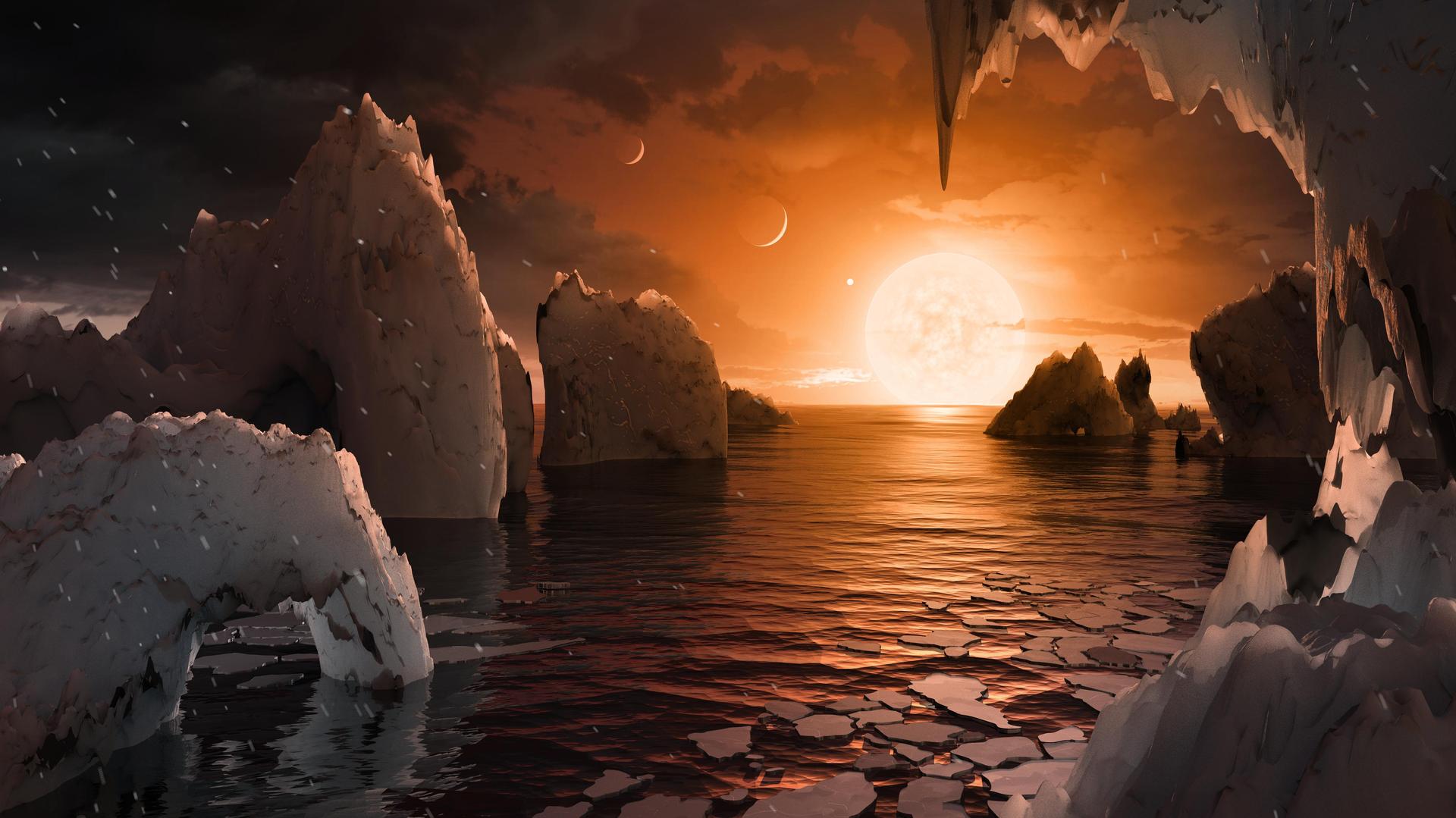
TRAPPIST-1 f has waited a long time for its close-up. The seven-planet system, an ultracool red dwarf about 39 light-years from Earth, has been a top target for atmospheric hunting ever since its discovery, precisely because several of its rocky worlds sit in or near the star's habitable zone. But f — the outer of the two classic habitable-zone members — has lagged behind its more frequently observed siblings. A paper submitted August 17, 2026, led by Olivia Lim and 27 co-authors including René Doyon and Ryan J. MacDonald, changes that with the first JWST transit spectra of the planet, and the headline result is a subtraction rather than a discovery: whatever TRAPPIST-1 f has going on, it almost certainly isn't a thick, puffy hydrogen-helium envelope.
The team observed five transits of TRAPPIST-1 f using the Near Infrared Imager and Slitless Spectrograph (NIRISS) in its Single Object Slitless Spectroscopy (SOSS) mode — the same instrument mode that has produced spectra for other TRAPPIST-1 planets, including the tentative methane hints reported for TRAPPIST-1 e. Stacking five separate looks at the planet's transit light curve let the researchers build up a spectrum precise enough to start testing specific atmospheric scenarios, rather than just detecting the presence of *something*.
The Problem That Didn't Show Up
Anyone who has tried to read a transiting planet's atmosphere off an M-dwarf star knows the catch: the star itself gets in the way. Ultracool dwarfs like TRAPPIST-1 are covered in starspots and bright faculae, and if a transiting planet crosses a patch of stellar surface that doesn't match the star's overall brightness or color, the resulting spectrum gets contaminated. This is the "transit light source effect," and it has been a persistent headache in earlier TRAPPIST-1 atmospheric work, sometimes mimicking or masking real planetary signals.
The new study went looking for that contamination in TRAPPIST-1 f's data and, notably, didn't find it — despite catching at least one stellar flare during every single one of the five visits. That's a bit of a surprise. A flaring, spotted red dwarf is exactly the kind of star expected to muddy the water, and TRAPPIST-1 has a track record of doing so for its inner planets. Instead, the team reports no evidence of unocculted stellar heterogeneities skewing the spectrum. That's a meaningful result on its own: it means the transmission spectrum extracted for TRAPPIST-1 f can be trusted as a reasonably clean read on the planet, not a fun-house mirror shaped by its star.
What the Clean Data Rule Out
With contamination off the table, the researchers could push harder on what the spectrum says about the planet itself. The answer is a strong negative: in the least flare-affected observations, they rule out a hydrogen/helium-dominated atmosphere with a surface pressure above roughly 20 millibars, at 95% confidence. For comparison, Earth's surface pressure is about 1,013 millibars — so this isn't ruling out something exotic and puffy so much as ruling out a genuinely substantial primordial envelope, the kind of atmosphere a young rocky planet might retain if it managed to hold onto hydrogen and helium accreted from its birth disk.
That's a fairly clean result, and it matches a broader pattern seen across the TRAPPIST-1 system: low-density, hydrogen-rich atmospheres seem to be hard to hang onto around this particular star, likely because of its history of intense flare and UV activity, especially early in its life. Constraints on heavier, higher-molecular-mass atmospheres — the CO2- or nitrogen-dominated kind more analogous to Venus, Earth, or Mars — are murkier. The paper notes those constraints depend on which data-reduction pipeline is used to process the raw NIRISS observations, meaning the current dataset can't yet say with confidence whether f has a thin, heavier atmosphere, a bare rock, or something in between.
Why It Matters
TRAPPIST-1 f matters because it's one of the closest-to-home tests of whether small, rocky planets around red dwarfs can hold onto air at all — a question with big implications given how common M-dwarf stars are in the galaxy. Unlike its more-studied neighbor TRAPPIST-1 e, planet f sits farther from the star and runs cooler, making it an outer bookend for the system's habitable-zone real estate. JWST has been steadily building a comparative atmospheric survey of the TRAPPIST-1 system, accumulating data across multiple planets rather than treating each as a one-off snapshot of an isolated world.
The absence of the transit light source effect in this dataset is arguably as important as the atmospheric non-detection. Stellar contamination has complicated interpretation of TRAPPIST-1 spectra before, and a demonstrably clean dataset gives researchers more confidence that future observations of f — and the reduction techniques validated here — can be trusted to isolate genuine planetary signals from stellar noise. Ruling out a thick H/He envelope also narrows the theoretical field: it pushes the conversation toward thinner, secondary atmospheres (or none at all), which are exactly the harder-to-detect, more Earth-like scenarios that require more transits and more careful spectroscopy to pin down. In other words, this result doesn't tell us whether TRAPPIST-1 f is habitable — it tells us what kind of question to ask next.
What Comes Next
The disagreement between data-reduction pipelines on heavier-atmosphere constraints is a reminder that JWST transit spectroscopy of small, faint planets is still pushing against the edge of what the instruments and analysis methods can cleanly resolve. Additional transits, and continued refinement of how NIRISS SOSS data gets processed, will likely be needed before astronomers can say with real confidence whether TRAPPIST-1 f has a thin secondary atmosphere, a bare surface, or something else entirely. For now, the system's outer habitable-zone world has had one major possibility taken off the table — and the search for what, if anything, TRAPPIST-1 f breathes continues.
Sources
- Atmospheric Reconnaissance of TRAPPIST-1 f with JWST NIRISS SOSS: No Evidence for the Transit Light Source Effect
- TRAPPIST-1 Atmospheric Reconnaissance with JWST: First Look at the Habitable-Zone Exoplanet TRAPPIST-1 f with NIRISS
- New Results from the JWST Suggest that TRAPPIST-1e Might Have a Methane Atmosphere, Though Caution is Advised
