
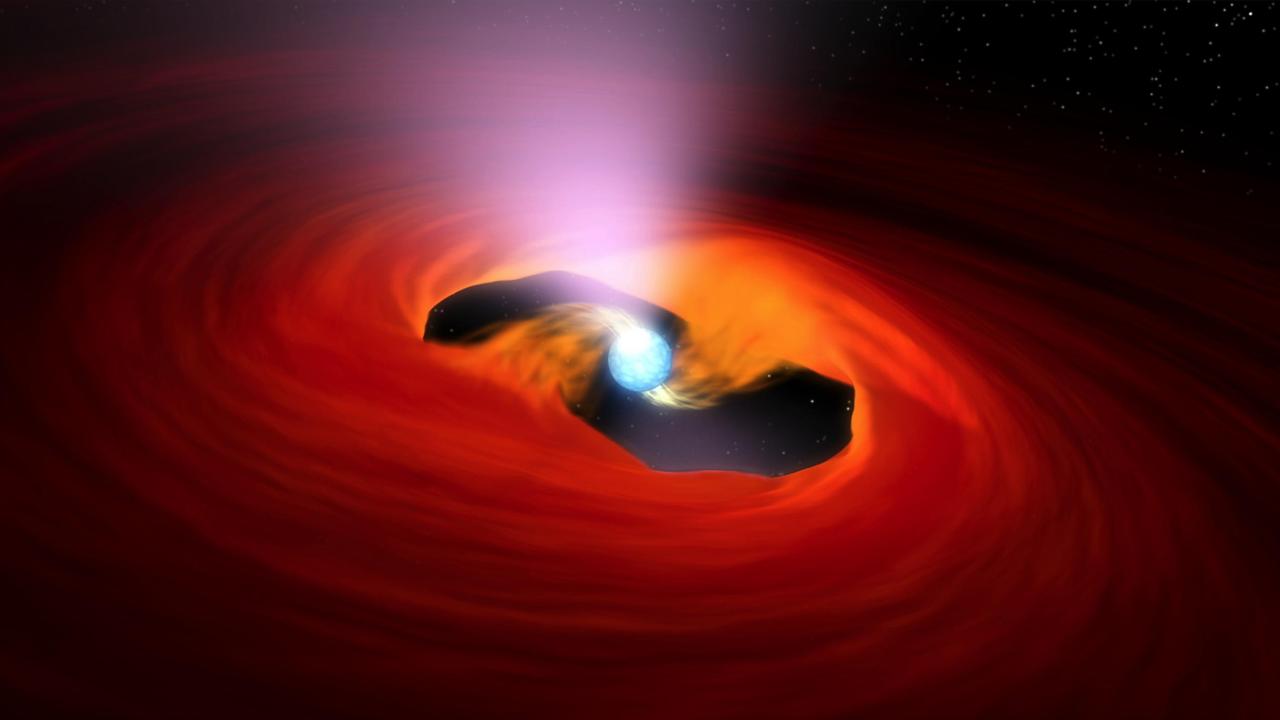
Fifteen years of public data from NASA's Fermi Gamma-ray Space Telescope contained a pulsar spinning 261 times per second. The best existing search method had already spent the equivalent of 600 years of computing on a standard processor and never found it. A new approach found it with roughly 10 hours.
The pulsar is PSR J1622-7204. The new method rests on an idea from a field that rarely appears in astrophysics papers: the mathematics cryptographers are using to build encryption that quantum computers can't break. According to NASA's announcement, an international team used it to search Fermi's archive for gamma-ray pulsars about a million times faster than earlier techniques. The paper was published in Physical Review Letters on Thursday, Nov. 19.
The problem: a clock you only hear a few ticks of
A pulsar is a spinning neutron star, and its value to astronomers lies in how regularly it rotates. The difficulty is that a gamma-ray telescope does not see a steady pulse. It records individual photons, each with an arrival time, and those photons are scattered across years of observation.
Fermi launched in 2008 and scans the whole sky every three hours, so its archive is enormous. For any single faint source, though, the photons are sparse, mixed in with background noise from other gamma-ray sources. Recovering a pulsar's period from them is a lot like working out a metronome's exact tempo from a few clicks heard at random moments over several years. The rotation frequency, how fast that frequency is slowing, and the source's precise sky position all shift the predicted arrival times. Searching all those parameters by brute force would take an impossible number of computations.
Dotan Gazith and Barak Zackay of the Weizmann Institute, who developed the method, laid out the problem in their earlier methods paper, with co-author Aaron Pearlman, submitted to arXiv in February 2024. Pulsar periodicity is the primary source of information we have about these objects. Identifying it from a discrete set of arrival times is a difficult algorithmic problem, particularly for pulsars in binary systems. The authors noted that hundreds of unassociated Fermi-LAT sources are still awaiting a timing solution, and that the same issue arises for repeating fast radio bursts.
The trick: turn it into a lattice problem
Gazith and Zackay reframed the search as a different kind of question. Rather than stepping through candidate frequencies one at a time, they treated timing recovery as finding the shortest vector in a high-dimensional lattice.
A lattice in this sense is a regular grid of points that extends into many dimensions. The shortest-vector problem asks which nonzero point in that grid sits closest to the origin. It sounds simple, but it is computationally hard in high dimensions, and that hardness is why cryptographers have built quantum-resistant encryption schemes around lattices. As a result, a great deal of work has gone into algorithms that solve lattice problems as efficiently as possible, mostly to test how strong those schemes really are.
The pulsar researchers used those algorithms. In the 2024 paper, the authors say they obtained solutions using off-the-shelf lattice reduction and sieving techniques. If the timing problem can be written so that the true pulsar solution corresponds to a short vector, a well-tuned lattice solver can find it directly instead of grinding through the whole parameter space. NASA reports that each trial run took about five minutes on a single processor core. Gazith put it plainly: "We have nothing to do with cryptography in our analysis here, but those algorithms can help us solve the problem of searching for pulsars in our data."
The proof: PSR J1622-7204
The Physical Review Letters paper builds on that 2024 groundwork. Its lead author is Daniel Pook-Kolb of the Max Planck Institute for Gravitational Physics, also known as the Albert Einstein Institute. The team ran the lattice method over 15 years of public Fermi data and found PSR J1622-7204, an isolated pulsar with no companion star, rotating 261 times per second.
The difference in cost is what stands out. NASA says the discovery took the equivalent of about 10 hours on a standard processor. The previous best method used enough computing power that a standard processor would take 600 years to do the calculation, and it did not find the signal. That is where the headline figure comes from: a speedup NASA describes as about a million times.
One discovery does not prove the method beats the old approach everywhere. It does show the lattice approach can find a real signal in real data that the established pipeline had searched and missed. NASA adds that once the method flagged a candidate, the researchers confirmed it against the full Fermi data set, which showed a signal too strong to be a chance occurrence.
What it replaces, and what it doesn't
Until now, the standard way to find gamma-ray pulsars this faint has been raw computing volume, much of it donated. Einstein@Home uses idle time on volunteers' computers to search for weak signals from spinning neutron stars in data from the LIGO gravitational-wave detectors, the MeerKAT radio telescope and the Fermi satellite, as well as archival Arecibo data, and it runs a dedicated Fermi Gamma-ray Pulsar Search. NASA notes that, even with volunteers' computers, finding a single pulsar this way typically took the equivalent of hundreds of computer-years.
The team is not trying to replace Einstein@Home. Clark said the next goal is to combine the new algorithm with the crowdsourced computing power of Einstein@Home and go after binary pulsars, which have long been considered out of reach. NASA says a companion star's gravity distorts the signal in ways that make these pulsars essentially impossible to find with traditional methods.
Co-author Colin Clark of the Max Planck Institute says there are probably tens or maybe even hundreds of such pulsars in the data set that researchers have not been able to find. That estimate is untested so far, since the published result is a single isolated pulsar. If the method scales to binaries, an archive that has already been searched heavily could still hold a sizable population nobody has found.
Why It Matters
The first reason is practical. Fermi's data is public, and NASA says each trial of the algorithm is easily doable on a standard laptop. A search that costs ten processor-hours instead of hundreds of processor-years is one that many more groups can afford to run, and questions that once needed a volunteer computing network may be within reach of ordinary hardware.
The second reason is scientific. Pulsars are valued for their regularity, and the 2024 paper notes that newly timed gamma-ray pulsars could be added to pulsar timing arrays. A tool built for the harder binary case could help clear part of the backlog of unassociated gamma-ray sources that Gazith and Zackay pointed to in their methods paper, and possibly help with the timing of repeating fast radio bursts too.
The third reason concerns how science works. The algorithms that made this possible were developed by cryptographers working on encryption designed to resist future quantum computers, not to study neutron stars. Their arrival in a pulsar search is a reminder that hard problems in very different fields sometimes share the same structure underneath. In this case, the payoff was a pulsar spinning 261 times per second that a search costing 600 processor-years had missed.
