
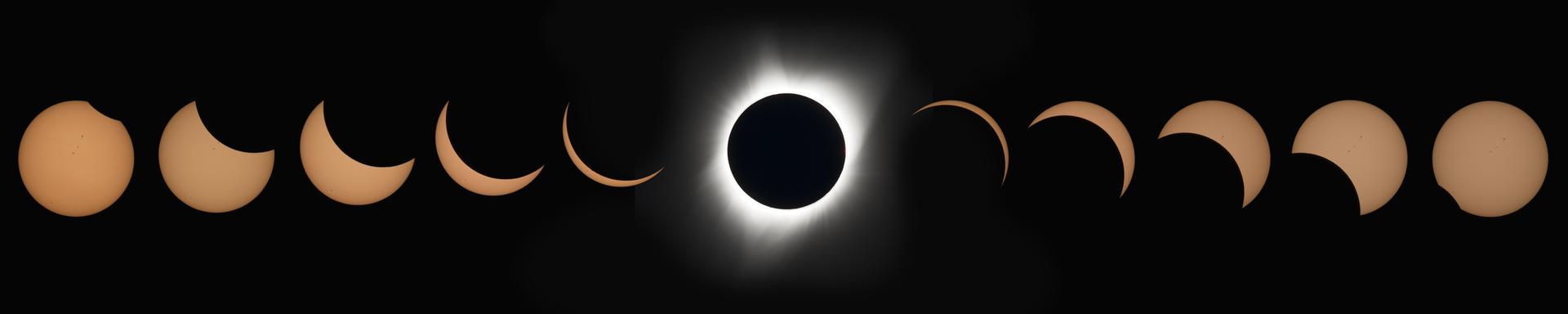
On the evening of August 12, 2026, the Moon's shadow will race across the North Atlantic, plunge Reykjavik into daytime darkness, and then sweep into northern Spain as the sun sets — the first time totality has touched mainland Spain in over a century. A few hours later, once the sky is fully dark, the same swath of Europe gets a second act: the Perseid meteor shower reaches its peak under a new moon, with no lunar glare to wash out faint streaks. It's a rare pairing of celestial events on a single calendar date, and this year the geography and the timing happen to line up almost perfectly for observers in Iceland and Spain.
A shadow path across open ocean
According to NASA, the path of totality begins over the Arctic Ocean, crosses Greenland and Iceland, clips northern Russia, then arcs back down across the Atlantic before making landfall again in Spain and a small corner of Portugal. The National Solar Observatory's mapping confirms the same route — Arctic Ocean, Greenland, Iceland, Atlantic Ocean, Portugal, northern Spain — and notes that most of the path runs over water or sparsely populated Arctic terrain, which is typical for eclipses that track this far north.
Totality itself is brief almost everywhere along the path — under two minutes for most of it, per NASA — but it peaks near the path's center over open water. Earth.com reports a maximum duration of 2 minutes 18 seconds over the Denmark Strait, the stretch of ocean separating Greenland and Iceland, with 2 minutes 6 seconds along Greenland's coast. NASA puts the center-line maximum at just under two and a half minutes. Either way, nobody watching from land gets the longest version of this eclipse — the deepest darkness happens over water, between two islands, visible mainly to ships and aircraft positioned to catch it.
When to look up, city by city
For ground-based observers, the timing shifts by nearly three hours across the path:
- Reykjavik, Iceland: totality from 5:48 to 5:49 p.m. local time — a single minute, but with the sun still reasonably high.
- Leon, Spain: totality from roughly 8:28 to 8:30 p.m.
- Valencia, Spain: totality from about 8:32 to 8:33 p.m., with the sun low near the horizon.
That low sun angle in Spain matters for anyone planning a viewing trip: an eclipsed sun sitting near the horizon means foreground scenery — mountains, coastline, cityscape — becomes part of the shot, but it also means a clear western horizon is non-negotiable. A single line of clouds or hills to the west can erase the whole event for Spanish observers in a way it wouldn't for someone in Iceland with the sun higher overhead.
Outside the path itself, a partial eclipse will be visible across a much wider swath of the Northern Hemisphere — most of Canada, the northern United States, much of Europe, and northwestern Africa, per NASA. The depth of that partial coverage varies enormously by location: NASA cites just 3 percent coverage in Detroit versus 99 percent in Madrid and Barcelona, meaning Spanish cities well outside the actual path of totality will still see the sun reduced to a sliver.
The Perseids show up on cue
The eclipse isn't the only reason to be outside that night. The Perseid meteor shower peaks the night of August 12–13, and the American Meteor Society is calling 2026 conditions "optimum," according to Earth.com — a rating driven entirely by the new moon, which removes the moonlight that usually drowns out fainter meteors. Under those dark-sky conditions, the Perseids typically deliver 30 to 50 meteors per hour at their peak, climbing toward 100 per hour in genuinely dark locations away from light pollution.
For observers already stationed in northern Spain to catch the sunset eclipse, the two events essentially chain together: totality ends, twilight fades, and by full darkness the Perseids are ramping up toward their peak. Earth.com singles out northern Spain specifically as offering the best combined viewing — eclipse at sunset, meteor shower after dark, same location, same night.
Why It Matters
Total solar eclipses are not rare globally — one happens somewhere on Earth roughly every 18 months — but they're rare at any given point on the map. The National Solar Observatory notes that a total eclipse returns to the same location only about once every 400 years on average, which is what makes an event reaching mainland Spain notable rather than routine. Spain hasn't seen a total solar eclipse cross its mainland in over a century, so August 12 is very likely a once-in-a-lifetime event for anyone living there, not a recurring attraction.
The Perseid pairing amplifies that. New-moon timing on the Perseid peak doesn't happen every year, and having it coincide with a total eclipse's path crossing a populated, accessible region is close to a coincidence of calendars — the kind of alignment that won't repeat on any predictable schedule. For skywatchers weighing whether a trip to Iceland or Spain is worth it, that combination of scarcity — rare eclipse geometry, rare dark-sky meteor conditions, same night, same region — is the actual case for going.
Watching safely
Both NASA and the National Solar Observatory are explicit on this point: it is only safe to look at the sun without protection during the brief window of full totality. Every partial phase — before and after totality, and the entirety of the event for anyone outside the path — requires certified solar viewing glasses meeting the ISO 12312-2 safety standard. Regular sunglasses, no matter how dark, do not qualify. NASA will also run a livestream of the eclipse starting at 1:15 p.m. EDT on August 12 at nasa.gov/live, for anyone not in the path or under clear skies.
