
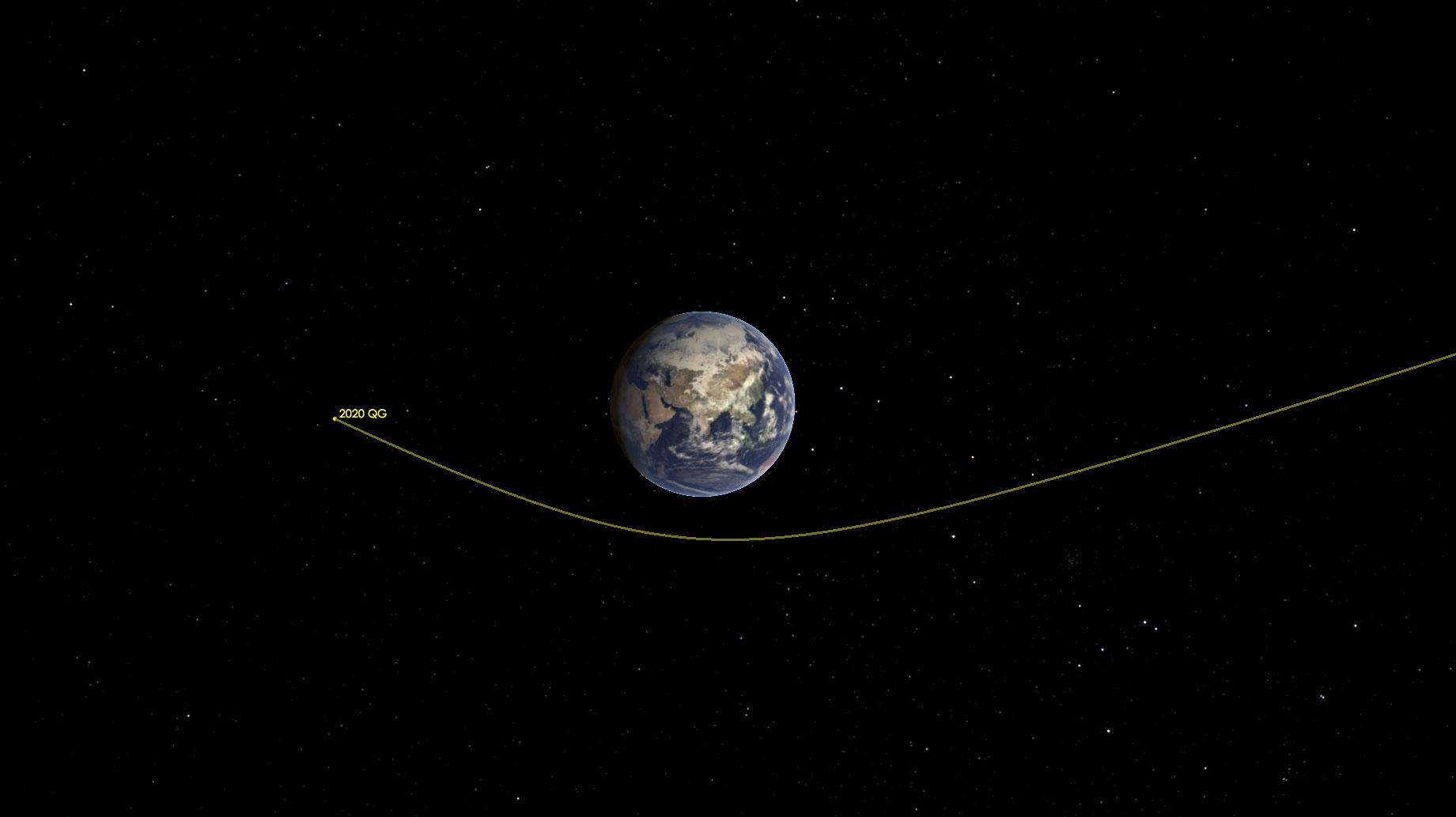
At 16:07 UTC on September 6, 2026, a rock roughly the size of a large armchair slammed into Earth's atmosphere over the Indian Ocean, somewhere off the northwestern coast of Australia. It disintegrated harmlessly, high above any ship or shoreline, and no one on the ground reported seeing so much as a flash. By most measures, nothing happened.
Except something did happen, and it happened six hours earlier, in the dark above Mount Lemmon, Arizona. That's where a telescope belonging to the Catalina Sky Survey caught a faint, fast-moving point of light that turned out to be the asteroid itself, hours before it arrived. Astronomers tagged it CERNQ52, then gave it a permanent name: 2026 RW1. It became only the 13th asteroid in history ever detected before it hit Earth — and the first to break a twelve-for-twelve pattern that had held since this kind of detection became possible.
A Six-Hour Head Start
2026 RW1 was small — about 80 centimeters (2.6 feet) across, per estimates reported by EarthSky, based on its brightness. That's not "planet killer" territory; it's barely bigger than a beach ball crate. Objects this size hit Earth's atmosphere fairly often and almost always go unnoticed, because they're faint enough that a telescope has to be looking in exactly the right patch of sky at exactly the right time to catch them before they arrive.
This time, one was. The Catalina Sky Survey, a NASA-funded near-Earth object (NEO) hunting program run out of the University of Arizona's Lunar and Planetary Laboratory in Tucson, flagged the object using its Mount Lemmon Observatory station. The survey exists for exactly this purpose — its stated mission is "fully dedicated to discovering and tracking near-Earth objects" — and it has the numbers to back that up: 510 new near-Earth asteroid discoveries so far in 2026 alone, and 17,779 cumulative discoveries since the survey began in 1995.
Once flagged, 2026 RW1's trajectory was refined quickly enough to predict, with reasonable confidence, where and roughly when it would enter the atmosphere. It came down over open ocean, away from population, and — as EarthSky put it — "would have caused no damage" regardless of where it landed, given its size. No fireball was visually confirmed from the ground.
Why the Orbit Type Matters
The detail that has near-Earth object specialists interested isn't the size — it's the shape of the orbit. 2026 RW1 is classified as an Aten-type asteroid, meaning its orbit around the Sun lies mostly inside Earth's own orbit. That's a meaningfully different category from Apollo-type asteroids, whose orbits cross Earth's from farther out and swing well beyond it.
All twelve previous pre-impact detections were Apollo-type objects. 2026 RW1 is the first Aten-type object ever flagged before it hit. Aten asteroids, by definition, spend much of their orbit closer to the Sun than Earth does, which can place them nearer the Sun in the sky than surveys typically scan. That geometric quirk is a plausible explanation for why an Aten object has never been caught before impact until now — though neither EarthSky nor the Catalina Sky Survey spelled out the mechanism in describing this detection, so it's worth reading as informed inference rather than a reported fact.
That 2026 RW1 got caught at all, on an orbit type surveys have a 0-for-12 record against, is arguably a bigger deal for planetary defense than the fact that a small rock burned up safely over the ocean, which happens with some regularity regardless of who's watching.
A Busy Week in Near-Earth Space
2026 RW1 wasn't the only object making news that week. NASA/JPL's Center for Near-Earth Object Studies (CNEOS), which maintains the close-approach database that underlies statistics like this one, logged several other small objects passing near Earth in the days that followed. Between September 7 and 13, its records show multiple bodies — with absolute magnitudes in the roughly H 26–31 range, corresponding to sizes from a few meters up to about 30 meters — sweeping past at distances ranging from about 0.58 to roughly 5.5 lunar distances (a lunar distance being the roughly 384,000-kilometer gap between Earth and the Moon).
Two stood out: 2026 RN2, which passed at about 0.58 lunar distances on September 8 — closer than the Moon by a comfortable margin, but still a clean miss — and 2026 RW3, which passed at roughly 1.05 lunar distances on September 10. Neither posed any threat; both are cataloged, tracked, and now filed away as data points in an ever-growing record of how much small debris quietly passes through Earth's neighborhood on an ordinary week.
Why It Matters
None of these objects were ever going to be catastrophic. An 80-centimeter rock and a scattering of small flybys are the routine background noise of a solar system with a lot of debris in it. But 2026 RW1 matters as a proof of concept: planetary defense doesn't need to catch every asteroid years in advance to be useful. Sometimes a six-hour warning is enough to confirm there's nothing to worry about, refine impact-location predictions for scientific study, and — more importantly — extend the kind of detection that has always worked on Apollo-type orbits toward the Aten-type blind spot. A survey system that can now flag inbound objects on sunward-leaning orbits, even small and even at the last minute, is a meaningfully more complete system than one that can't. The next object on that kind of orbit might not be 80 centimeters across, and the difference between six hours' warning and zero is the difference between an evacuation and a surprise.
