
Early on the morning of Tuesday, Oct. 13, people from Georgia to Washington, D.C. looked up and saw something that didn't fit any easy explanation. Before sunrise, while the ground was still dark, a pale glowing shape spread across the sky. It had a bright core and a wide, billowing cap, and it trailed streamers below it. People posted photos and asked each other what it was. Many settled on the same description: a jellyfish.
It wasn't a UFO, an aurora or a strange cloud. It was rocket exhaust, and specifically the plume from SpaceX's launch of NASA's 35th commercial resupply mission to the International Space Station. The odd part is the lighting. Here's what happened and why.
The launch behind the light show
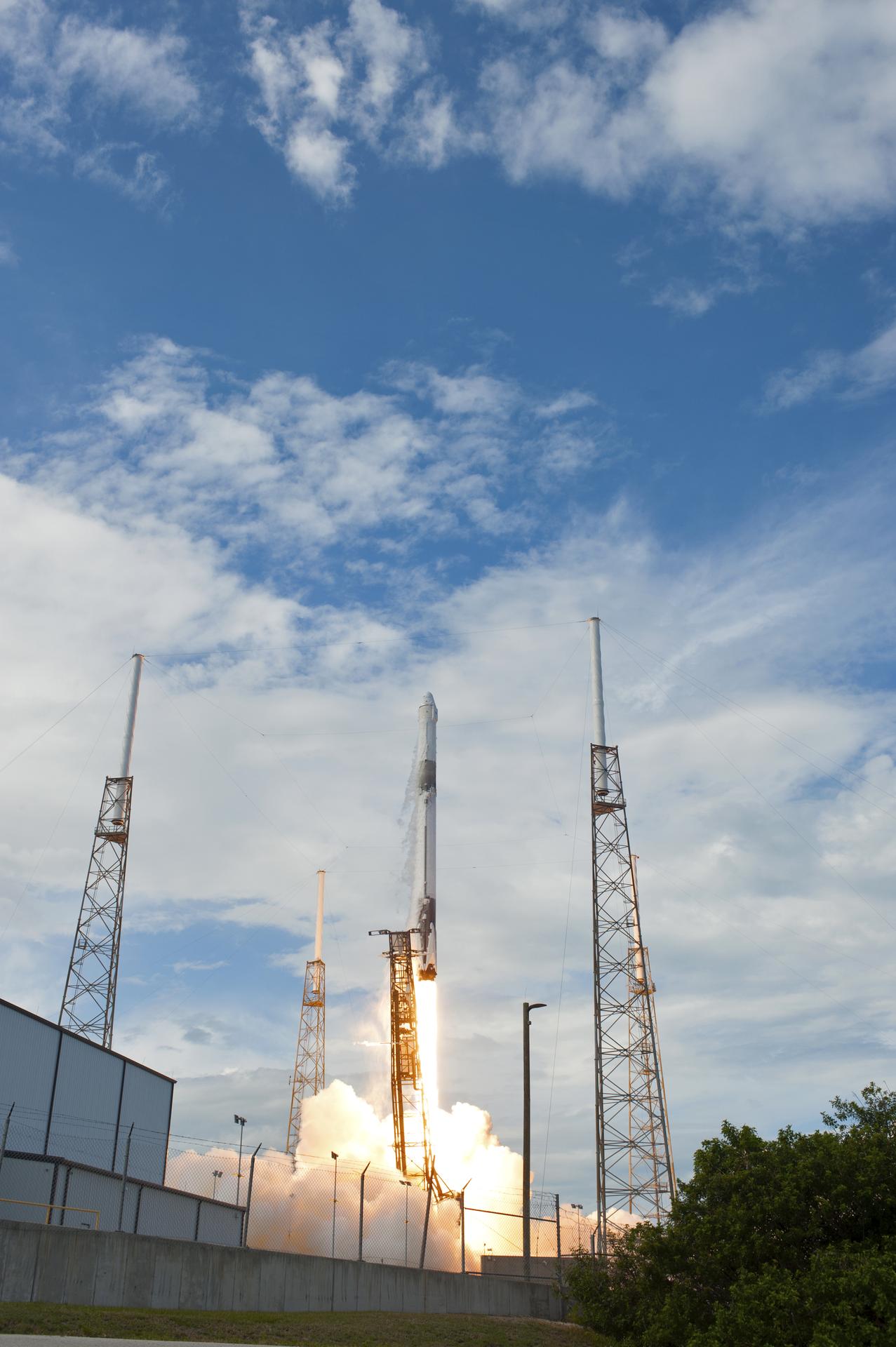
According to NASA, the CRS-35 Dragon lifted off at 6:33 a.m. EDT from Space Launch Complex 40 at Cape Canaveral, carrying more than 6,300 pounds of science and supplies to the station. Spaceflight Now also gives liftoff as 6:33 a.m. EDT (1033 UTC). Some coverage listed other times, but the agency's own release and the on-site reporting agree on 6:33.
The flight went as planned. Spaceflight Now reports that the first-stage booster, B1096, was making its eighth flight and landed back at Landing Zone 40 less than 7.5 minutes after liftoff. The Dragon capsule, designated C211, then separated to start its two-day trip to the station.
That timing is what produced the show. A launch just before dawn means the rocket climbs out of darkness and into sunlight while everyone on the ground is still waiting for sunrise.
So why did it glow?
NASA's Kennedy Space Center gave the short answer in a post on X, quoted by Space.com: "A jellyfish happens near sunrise or sunset when the exhaust plume from the rocket becomes brightly illuminated, creating a glowing shape resembling a jellyfish."
The longer answer has two parts: altitude and air pressure.
Altitude. Before dawn, the Sun is below your horizon, but its light still reaches the highest parts of the atmosphere. EarthSky explains that the exhaust trail expanded and got high enough to be sunlit by the approaching dawn even though the sky below was dark. The result is a bright object against a dark background, which is why it looked like it was glowing on its own.
Air pressure. Near the ground, dense air keeps a rocket's exhaust fairly narrow. Higher up, the air thins out and there is much less to hold the plume together. As Space.com reports, the Falcon 9's expanding engine plume grew substantially wider than the rocket itself as it climbed into thinner, less dense air. That spreading makes the wide, rounded "bell" of the jellyfish.
Put a widening plume high in sunlit air above an observer who is still in darkness, and you get a jellyfish.
The same trick satellites use
If this sounds familiar, it should. EarthSky points out that we see the jellyfish effect for the same reason we can see satellites orbiting Earth before sunrise and after sunset. The Sun's rays are still reaching the highest portions of the atmosphere, lighting the objects there, whether that be a satellite or water vapor. A satellite doesn't make its own light. You see it because it's high enough to catch sunlight while your patch of ground is dark.
For anyone who watches the sky, the practical lesson is the same in both cases. The hour or so around twilight is when high objects are lit and the sky behind them is dark. Satellite spotters use that window, and so does a well-timed launch.
How far away could you see it?
Much farther than most people expected. EarthSky says observers could see the phenomenon from up to 800 miles away, and its readers sent photos from Washington, D.C., Georgia and Tennessee. Space.com collected views from Georgia and from Durham, North Carolina, and said the sight was visible to millions of people along the East Coast.
The reason is the same altitude that put the plume in sunlight. Something very high above the ground stays above the horizon for observers a long way off, and a big sunlit cloud against a dark sky is easy to spot even at a distance. People hundreds of miles from Cape Canaveral, who may not have known a launch was happening, got a clear view.
What's actually on board
The jellyfish was the most visible part of the mission, but the cargo is the reason for it.
The biggest item is hardware for the station's power system. NASA says Dragon is carrying the final pair of ISS Roll-Out Solar Arrays, known as iROSA, and astronauts will install them during a series of spacewalks planned for later this fall. Spaceflight Now reports that the two wings are riding in Dragon's unpressurized trunk. They are the fourth and final pair, and each is capable of providing more than 20 kilowatts of power for more than 10 years. With this delivery, the series of upgraded arrays is complete.
The pressurized cabin carries research. NASA lists hardware to manufacture artificial retinas in microgravity that could help restore vision for patients on Earth, 3D heart tissue models to advance large-scale drug testing on future space missions, and brain organoids that could uncover potential treatment targets for neurodegenerative diseases like Alzheimer's, Parkinson's and multiple sclerosis. Dragon also carries materials to study how a new type of glass is formed in microgravity. These are the kinds of studies that use the microgravity environment of the station.
NASA says Dragon is scheduled to dock autonomously at 11 a.m. EDT on Thursday, Oct. 15, at the space-facing port of the station's Harmony module.
Why It Matters
It's easy to treat a space jellyfish as just a pretty sight, and it is one. But it's also a clear demonstration of how sunlight and altitude work together, something most people never think about. The same geometry that lets you see satellites before sunrise and after sunset lit up a rocket plume along the East Coast on Oct. 13.
Moments like this also show how routine launches have become. A cargo run to the station, with a reused booster landing back next to the pad in under eight minutes, barely makes the news anymore. It took an accident of timing and lighting for millions of people to look up and notice. The mission's actual payload, solar arrays that will add power to the station for years and biology experiments that rely on microgravity, is the reason for the flight.
If you missed this one, it's worth checking launch schedules for flights planned near dawn or dusk. When a rocket climbs out of twilight into sunlight, you may get to see your own jellyfish.
Sources
- NASA Science, Cargo Launch on 35th SpaceX Resupply Mission to Station (NASA)
- SpaceX launches NASA science and cargo to the International Space Station (Spaceflight Now)
- SpaceX rocket launch creates incredible 'space jellyfish' visible throughout US East Coast (Space.com)
- Did you see a strange cloud on the East Coast? (EarthSky)
