
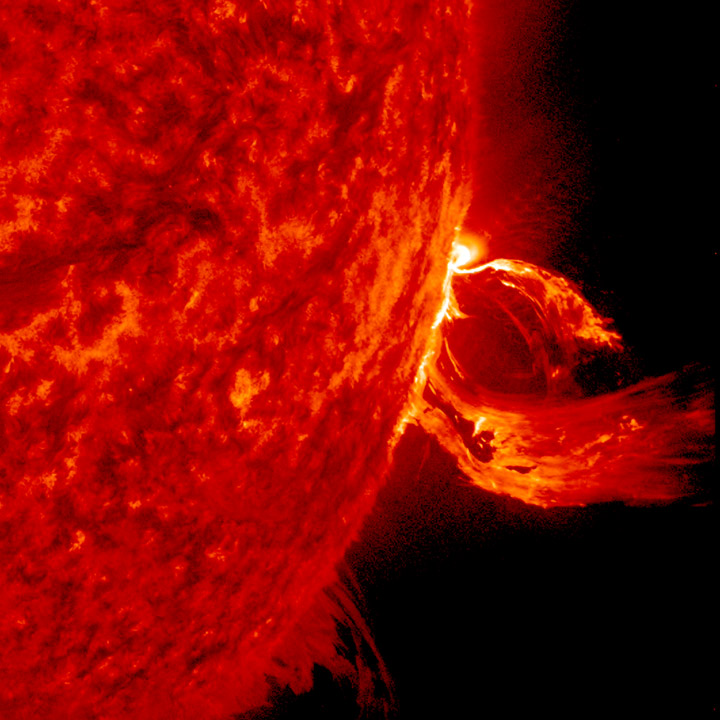
The Earth-facing side of the Sun has gone remarkably quiet. As of NOAA's 0030 UTC update on Oct. 25, only one numbered sunspot group is left on the visible disk, and it is on its way out. It is fair to say the star is close to a spotless day. Yet a slow, sideways-aimed cloud of solar material launched on Oct. 21 is still expected to reach Earth this weekend, and forecasters do not quite agree on how much it will matter. For anyone hoping to see aurora, the useful answer is: some activity is possible at high latitudes, and not much anywhere else.
Here is a look at what the main forecast sources are saying, where they differ, and how to read the gap between them.
One sunspot left, and it is leaving
The NOAA Space Weather Prediction Center forecast discussion issued at 0030 UTC on Oct. 25 lists Region 4560 as the only spotted region on the disk. It sits at N13W72, meaning 13 degrees north of the solar equator and 72 degrees west of the central meridian. That puts it near the Sun's western limb, and solar rotation is carrying it off the visible face. NOAA classifies its magnetic configuration as beta-gamma, which describes a mixed polarity layout that is more complex than a simple bipolar group but NOAA's own wording is a plain beta-gamma, with no delta.
That group was more complicated not long ago. According to EarthSky's Oct. 24 sun news update, AR4560 has lost its delta classification. A delta configuration is the arrangement forecasters watch most closely for strong flares, so its loss is consistent with the overall decline in activity. EarthSky also reports that a neighboring group, AR4557, has rotated onto the far side of the Sun.
The flare count tells the same story. EarthSky tallied just five flares in its most recent reporting window, three C-class and two B-class, compared with 17 the day before. Spaceweather.com listed the largest flare in the 24 hours to its Oct. 24 update as a modest C1 at 0644 UT. The USAF/NOAA Report of Solar-Geophysical Activity issued at 2200Z on Oct. 24 described solar activity as very low.
EarthSky adds a notable detail: a spotless Sun has not been recorded since Sept. 18. With a single group remaining and heading for the limb, the disk could be clear of numbered spots soon, unless new regions emerge or rotate into view from the east. Spaceweather.com still listed a sunspot number of 51 and a 10.7 cm radio flux of 101 solar flux units in its Oct. 24 snapshot, so this is quiet, not dead.
So where does a CME come from?
A quiet disk today does not mean nothing is on the way. Coronal mass ejections take days to cross the gap to Earth, so what arrives this weekend was launched earlier in the week. EarthSky reports that a CME from an Oct. 21 eruption may reach Earth on Oct. 25 as a glancing blow, meaning the bulk of the cloud is aimed away from us and only its flank may brush past.
On top of that, Earth has been sitting in a stream of faster solar wind flowing from a coronal hole, and EarthSky notes that this stream could add to any auroral display. NOAA's discussion, however, shows the wind already easing. NOAA does expect enhanced solar wind on Oct. 25-26 from a small, negative-polarity coronal hole stream and possible glancing CME effects, but over the past day the observed wind speed declined from about 425 km/s to roughly 350 km/s, and the interplanetary magnetic field strength (Bt) stayed below 5 nanotesla without any significant southward turn of its Bz component. Spaceweather.com's snapshot put the solar wind at about 351.1 km/s, in line with NOAA's figure.
That southward Bz detail matters most for aurora. Without a southward-pointing magnetic field in the incoming solar wind, energy couples into Earth's magnetosphere much less efficiently, and a passing CME can arrive without much effect.
Three forecasts, one shrug
This is where the sources part ways, a little.
EarthSky says forecasters expect active geomagnetic levels, around Kp 4, with a chance of a G1 (minor) storm at high latitudes through the weekend into Oct. 26. It notes that the Kp index already reached 4 at 19:53 UTC on Oct. 23.
NOAA's 3-Day Forecast, issued at 0030 UTC on Oct. 25, is more conservative than its own discussion. It puts the greatest expected 3-hour Kp for Oct. 25 through 27 at 4.00, which is below the threshold for NOAA's storm scale. Its stated rationale is blunt: no G1 or greater storms are expected, and no significant transient or recurrent solar wind features are forecast. The NOAA discussion, by contrast, says periods of active conditions with a chance for G1 storming are possible on Oct. 25 from the coronal hole stream and potential glancing CME impacts, with mostly quiet conditions on Oct. 26-27. It also says no new Earth-directed CMEs have been observed.
The USAF/NOAA geophysical report lands in between. It describes the geomagnetic field as quiet over the past 24 hours, with a solar wind peak of 442 km/s at 2139Z on Oct. 23. It expects quiet to active conditions on Oct. 25, quiet to unsettled on Oct. 26, and quiet on Oct. 27.
The gap here is small, the difference between "active, with an outside chance of G1" and "active at most, no G1", and NOAA's own products straddle it. All the views agree on a ceiling near Kp 4. They differ on how much weight to give the glancing CME, that is, whether the glancing CME it is worth counting as a meaningful transient. A glancing blow is hard to model, and a modest or poorly organized magnetic field in the cloud could leave it as a non-event. At the same time, EarthSky notes Kp already touched 4 on Oct. 23, a day with only fast solar wind in the picture.
For a sky-watcher, the practical reading is this: Kp 4 is the level where aurora tends to appear for observers at high latitudes, and the forecasts give no reason to expect displays reaching much farther toward the equator. If you live under the usual auroral zone, it is worth checking the sky on the night of Oct. 25. If you don't, this is probably not your weekend.
Flares and radiation: low odds across the board
Flare probabilities are similarly muted. The USAF/NOAA report puts the chance of an M-class flare at 10 percent per day from Oct. 25 through 27 and the chance of an X-class flare at 1 percent, and EarthSky quotes the same figures. NOAA's 3-day forecast gives a 10 percent chance of R1 to R2 radio blackouts, a 1 percent chance of R3 or greater, and a 1 percent chance of an S1 or greater solar radiation storm.
One number does stand out. NOAA reports that the flux of electrons above 2 MeV at geosynchronous orbit reached high levels, peaking at 3,259 pfu. That matters more to satellite operators than to sky-watchers.
Meanwhile, elsewhere in the sky
Two other notes for stargazers this week. Spaceweather.com reports what it calls "the Orionid drought": counts from the annual Orionid meteor shower stayed below the sporadic background rate even at the Oct. 22-23 peak. If you went out and saw little, you weren't imagining it.
And Venus reached inferior conjunction on Oct. 24, passing between Earth and the Sun. Spaceweather.com puts its closest apparent approach to the Sun at 6.48 degrees at 1400 UTC.
Why It Matters
This weekend is a useful case study in reading space weather forecasts. The headline elements, a CME on its way and a coronal-hole stream, sound dramatic, but the details underneath say otherwise: a glancing geometry, a wind that has already eased, a magnetic field with no southward tilt, and a quiet disk with no new Earth-directed eruptions. Different outlets will round these facts up or down. NOAA's 3-day forecast leaves out a G1 storm, while its forecast discussion and EarthSky both keep a chance of one on the table. All put the realistic peak near Kp 4.
For anyone planning a night out, the takeaway is to set expectations by the Kp number rather than the word "CME," and to treat the forecast as a window rather than a promise. A spotless Sun, if it arrives, would also be the first since Sept. 18, a small but real marker of how variable solar output remains from week to week.
