
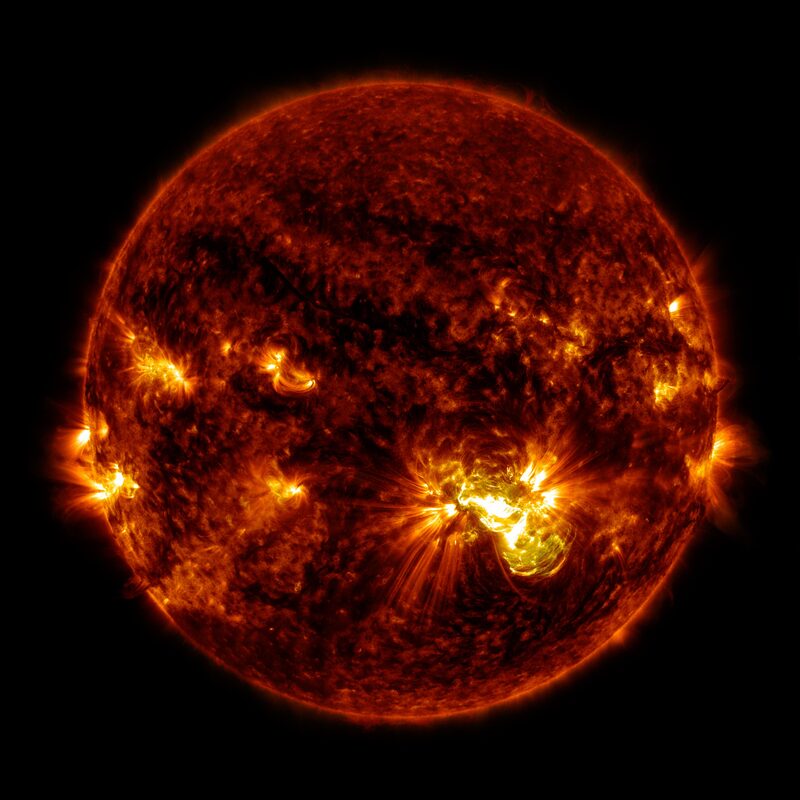
There isn't much on the Sun right now, but one sunspot is making up for it. On Oct. 23, EarthSky counted only two numbered sunspot regions on the Earth-facing disk. One of them, AR4560 in the Sun's northwest quadrant, has been growing since it appeared on Oct. 18 and now has a beta-gamma-delta magnetic classification. That label is the one forecasters watch most closely for flares.
At the same time, two separate streams of solar material may reach Earth around Oct. 24-25. One is wind from a coronal hole. The other is the edge of a coronal mass ejection (CME) launched on Oct. 21. Whether they add up to a geomagnetic storm depends on whose forecast you read. Here is what the data actually show.
A Small Sunspot Count With One Busy Region
The flare record for the past day is busy but not dramatic. EarthSky reports 20 flares between 11 UTC on Oct. 22 and 11 UTC on Oct. 23: eight C-class and 12 B-class. Those are among the weakest classes on the standard scale. AR4560 was the top producer, with 14 of the 20 flares. Its biggest event was a C3.3 flare at 05:42 UTC on Oct. 23, the strongest of the period.
C-class flares rarely affect anything on Earth. What matters is the new magnetic structure. In a delta configuration, opposite magnetic polarities are packed close together inside a single sunspot region, and that kind of tangle is a common setting for stronger flares. EarthSky says the delta gives AR4560 the potential for M-class and even X-class flares, and forecasters hold the chance of an M-class flare at 20% and an X-class flare at 5%. Those odds are real but modest. Most likely, AR4560 keeps producing C flares unless it keeps growing more complex.
The quiet disk also says something about where the solar cycle is. According to SpaceWeather.com, the Sun currently has no spotless-day streak. Still, 2026 has had four spotless days so far, about 2% of the year, compared with none in all of 2025 and none in 2024. Four days is a small number. But spotless days were completely absent in 2024 and 2025, so their return fits a cycle past its peak. For scale, EarthSky notes that August 2024 was the peak month in raw sunspot numbers for Solar Cycle 25, with 216 sunspots.
Two Streams Headed Our Way
Earth's magnetic field has already been a bit unsettled. EarthSky reports that the planetary Kp index reached 4 for a couple of three-hour periods over the past day. NOAA's Space Weather Prediction Center (SWPC) had an extended K-index 4 warning in effect until 03:00 UTC on Oct. 23. The SWPC alerts feed said aurora may be visible at high latitudes, such as Canada and Alaska.
The next disturbance may come from two sources at once. EarthSky says fast wind from a second coronal hole could start arriving on Oct. 24, and that on Oct. 25 it could combine with a glancing blow from the Oct. 21 eruption, bringing unsettled to active conditions with a chance of G1 (minor) storm levels. A CME that only grazes Earth delivers less energy than a direct hit, but it can still disturb the magnetic field, especially when it lands on top of a stream that is already elevated.
NOAA Is More Cautious
NOAA's official outlook is calmer. The SWPC 3-day forecast issued at 00:30 UTC on Oct. 23 puts the highest expected Kp for Oct. 23-25 at 3.67. That falls below the threshold for NOAA's geomagnetic storm scale, and the forecast states that no G1 or stronger storms are expected. The same forecast gives a 5% chance of an S1 solar radiation storm on each of the three days.
The two forecasts don't contradict each other as much as it might seem. EarthSky describes what could happen if the coronal-hole wind and the CME both arrive as expected, with only a chance of G1 levels. NOAA's numbers, issued earlier, show a quieter outlook and say no significant transient or recurrent solar wind features are forecast. Glancing CMEs are hard to time, so the forecast may change. For skywatchers, plan around NOAA's number and treat anything above it as a bonus.
Something Is Already Elevated: Energetic Electrons
One part of near-Earth space weather already crossed an official threshold this week. At 11:47 UTC on Oct. 23, SWPC issued an alert that the GOES-19 satellite measured electron flux above 2 MeV exceeding 1,000 pfu (particle flux units). This alert concerns high-energy electrons in the region where geostationary satellites orbit, not aurora. It is the sort of condition satellite operators track, because energetic electrons can build up charge on spacecraft. You won't see anything from the ground, but it shows the solar wind is already doing work near Earth.
Why It Matters
For most readers, the practical question is whether the aurora will be visible. The honest answer is: probably only far north. NOAA expects Kp to peak just under storm level, and the recent K-index 4 warning pointed to places like Canada and Alaska. If the coronal-hole wind and the Oct. 21 CME combine better than NOAA expects, those high-latitude displays could get stronger. Nothing in the sources reviewed points to a likely aurora at mid-latitudes.
The bigger story is AR4560. It has grown since Oct. 18 and developed its delta configuration on Oct. 23. On a disk with only two numbered regions, it is now the main driver of flare risk, according to EarthSky. A 20% chance of an M-class flare is not a prediction that one will happen, but it is worth watching. AR4560 is in the northwest quadrant, which means solar rotation will carry it toward the western limb over the coming days, so the angle of any eruption relative to Earth will change.
For the longer view, the return of spotless days is a reminder that the cycle is winding down after the August 2024 peak. Even so, a single region can still produce flares and send material toward Earth while the overall cycle declines.
