
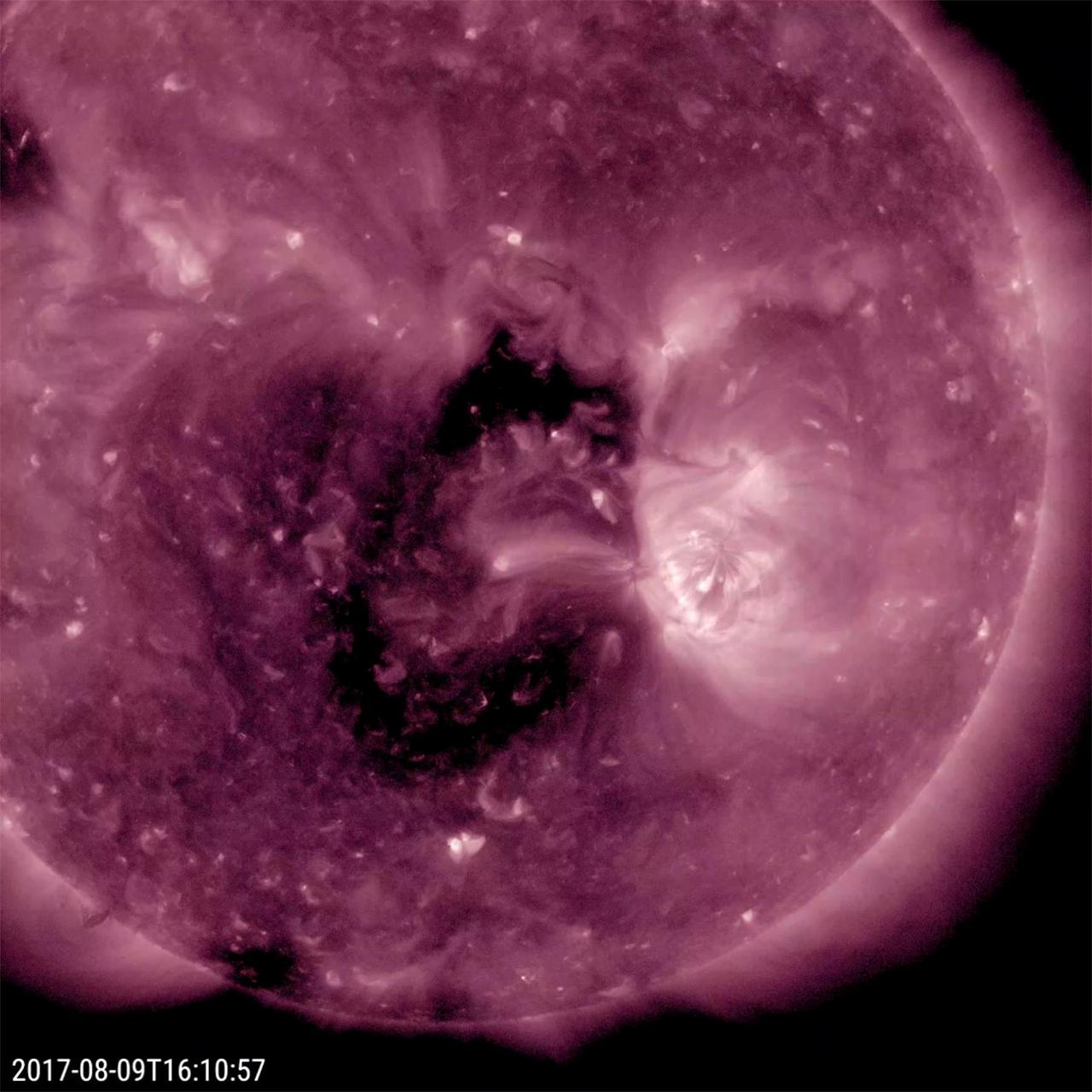
The geomagnetic storm everyone was waiting for did turn up. It just came about a day late. At 23:59 UTC on Oct. 21, the planetary K-index reached 5, which is the threshold for a minor G1 storm on NOAA's scale. EarthSky described the sequence as a Kp 4 surge followed by a Kp 5 surge, and put the crossing a day later than forecast. If you went out to watch for aurora on the night the original forecast pointed to and saw nothing, this is why.
We covered the earlier forecast for this coronal-hole stream when it first appeared. This follow-up covers what the solar wind actually did, and what forecasters expect over the coming week. The short version: one more coronal-hole stream is due around Oct. 24, and a slow coronal mass ejection launched Oct. 21 might clip Earth around Oct. 26 or 27. Forecasters give that second possibility low confidence.
What the Solar Wind Actually Did
The cause was a high-speed stream, meaning faster-than-usual solar wind flowing out of a coronal hole. Coronal holes are regions where the Sun's magnetic field opens out into space instead of looping back down. According to the NOAA Space Weather Prediction Center forecast discussion issued at 00:30 UTC on Oct. 22, solar wind speed peaked near 525 km/s before settling to about 450-460 km/s. The total magnetic field ranged from 7 to 10 nT, and the north-south component, called Bz, was mostly southward, reaching between -5 and -8 nT.
That southward Bz is the part that matters most. A southward-pointing field, which shows up as a negative Bz value, links up much more effectively with Earth's magnetic field and lets energy into the magnetosphere. Values of -5 to -8 nT are modest. Paired with a moderately fast stream, though, they coincided with a storm that reached G1. EarthSky noted that the strongest and steadiest Bz peaks pointed south, and that long southward stretches favor auroral displays. NOAA's 3-day forecast records the greatest observed 3-hour Kp in the prior 24 hours as 5.
Different sources report slightly different numbers. SpaceWeather.com lists the 24-hour maximum as Kp 4.67 rather than the 5 that NOAA and EarthSky report, so the two do not agree on whether the storm threshold was reached. When we read the front page, it showed solar wind at 449.3 km/s, density at 4.5 protons per cubic centimeter, and the current Kp at 3.00. EarthSky likewise said the Kp index had dropped to 3 by the time of its report, so the storm had already eased.
Was There Aurora?
Before the storm peaked, EarthSky showed NOAA's aurora forecast for 14:30 UTC on Oct. 21, with the oval glowing over Alaska and northern Canada. At that hour it was daytime across most of North America, so the display was hidden from most observers there. EarthSky's outlook for Oct. 22 says that after the G1 storm, auroras will likely retreat to the highest latitudes.
Timing counted against many observers. A storm peak only helps you if it happens while your sky is dark. The G1 crossing came at 23:59 UTC, which was early evening on the U.S. East Coast and still afternoon on the Pacific coast. NOAA's forecast then expected further G1 activity in the 06-09 UT window on Oct. 22, with unsettled conditions after that.
What Comes Next: Three Things to Watch
1. Lingering stream effects early Oct. 22
NOAA's 3-day forecast expected G1 levels early on Oct. 22, in the 06-09 UT window, as the current high-speed stream continued. The highest Kp forecast for Oct. 22-24 is 4.67, which NOAA classes as G1.
2. A second coronal hole around Oct. 24
The forecast discussion expects disturbed geomagnetic conditions on Oct. 24, driven by a negative-polarity coronal-hole stream, with unsettled to active conditions. EarthSky puts the possible arrival of this second fast wind at late Oct. 23 or early Oct. 24. NOAA's forecast has Kp climbing to about 4.33 in the 18-21 UT window on Oct. 24. That is just below the G1 threshold of Kp 5, but it is close enough that a minor storm cannot be ruled out.
One detail is easy to miss. SpaceWeather.com's page said there were no significant equatorial coronal holes on the Earth-facing side of the Sun at that moment, while NOAA and EarthSky still expect a second stream. The sources do not reconcile the two, and it is a reminder that these forecasts depend on modeling, and arrival times can shift. This week's late storm showed how much.
3. A slow CME, possibly Oct. 26-27
NOAA's forecasters saw a coronal mass ejection just after 09:00 UTC on Oct. 21. It originated near N28E05, close to the center of the solar disk as seen from Earth. Their modeling of the relatively slow ejecta suggests a weak glancing blow is possible by Oct. 26 or 27, and they explicitly call that low confidence, noting that a bulk of the material should pass well behind Earth's orbit. Treat it as something to keep an eye on, not a date to plan around.
Meanwhile, on the Sun
Flare activity has been steady but restrained. EarthSky counted 11 flares in the previous 24 hours: seven C-class and four B-class. The strongest was a C3.5 from active region 4560 at 3:09 UTC on Oct. 22. NOAA's discussion also lists a C2.1 from the same region at 22:52 UTC on Oct. 21. Region 4560 is at N13W28 and has a beta-gamma magnetic configuration. SpaceWeather.com notes that this kind of field holds enough energy for M-class flares. Elsewhere on the disk, Region 4551 is crossing the west limb and rotating out of view. SpaceWeather.com gave the sunspot number as 66.
NOAA puts the chance of isolated M-class flares through Oct. 24 at 15-20%. Its 3-day forecast gives a 20% chance of R1-R2 radio blackouts on Oct. 22, falling to 15% on Oct. 23 and 24. The chance of R3 or stronger blackouts is 5% on the first day and 1% after that. The chance of an S1 solar radiation storm is 5% each day, though NOAA does not expect one.
Why It Matters
NOAA rated this storm minor, and C-class flares are low-level events. Their value this week is in what they show about how well forecasts work. Coronal-hole streams are comparatively easy to anticipate because the holes can persist, so their effects tend to recur as the Sun rotates. Even so, this one arrived roughly a day off schedule. Forecasters can say fairly reliably which stream is on its way. Pinning down when it will reach Earth, and whether its magnetic field will be pointing south when it does, is still hard.
For skywatchers, the practical advice follows from that. Take forecast dates as a window, not an appointment. Check real-time solar wind and Kp readings before heading out. The Oct. 24 stream and the possible Oct. 26-27 glancing blow are the next two chances, and both carry the same uncertainty about timing.
