
Eclipsing binaries are common enough that astronomers catalog them by the thousands: two stars, one orbit, a periodic dimming as each star ducks behind the other. Eclipsing quadruple systems, where two such binary pairs orbit a shared center of mass, are rarer but not unheard of. What nobody had confirmed until now was a quadruple system in which the pairs themselves eclipse each other — one binary's stars passing in front of the other binary's stars, layered on top of each pair's own internal eclipses.
That geometry has now been caught for the first time, in a system cataloged as TIC 433545934. The discovery, described in a preprint posted August 13, 2026 by Tamás Borkovits, Saul Rappaport, Petr Zasche, and collaborators, combines data from NASA's Transiting Exoplanet Survey Satellite (TESS) with follow-up ground-based observations to reconstruct the full architecture of a system that packs four stars into an unusually tight arrangement.
A "2+2" system, mapped in detail
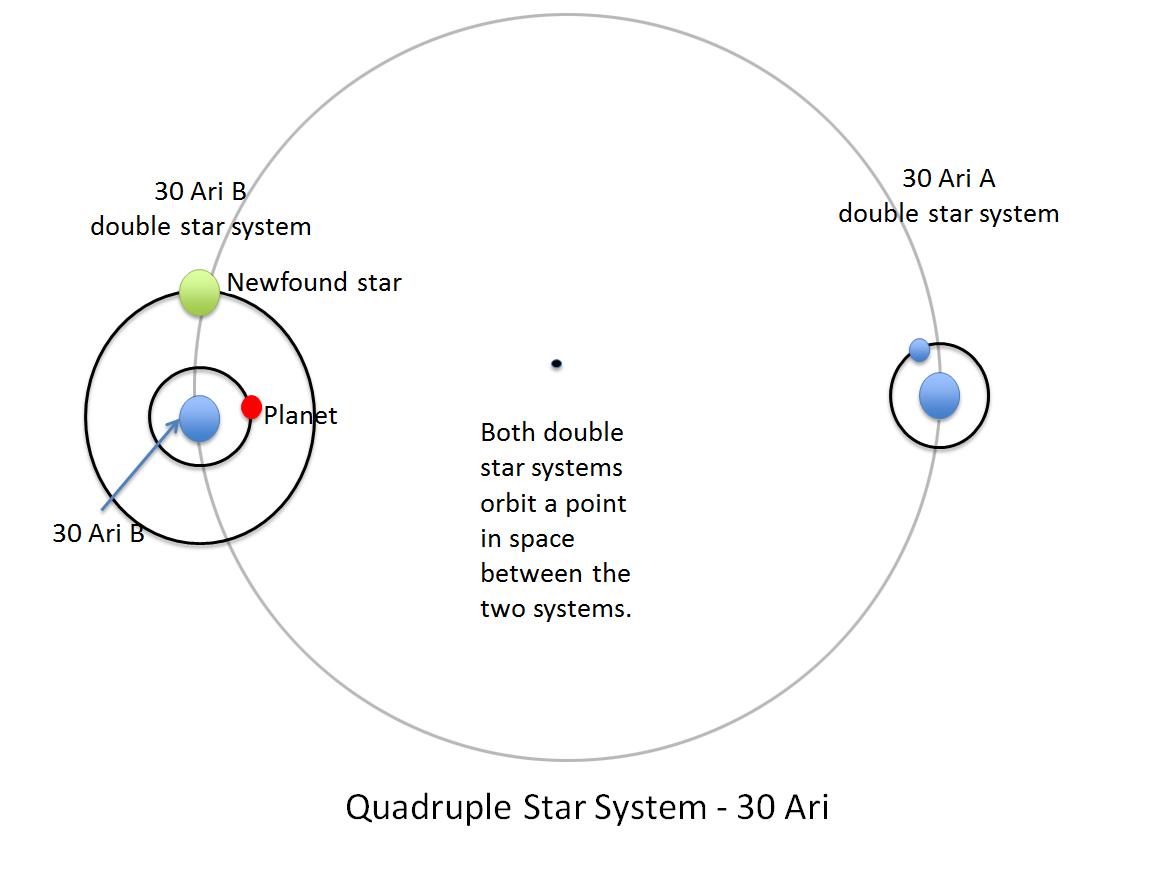
TIC 433545934 belongs to a class astronomers call "2+2" quadruples: two separate binary pairs, each gravitationally bound internally, that also orbit each other as a pair-of-pairs. In this system, the researchers designate the two binaries Pair A and Pair B.
Pair A consists of two late A-type stars of comparable mass, 2.2 to 2.4 times the mass of the Sun, orbiting each other every 2.07 days. Pair B is more lopsided, with stars of roughly 2.4 and 1.3 solar masses circling each other on a tighter, 1.41-day period. The two pairs then orbit each other on a much wider, 224.5-day outer orbit — one that's notably eccentric, with an orbital eccentricity of 0.62, meaning the two binaries swing from relatively close approach to much greater separation and back over each outer cycle.
What makes the system geometrically remarkable is how flat it is. The mutual inclination between the orbital planes of Pair A, Pair B, and the wide outer orbit is less than about 2 degrees — all four stars and both orbits are nearly coplanar. That alignment is what allows the doubly eclipsing behavior to happen at all: because the plane of Pair A's orbit and the plane of the outer orbit are nearly the same, there are times when Pair A, seen from Earth, passes directly in front of the stars of Pair B (or vice versa), producing an eclipse event that has nothing to do with either pair's own internal binary motion.
What "doubly eclipsing" actually means
It helps to separate the three kinds of dimming layered into this system's light curve, as captured by TESS:
- Pair A eclipses: the two A-type stars in Pair A periodically pass in front of each other every 2.07 days.
- Pair B eclipses: the two stars in Pair B do the same on their own 1.41-day clock.
- Mutual eclipses: as the two pairs swing around their shared 224.5-day outer orbit, there are configurations where a star (or stars) from one pair passes in front of a star from the other pair entirely.
That third category is the new piece. Astronomers had previously confirmed 2+2 quadruples with two independently eclipsing pairs, but a system where the pairs themselves also eclipse each other, superimposed on the internal binary eclipses, had not been confirmed before TIC 433545934. Phys.org's August 24 report on the find frames it plainly: this is a four-star system "caught eclipsing itself in a way never seen before."
Untangling which dip in the TESS light curve belongs to which pair, and which belongs to the rarer mutual events, is not trivial — it's the kind of signal-modeling problem that requires combining space-based photometry with ground-based follow-up to pin down each star's mass, period, and orbital geometry independently. That reconstruction is what the Borkovits, Rappaport, and Zasche team did to confirm the system's structure.
An aging, compact system on a countdown
The researchers estimate TIC 433545934 is about 580 million years old — young by stellar standards, but old enough that the system's dynamical evolution is already underway. Their modeling projects that Roche lobe overflow, the point at which one star's outer layers spill onto its companion under gravitational stress, will begin in roughly 152 million years. When that happens, the more massive star in each of the two close pairs is expected to overflow its Roche lobe and transfer mass onto its companion, reshaping the system's structure and evolution going forward.
Coverage of the discovery from IFLScience also situates TIC 433545934 among known compact quadruples more broadly: it ranks as the fifth most compact 2+2 quadruple system yet identified, a measure of just how tightly its four stars and two orbits are packed together relative to other known systems of the same type.
Why It Matters
Multi-star systems are a natural laboratory for testing how stars form and evolve when gravity has more than two bodies to juggle. A compact, nearly coplanar 2+2 quadruple like TIC 433545934 is especially valuable because its tight orbital alignment lets astronomers observe, rather than just infer, the interactions between the two binary pairs — the mutual eclipses provide direct geometric and timing constraints that are otherwise very hard to obtain for systems where the outer orbit is wide or highly inclined.
The system's eccentric, 224.5-day outer orbit combined with two closely spaced inner binaries also makes it a useful test case for dynamical stability models: understanding how such systems remain (relatively) stable, and how they're expected to evolve toward the mass-transfer phase projected in about 152 million years, feeds directly into broader theories of binary and multiple-star evolution, including how systems like this one might eventually produce mergers, mass transfer events, or other endpoints astronomers care about when modeling stellar populations. It's also a reminder of what long-baseline, high-precision photometric surveys like TESS are for: finding the rare configurations that don't show up in smaller or shorter datasets, and that reshape the catalog of what's dynamically possible among multiple star systems.
