
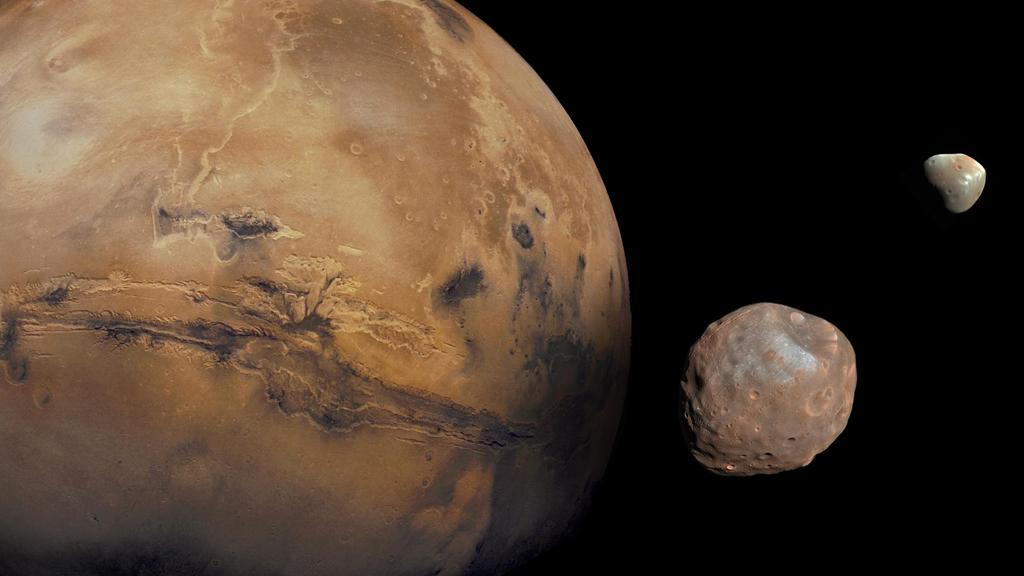
After a two-year slip, Japan's mission to bring home a piece of a Martian moon is close to launch. JAXA's Martian Moons eXploration spacecraft, called MMX, is scheduled to lift off aboard H3 flight No. 10 from the Yoshinobu Launch Complex at Tanegashima Space Center. Space.com reports the target time as 3:41 p.m. EDT on Monday, Oct. 19 (1941 GMT). In Japan that is 4:41 a.m. on Tuesday, Oct. 20. The launch window runs through Nov. 7.
On Oct. 8, NASA announced a media teleconference for 4 p.m. EDT on Thursday, Oct. 15, to explain what the United States is contributing. That turns out to be a lot: a science instrument, the mechanism that actually grabs the sample, and communications and navigation support.
The plan, in brief
MMX's targets are Mars' two small moons. Phobos is about 14 miles (22 km) across and Deimos about 7.5 miles (12 km), according to Space.com. The mission's centerpiece is a sample return: the spacecraft is meant to collect about 10 grams of material from Phobos and bring it back to Earth.
NASA gives this timeline:
- Launch: Oct. 19 EDT (Oct. 20 JST) from Tanegashima
- Arrival at Mars: August 2027
- Phobos sample collection: no earlier than December 2028
- Sample delivery to Earth: 2031
Space.com's account of the return leg is a little different. It says the samples leave Mars orbit in 2030 and arrive about a year later. The two versions don't clash: a 2030 departure followed by a year-long cruise ends in 2031, the delivery year NASA gives. "No earlier than December 2028" is the key phrase for the sampling date. It is a floor, not a promise, and it leaves the team room to study Phobos before committing to a touchdown.
JAXA's own August launch-schedule announcement notes that the launch time may change within the reserved launch period. That's standard wording, but worth remembering for a new rocket on only its tenth flight.
What the U.S. is putting on board
NASA lists three hardware and operations contributions, plus funding for U.S. members of the science team.
MEGANE. This is a gamma-ray and neutron spectrometer built by the Johns Hopkins Applied Physics Laboratory, with David Lawrence as principal investigator. Instruments like this measure the radiation coming off a body's surface to work out what it is made of. NASA says the spacecraft will survey Phobos in detail before it collects its sample.
The sampler mechanism. The surface sampler comes from Honeybee Robotics, now part of Blue Origin, and NASA lists Kris Zacny, vice president of Blue Origin's Honeybee Robotics, among the briefing participants. NASA describes it as a pneumatic sampler. The sample return depends on this part. Every other step can go perfectly, but without a working sampler there is nothing to bring home.
Communications and navigation. NASA is also providing communications and navigation support, the less visible work of tracking a spacecraft and talking to it between Earth and Mars.
NASA says Lindsay Hays and Tom Statler are among the speakers at the Oct. 15 teleconference.
A rover on a moon
MMX also carries IDEFIX, a 55-pound (25 kg) French-German rover, according to Space.com. That makes this a joint effort with Europe as well as the United States. It also means the mission plans to operate on the surface of Phobos, not just pass over it.
Why the delay
MMX was first supposed to launch in 2024. Space.com reports that the date slipped because of problems with the H3 rocket. A flagship planetary mission doesn't fly on a rocket the agency doesn't trust, so the Oct. 19 date suggests confidence in the H3, at least on paper. The real test comes when the countdown hits zero.
Timing matters for any Mars mission because launch opportunities are tied to the planets' positions. Space.com says Mars and Earth align properly for interplanetary launches just once every 26 months, which is why the slip was significant. It gives the trip to Mars as about a year, and NASA's August 2027 arrival date fits that. The reserved launch period runs through Nov. 7, which gives the team room if the launch has to move.
Why It Matters
Sample return is the gold standard of planetary science. Instruments in orbit and on the surface can learn a great deal. But a few grams of real material in an Earth lab can be tested with equipment far too large, too delicate, or not yet invented to fly on a spacecraft. Labs can also keep studying the material for decades as techniques improve.
Phobos is a good target for that kind of study. MMX will also observe Deimos, but the sample is to come from Phobos. Bringing back about 10 grams from it is a chance to test ideas about where Mars' moons came from. Remote-sensing data such as MEGANE's could help put the samples in context.
The mission is also a model for splitting up work across nations. Japan leads, the United States supplies the instrument, the sampler and communications and navigation support, and France and Germany provide the rover. If the sampler works and the samples reach Earth in 2031, the payoff will be shared among all the partners.
First, though, the H3 has to get MMX off the ground. NASA's teleconference on Oct. 15 comes just four days before the launch date.