
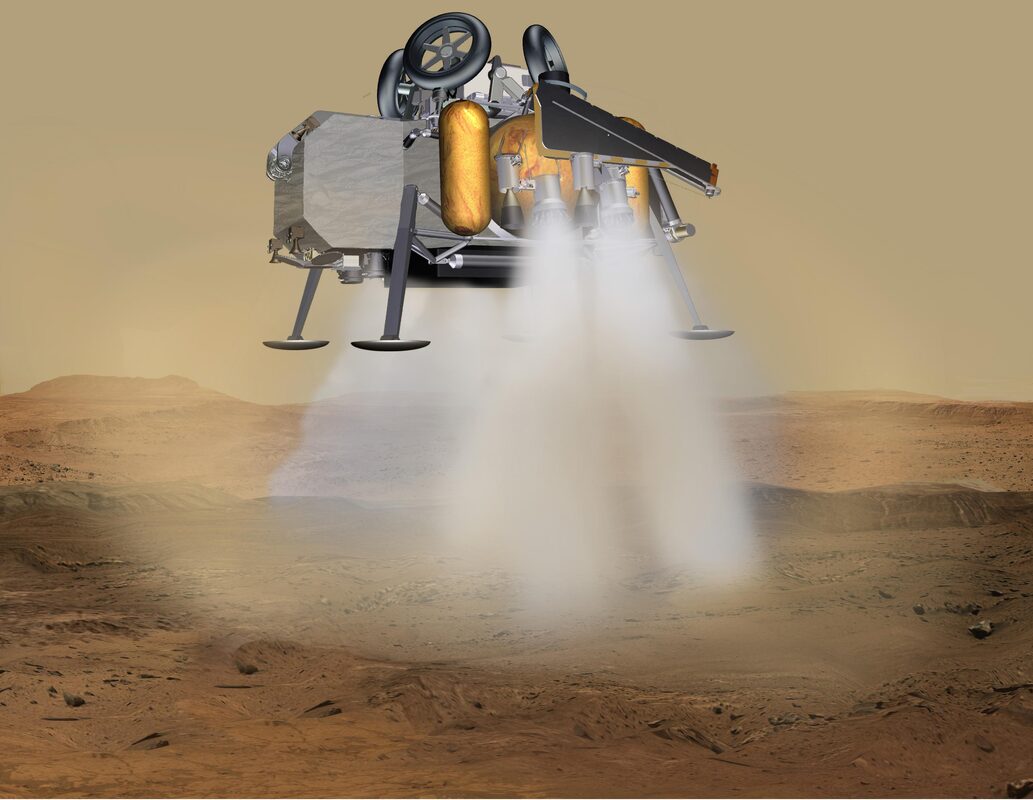
Picking a place to land on Mars is a negotiation between two things that rarely agree: where the science is best, and where the spacecraft can actually survive touchdown. China's Tianwen-3 mission — the country's first attempt to bring physical samples of the Red Planet back to Earth — has just moved a step further through that negotiation, trimming its list of candidate landing sites from 19 down to eight.
The mission's chief scientist, Hou Zengqian, an academician with the Chinese Academy of Sciences, laid out the selection process on China's official government news portal earlier this year. The search began with more than 80 candidate sites across Mars. Engineering constraints alone did most of the early culling: any site has to fall between 17 and 30 degrees north latitude, a band that balances the thermal environment, solar power availability, and the entry, descent and landing physics the spacecraft can handle. That requirement alone knocked the list down from 80-plus to 19.
According to reporting from Daily Galaxy, the current eight finalists were drawn from three broader candidate regions: Amazonis Planitia, Chryse Planitia, and Utopia Planitia — the same region where China's Zhurong rover touched down in 2021. All three are lowland plains with geological evidence of past standing water — sedimentary deposits that, on Earth, are exactly the kind of environment where microbial life leaves traces that persist for billions of years. That's the scientific logic driving the whole search: Tianwen-3 isn't just collecting rocks, it's trying to collect the *right* rocks — ones deposited in a setting where ancient biosignatures, if they ever existed, would have had a chance to be preserved.
How the Selection Timeline Works
Hou said three finalists will be chosen from the current shortlist by the end of 2026, as the mission's spacecraft hardware advances from design into flight-hardware development ahead of the launch window that opens in late 2028. That's not a lot of runway. The landing-site decision needs to be locked in with enough lead time to finalize entry trajectories, heat-shield design, and the terrain-relative navigation software the lander will use to avoid rocks and slopes in real time.
Once launched, the mission profile calls for roughly seven to eight months of transit to Mars, then about one year of surface operations. Tianwen-3 carries no rover; instead, a drone will range within several hundred meters of the landing site to gather surface material, while a drill bores up to two meters into the subsurface — the first time any international Mars mission has attempted drilling to that depth — and the collected samples are sealed and staged for ascent. The target haul is at least 500 grams of Martian material.
From there, an ascent vehicle would lift the sealed samples off the Martian surface, rendezvous with a return spacecraft, and begin the trip home. China's stated target is to have the samples back on Earth by around 2031 — three years after launch, a notably tight round-trip compared to the multi-mission, multi-decade architecture NASA and ESA have pursued for their own Mars Sample Return effort, which has been beset by cost overruns and schedule slips.
A Different Approach Than NASA's
It's worth pausing on that contrast, because it's the backdrop against which Tianwen-3 is being read internationally. The NASA/ESA Mars Sample Return concept, as originally conceived, split the job across multiple spacecraft: the Perseverance rover to cache samples (already happening, at Jezero Crater), a lander to retrieve them, a small rocket to launch them into Mars orbit, and an orbiter to catch them and fly them home. That complexity is precisely why the American program has struggled — every additional spacecraft is another point of failure and another line item.
Tianwen-3 still requires two separate launches — one for the lander and one for the orbiter that will rendezvous with the ascent vehicle in Mars orbit — but, as described in China's own mission briefings, it skips the rover-driven fetch step entirely: the ascent vehicle lifts off from the same spot where the lander touched down, rather than depending on a rover to drive samples to a separate rendezvous point first. If China hits its 2028 launch and 2031 return targets, it would put samples of Mars in a laboratory on Earth years before NASA's program is currently projected to manage the feat — a gap that has not gone unnoticed among planetary scientists watching both programs.
Why It Matters
Every rover that has driven across Mars — Curiosity, Perseverance, and China's own Zhurong — has had to interpret the planet's history through instruments carried on board: cameras, spectrometers, ground-penetrating radar. Those tools are good, but they're not a substitute for getting Martian material into a real laboratory, where mass spectrometers, electron microscopes, and isotope analyzers built without the mass and power constraints of a spacecraft can be brought to bear. Sample return has been called the single highest-priority goal in planetary science for exactly this reason: it's the difference between studying a rock through a keyhole and holding it in your hand.
The stakes are compounded by the biosignature question. If Tianwen-3's landing site does preserve evidence of ancient microbial life — or definitively shows no such evidence in material where it should have survived if life existed — that result would reshape one of the oldest open questions in planetary science, independent of which country's flag is on the return capsule. And if China's samples arrive on Earth before NASA's, it would make China the first nation to return material from the Martian surface — a milestone the United States has pursued far longer but, so far, has not achieved, with real consequences for how the international planetary science community accesses and studies that material in the years that follow.
None of that is settled yet. Three of the eight sites still have to be chosen, hardware still has to move from prototype to flight-ready, and Mars missions have a long history of humbling well-laid schedules. But the funnel from 80 sites to 19 to eight is a concrete sign that Tianwen-3 is no longer a concept on paper — it's a mission actively deciding where, specifically, it plans to dig.
