
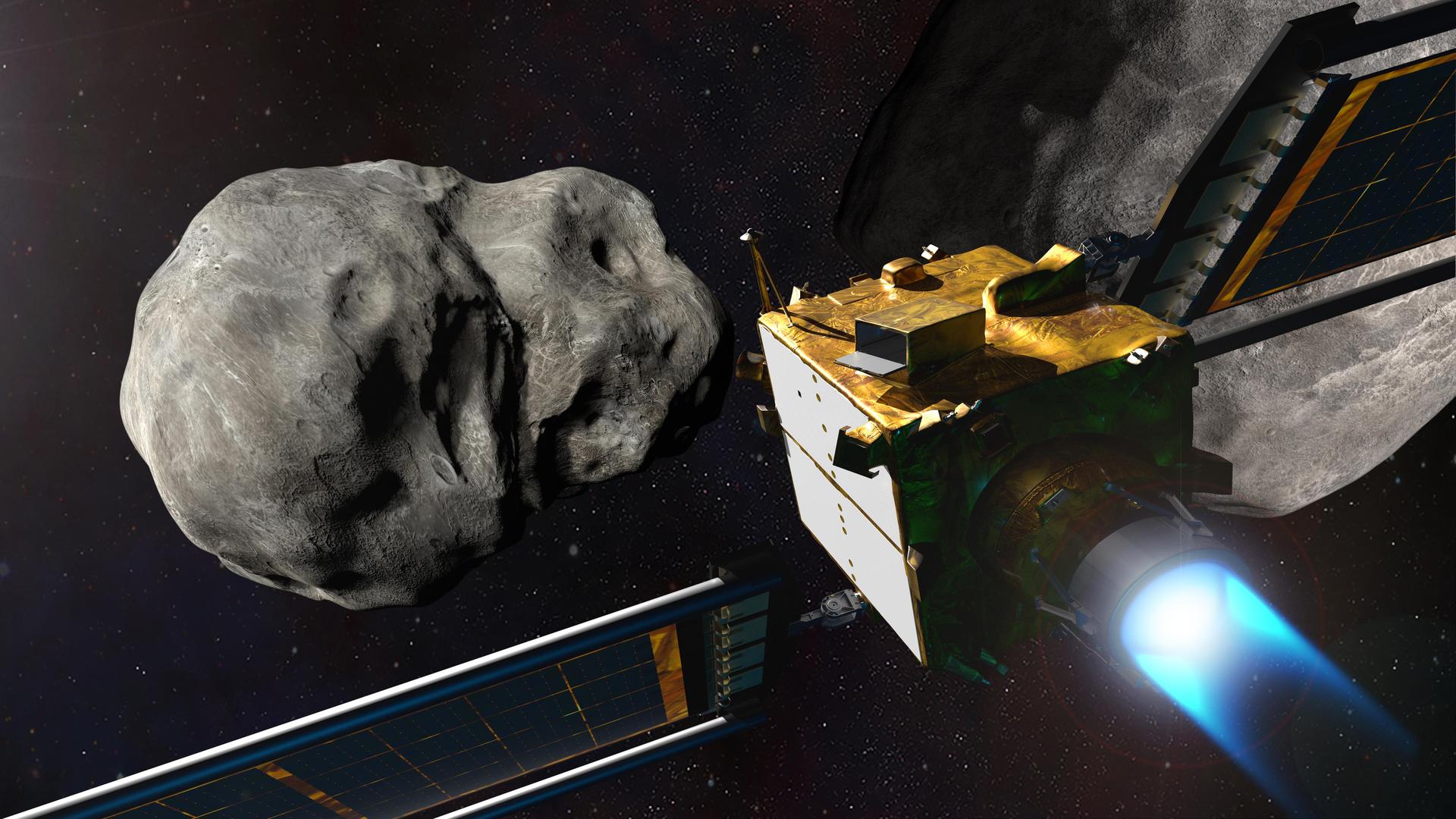
Exactly two years after it left Cape Canaveral, ESA's Hera spacecraft has seen where it is going. On Oct. 7, 2026, the mission's second launch anniversary, ESA released Hera's first detection of the Didymos binary asteroid system. The image isn't much to look at. Didymos is smaller than a single pixel, a faint point against the stars. Even so, it comes as Hera prepares for what ESA calls its most challenging activity since lift-off: sustained braking burns meant to take a spacecraft moving at interplanetary speed and leave it almost at rest beside a pair of small asteroids.
Hera launched on Oct. 7, 2024, just ahead of Hurricane Milton. According to ESA, it is now moving at more than 12 km/s relative to Earth. Arriving at Didymos means getting rid of most of the speed it has relative to the asteroids, and the agency has set out how it plans to do that over the rest of October.
A Sub-Pixel Sighting
At the time of the detection, Hera was about 236,500 km from its target. From that distance, the 780-meter Didymos and its 150-meter moonlet Dimorphos can't be resolved. ESA says the team combined multiple images and ran a photometric analysis to pull the system out of the star field. Didymos fills less than one pixel, but it is bright enough for the camera to detect, so for now Hera's destination appears as little more than a single bright point.
That point of light matters for more than the anniversary. ESA says that from now on, Hera's destination is no longer just a calculated point in space: Hera can see it. The spacecraft will have to travel much closer before its cameras can resolve the two asteroids separately.
The Braking Campaign, Step by Step
Arrival is split into two braking manoeuvres followed by a set of smaller transition burns. Here is the sequence as ESA describes it.
BRM-1, Oct. 15. For the first braking manoeuvre, Hera rotates so that its ring of Orbit Control Thrusters points toward the Didymos system. Three hydrazine-based thrusters then fire together and continuously for a total of 93 minutes. ESA says the burn will cut Hera's velocity relative to the asteroids by a few hundred meters per second. EarthSky, quoting ESA, gives the same figure of three thrusters igniting at once for a total of 93 minutes. ESA adds that the flying is tricky, because Hera's Reaction Control Thrusters also have to help maintain the spacecraft's attitude. Mission controllers ran a brief test burn on Oct. 2 ahead of the main event.
Confirmation. As soon as possible after the burn ends, the team will acquire Hera's signal through one of ESA's two 35-meter deep space antennas at New Norcia, Australia. ESA flight dynamics engineer Francesco Castellini describes two sources of evidence on whether the direction and magnitude of the braking matched the anticipated change in velocity, or delta-v. The first is the output of the spacecraft's guidance, navigation and control sensors, received via telemetry. The second is ranging and Doppler data embedded in the signal itself.
BRM-2, Oct. 22. After a few days of checks and calculations, the command sequence for a second, shorter braking manoeuvre will be uplinked for execution on the early morning of Thursday, Oct. 22. The burn lasts approximately 31 minutes. ESA says it should complete most of the delta-v required to match the velocity of the Didymos system, and that it will also compensate for any underperformance in BRM-1.
Transition manoeuvres, late October. Towards the end of the month, three smaller transition manoeuvres will reduce Hera's velocity relative to Didymos to near zero. EarthSky says Hera should then reach the system in November.
What Hera Is Going There to Do
Didymos is not a randomly chosen rock. In September 2022, NASA's DART spacecraft deliberately crashed into Dimorphos and changed its orbit around Didymos. ESA describes it as demonstrating asteroid deflection for the first time.
Hera's job is to follow up. ESA says the spacecraft will perform a close-up investigation of the impact site and measure in detail how Dimorphos responded to the collision. According to EarthSky, Hera should reach the system in November 2026 and then spend about six months studying the aftermath.
Hera also carries two passengers. EarthSky reports that the spacecraft will release two cubesats. Milani will make spectral observations of the asteroids' surfaces. Juventas will take the first radar soundings of the interior of an asteroid.
The target is useful scientifically in another way too. EarthSky notes that about 15% of known asteroids are binary systems whose origins remain mysterious. Hera will determine whether Dimorphos and Didymos are made from the same material, which would hint that the rapidly spinning Didymos once threw off debris that later formed Dimorphos.
Why It Matters
A single kinetic impactor test is a striking result, but one experiment is not yet a settled planetary defence technique. According to EarthSky, Hera will measure the density and composition of Dimorphos in detail, helping scientists determine whether it is a rubble pile loosely held together by gravity or a solid core covered in boulders and gravel. It will also map the crater DART created down to 10-centimeter resolution to show how the surface material responded to the collision. EarthSky notes it is possible there is no crater at all, and that the impact reshaped the entire asteroid.
ESA says these measurements will help turn the DART impact experiment into a well-understood and potentially repeatable planetary defence technique. Knowing what Dimorphos is made of and how its surface responded is the kind of detail that would bear on how any future deflection is planned.
None of that happens unless the October burns go as planned. A spacecraft travelling at more than 12 km/s relative to Earth has to finish its approach almost stationary beside a 780-meter asteroid and its 150-meter moon. The sub-pixel image released on the anniversary shows the target is in view. The 93-minute burn on Oct. 15 begins the work of actually slowing down to meet it.
