
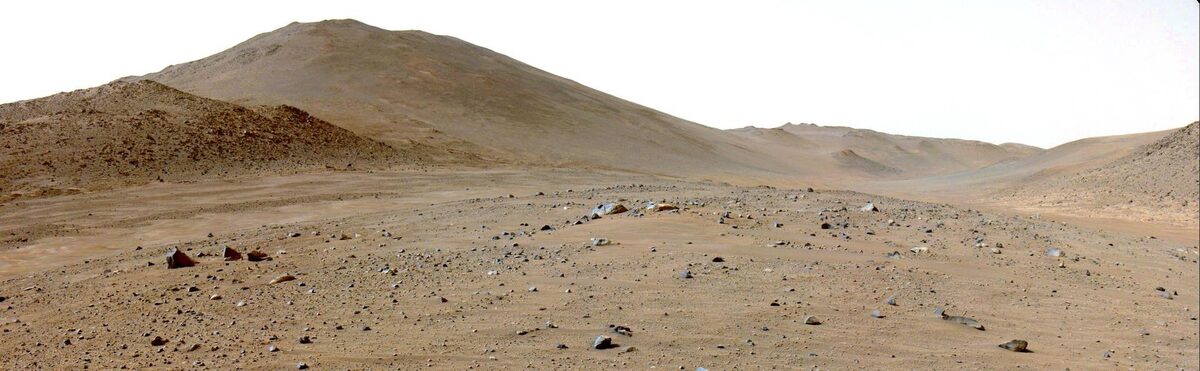
Some of the brightest rocks Perseverance has found have turned out to be something other than what they first seemed. In a mission blog post published November 16, Purdue University's Candice Bedford reports that newly downlinked data from the rover's SuperCam instrument show that light-toned rocks at a site called Idubi are not igneous. They are rich in hydrated silica.
That distinction matters. Igneous rock records cooling magma. Hydrated silica records water, and the NASA post calls it remarkable for its capacity to preserve microfossils.
The result has so far appeared only in the NASA blog. It has not been published in a peer-reviewed paper, and the team has not yet released detailed compositional numbers. Treat it as a strong first look from the people running the instruments, not a final word.
Where Idubi Sits
Idubi is an area of ancient crust in a region the team calls Lac de Charmes, outside Jezero crater. An earlier mission update, republished by Mirage News, described Lac de Charmes as a "wild west frontier" of valleys and ridges west of Jezero's rim. Its rocks are among the oldest Perseverance has encountered. They formed while Mars was still a young planet bombarded by asteroid impacts, long before the sedimentary rocks inside Jezero formed in rivers and lakes. The rover has spent 2026 working through this terrain.
So these are not the lake and delta deposits that made Jezero the landing site in the first place. They are older rocks, and they carry a record of whatever was happening on early Mars before the lake sediments existed.
From Gabbro to Silica
The light-toned rocks were not always expected to tell a water story. An October update, reposted by Astrobiology.com, described how Perseverance found a vast field of light-toned rocks after about six months in Lac de Charmes. At that point, data indicated that many of them were gabbro, a coarse-grained igneous rock dominated by minerals rich in iron and magnesium. A nearby patch of possible bedrock looked like breccia, a jumble of light and dark angular fragments. The team was investigating whether the light-toned boulders had eroded out of that breccia, and whether impacts might have dug up the blocks.
The September Mirage News update places the hundreds of light-toned boulders at Idubi. It also reports that an abrasion patch on one boulder, named "Badger Peak," showed a light-and-dark texture unlike any the rover had seen before, and that an attempt to sample that boulder failed because the rock was too hard.
The new Bedford post describes the Idubi rocks as brighter than both the igneous rocks and the impactites (rocks formed in the aftermath of an impact) the rover had examined earlier. With the latest SuperCam data on the ground, the team says the light-toned rocks are not igneous in origin.
The public posts do not say how much of the boulder field shares the silica-rich composition, or how the silica relates to the breccia outcrop. That is the sort of question a closer investigation should answer. For now, the record shows a working hypothesis from early data being revised as better measurements came in. That is how it is supposed to work.
What Hydrated Silica Tells You
According to the NASA post, hydrated silica can form in many aqueous environments on Earth, including three named in the post:
- Hydrothermal systems, where heated water circulates through rock.
- Pedogenic settings, meaning soil-forming processes.
- Groundwater systems, where water moves through rock below the surface.
Each would mean something different for the history of early Mars, and the post says several of these environments could have been capable of supporting life. Telling them apart is a large part of what the rover now has to do. The blog post does not say which setting the team favors.
The astrobiology connection is the main reason for the excitement. The NASA post notes that hydrated silica has a remarkable capacity to preserve microfossils, and calls such deposits prime targets for understanding Mars' hydrological history. It asks whether these pale remnants of an ancient Martian water system could hold signs of ancient life. That question is open.
Why Size Changes Everything
This is not the first silica Perseverance has seen. According to Bedford's post, the rover previously encountered silica-rich rocks on the inner rim of Jezero crater. Those deposits were too small to deploy proximity science instruments and gather the high-resolution chemical and mineralogical data needed to constrain their origin and biosignature preservation potential.
Idubi is different because of its scale. The post says the rocks offer a much more promising scale, and a detailed proximity science campaign is already underway. Remote measurements from SuperCam can identify a material from a distance. The close-up data are what make it possible to constrain how a deposit formed and whether it could preserve biosignatures.
Why It Matters
Perseverance's broader job is to understand Mars's past habitability and to look for rocks that could hold signs of ancient life. A large, accessible deposit of hydrated silica in some of the oldest rock the rover has encountered is a promising target for that work.
It also adds water to the story of a region where investigations had so far suggested mostly igneous and impact-related rocks. Lac de Charmes rocks formed long before the sedimentary rocks inside Jezero. If water deposited this silica, aqueous systems may have been active on Mars at an early stage, though the posts do not yet say when the silica formed.
The caveats are the usual ones and they are real. The finding comes from a mission blog, not a peer-reviewed study. The formation setting is still open. Hydrated silica that is good at preserving microfossils is not evidence that any microfossils are there. What the team has is a bright, water-related rock big enough to study properly, and the rover is already studying it.
