
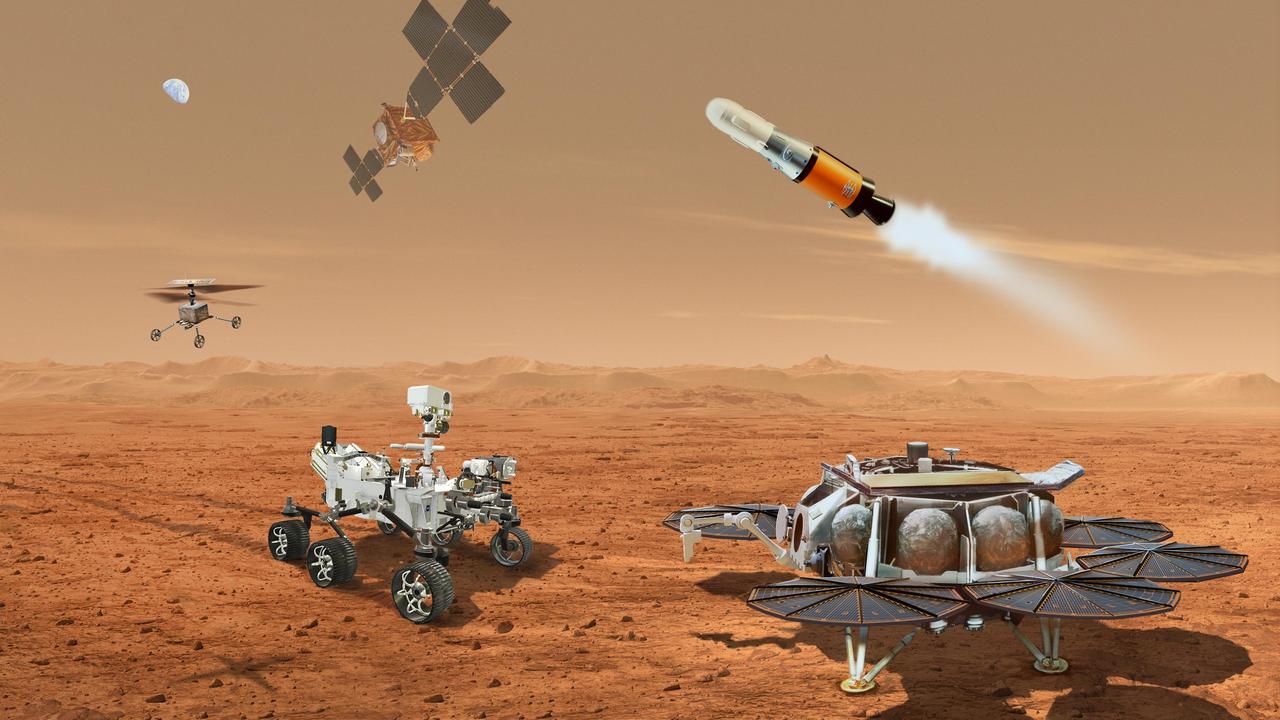
Perseverance has spent more than five years exploring Jezero Crater on Mars, collecting rock samples and sealing them in tubes. The plan was always that someone would come and collect them. That plan now has a new name and a much more modest starting point.
On November 9, 2026, Tiffany Morgan, director of NASA's Mars Exploration Program, told a virtual meeting of the Mars Exploration Program Analysis Group (MEPAG) about a new effort called the Perseverance Sample Retrieval Architecture, or PSRA. Space.com and EarthSky both reported it. PSRA isn't a mission yet. It's a study meant to work out what a mission should look like after the last one collapsed under its own price tag.
What PSRA actually is
As Morgan described it, PSRA will produce impartial recommendations for retrieving the Perseverance samples. The work has four parts: assess the mission requirements, review lessons learned, evaluate current capabilities, and look at acquisition options. EarthSky described it as a framework that an actual mission could later be built on.
The team doing this work is small. A NASA spokesperson told SpacePolicyOnline that it will be an internal team staffed through three year-long detail opportunities for NASA civil servants. The schedule matches that scale. Morgan said the strategy team will start in January 2027 and deliver a final report in winter 2027-2028. SpacePolicyOnline separately reports that George Tahu, NASA's Program Executive for Mars Exploration, gave a similar timeline: kickoff in January, followed by a year of work.
That means the agency's formal answer to how it gets the samples home is still about a year or more away. Even then, it will be a recommendation, not a funded program.
How the old plan fell apart
Mars Sample Return, or MSR, was supposed to be the second half of Perseverance's mission. NASA's own mission page now describes it in the past tense, as "a plan for an ambitious, multi-mission campaign" and "a proposed multi-mission campaign by NASA and ESA" to bring the samples to Earth. In that design, a Sample Retrieval Lander would have touched down near Perseverance's landing site in Jezero Crater, with the European Space Agency as a partner.
The problem was cost and schedule. According to Space.com, the estimate reached about $11 billion, with samples possibly not returning until 2040, and NASA judged that too expensive. SpacePolicyOnline also cites the $11 billion figure and notes that the FY2026 budget request called for cancelling the program outright. EarthSky summed it up: costs kept growing and the timeline stretched too far.
One number in the record matters for what comes next. Space.com reports that a separate appraisal found the samples could come back as early as 2035 for about $8 billion. That's still a lot of money. But it suggests the $11 billion, 2040 version wasn't the only way to do the job, and that how NASA structures and buys the mission may matter as much as the engineering.
Congress kept a door open
Cancellation in the budget request did not end Mars planning. SpacePolicyOnline reports that Congress provided $110 million for Mars Future Missions. SpacePolicyOnline notes the money was not designated specifically for Mars Sample Return, so it is not a return-mission budget, but it leaves room for the agency to keep working on Mars plans while it decides what it can afford.
There's also support at the top of the agency. SpacePolicyOnline notes that NASA Administrator Jared Isaacman has said several times that returning the samples would be one of the most important scientific achievements in history. That's strong language for a project the administration's budget request proposed cancelling, and it helps explain why PSRA exists at all.
Why It Matters
The samples are the reason all of this matters. Perseverance landed in Jezero Crater in February 2021, and EarthSky notes that some of the material it has collected may contain evidence of ancient microbial life on Mars. Space.com describes the goal as rigorous inspection on Earth with state-of-the-art equipment, which is the kind of analysis a rover cannot do on its own.
Until the tubes are retrieved, that evidence stays on the Martian surface, out of reach of the tools that could confirm or rule out what it might hold. Every year of delay is another year that one of planetary science's biggest open questions stays open.
China adds another kind of pressure. SpacePolicyOnline reports that China plans to launch Tianwen-3 to Mars in 2028 and return samples to Earth in 2031, which is the competitive backdrop for any US decision. If NASA takes a long time to decide, China may be first to bring Mars rock back to Earth. That's partly a matter of prestige, but whoever returns samples first also gets the first direct look at the material.
PSRA's design reflects the lessons of MSR. Instead of committing to a large architecture first and then watching its cost grow, NASA is starting with a small team asking basic questions: what the mission actually needs, what went wrong last time, what capabilities exist now, and how the hardware could be bought. The "acquisition options" item deserves attention. The gap between the $11 billion estimate and the $8 billion one suggests that contracting approach, not just spacecraft design, may decide whether this happens.
What to watch
Three things are worth tracking. First, whether the strategy team starts on schedule in January 2027. Second, whether its winter 2027-2028 report points to an architecture that clearly costs less than $11 billion and returns samples sooner than 2040. Third, whether Congress backs a concrete plan with funding aimed specifically at sample return.
In the meantime, the samples are still sealed in their tubes on Mars. NASA's mission page still describes the hardware meant to collect them, but it no longer describes a plan to fly it.
