
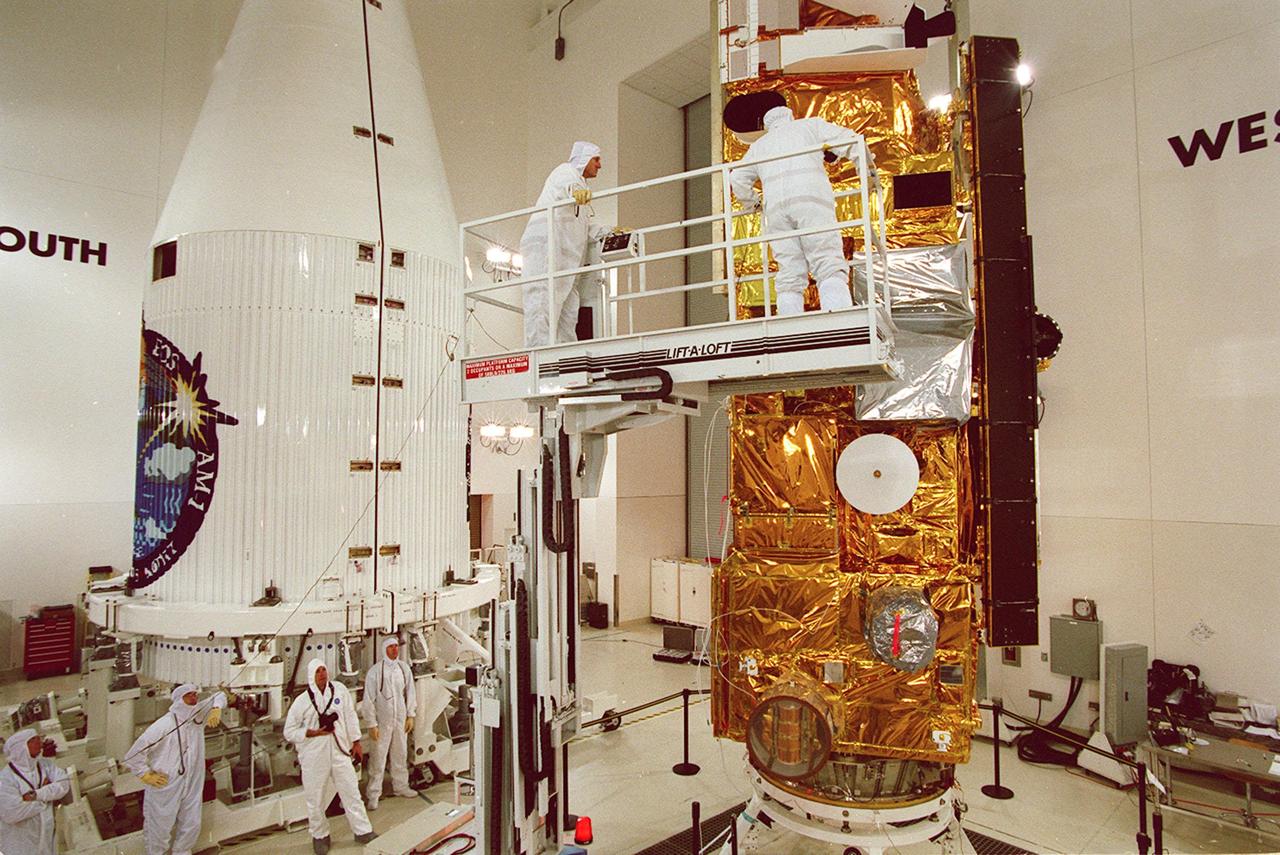
Terra was built to last six years. It has lasted 27. On Nov. 17, NASA announced that the flagship of its Earth Observing System will stop collecting science data on Dec. 1. The agency cited what tends to end long missions: the spacecraft's systems are aging, and its orbit is drifting. After that date, controllers will use the remaining fuel to lower Terra's orbit. Then, in January 2027, they will power off every system on board.
Terra launched on Dec. 18, 1999, so it will fall just short of its 27th launch anniversary. By NASA's count it ran more than four times longer than planned. Over that time its instruments built a detailed record of the planet. That record covers land use, wildfires, dust and smoke, the atmosphere and ice.
A five-instrument workhorse
Terra carried five instruments: ASTER, CERES, MISR, MOPITT and MODIS. Not all of them will be running when the science phase ends. NASA says MOPITT, along with parts of CERES and ASTER, was already shut off to save power. NASA says those parts were switched off to conserve power.
Terra was useful because of its orbit as much as its sensors. According to a NASA Earthdata feature on the mission's end-of-life planning, Terra flew a sun-synchronous orbit at 705 kilometers. It crossed the equator at 10:30 a.m. local time, and for more than 20 years the team held that crossing within about two minutes. A steady crossing time means each image is taken under nearly the same sunlight conditions year after year. That consistency is what lets scientists treat decades of pixels as one dataset rather than a patchwork.
The spacecraft launched with 340 kilograms of hydrazine and has completed more than 100,000 orbits. Its last inclination-adjustment burn took place in February 2020. After that, the orbit began to drift. "We've left our two-minute box of time control," Terra project scientist Kurt Thome told Earthdata. As the crossing time slides, the Sun angle at the time of observation changes.
How you retire a satellite
Terra will not crash back to Earth in a fireball next month. The Earthdata feature describes the decommissioning, which NASA calls Phase F, as a methodical shutdown. The team powers down the instruments, lowers the perigee (the orbit's lowest point) with the last of the propellant, and drains the batteries so nothing aboard can later release stored energy. NASA's announcement confirms that sequence: lower the orbit first, then switch everything off in January 2027.
Even after the burns, the spacecraft will stay in orbit for a long time. The Earthdata feature says reentry is not expected until more than 40 years after shutdown, with minimal risk. That piece was first published in May 2022 and last updated in August 2025, so its exact timeline predates the current schedule. Its description of how the disposal works still applies.
The MODIS problem
For many data users, the bigger story is MODIS. Scientific American describes it as providing a wide range of Earth observations, including measurements of forests, clouds and glaciers. NASA has been preparing users for its loss for some time. A NASA Earthdata alert on the transition from MODIS to VIIRS was first issued on May 2, 2025. The page now carries a banner stating that Terra observations cease on Dec. 1, 2026.
Terra is not the only spacecraft involved. According to the alert, both Terra and Aqua, which carries the other MODIS, "will begin shutting down operations" in late 2026 or early 2027. Both platforms are drifting out of their designed orbits, which is affecting crossing times and possibly the data. The alert says a final reprocessing of MODIS data will take place, and it encourages users to explore similar products from VIIRS, the Visible Infrared Imaging Radiometer Suite.
The alert describes VIIRS products as similar, not identical, to MODIS products. Moving from one instrument family to another is therefore not a simple swap, and users will need to check how the products compare for their own work.
Why It Matters
Terra's retirement was always going to come. The open question is what replaces it. In April 2025, months before this announcement, Scientific American and E&E News reported that Terra, Aqua and Aura were running out of fuel and gradually drifting out of their intended orbits. The three satellites launched between 1999 and 2004. The report said there was no plan to replace them. Some of their instruments have no successor at all. CERES, which helps scientists measure the solar radiation Earth absorbs, had only one planned follow-on: a NOAA satellite scheduled to launch in 2027 with an estimated lifespan of only around seven years. Language in a Senate spending proposal asking NASA for a transition plan was left out of the government funding measure signed in March 2025.
"People have come to rely on them, and now they're going away," Gavin Schmidt, director of NASA's Goddard Institute for Space Studies, told the publication at the time. That report predates the Nov. 17 announcement and should be read as background. Still, the core problem it described has not changed. Terra is now ending science operations, and NASA's own data alert says Aqua will begin shutting down in the same late 2026 to early 2027 window.
Climate science depends heavily on continuity. A single year of satellite data shows what happened that year. Decades of data from the same orbit, collected at similar Sun angles, form a climate data record. Gaps or shifts between instruments make that kind of record harder to extend.
Terra's data will not disappear with the spacecraft. NASA says the mission's records will stay free and publicly available, and the Earthdata feature says they will stay archived and available without restriction through the agency's Earth Observing System Data and Information System (EOSDIS). Researchers who use the archive for years to come will still be working from what Terra gathered over its 27 years. The harder task for NASA and its partners is extending that record past this point without a break.
