
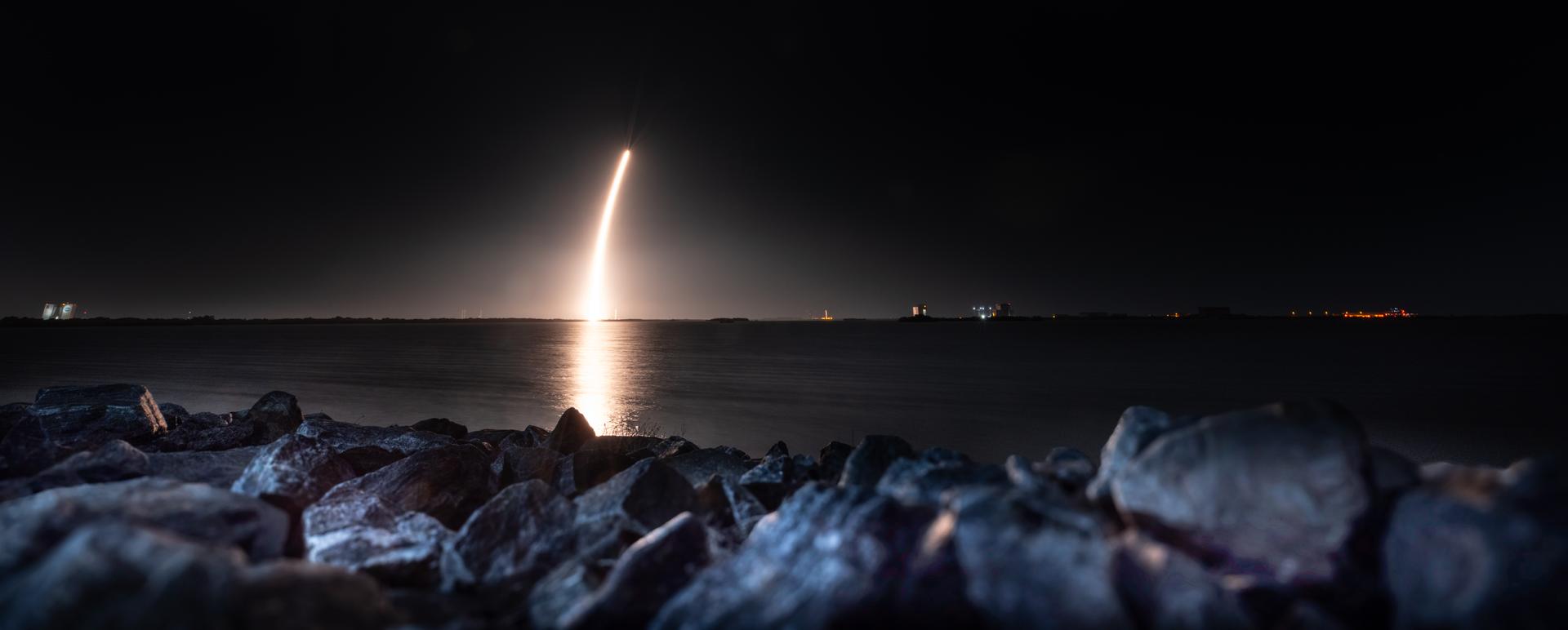
Rockets don't launch from wherever is convenient. Every spaceport on Earth sits where it does because of a small set of hard physical constraints — how fast the ground is already moving, which direction the rocket needs to fly, and what's downrange if something goes wrong — layered on top of decades of geopolitics and industrial history. Here is the physics behind the choice, and a tour of the sites that show how differently it can play out.
The physics: three constraints, one decision
Earth's rotation is a free velocity boost — if you're close enough to the equator. The planet's surface moves fastest at the equator, roughly 1,670 km/h (about 465 m/s) eastward, and that speed carries over to anything launched from there. A rocket launching due east from the equator gets that ~465 m/s added to its own thrust for free; a rocket launching from a site at 45°N, like Baikonur, only gets about 330 m/s of that same bonus, because rotational speed falls off with latitude. Arianespace, which operates from French Guiana at 5°N, describes this directly as exploiting "the slingshot effect of the Earth's rotation" to carry heavier payloads on less propellant — by some published comparisons, an Ariane rocket from Kourou can lift roughly 65% more payload to geostationary transfer orbit than the same vehicle would from a high-latitude Russian site.
Launch site latitude sets a floor on achievable orbital inclination. Without extra maneuvering, a rocket cannot reach an orbital inclination lower than the latitude it launched from — the geometry doesn't allow it, since the orbital plane has to pass through both the launch site and Earth's center. That's why a Kennedy Space Center launch at 28.5°N heading to the International Space Station's 51.6° orbit has to fly northeast and then execute a "dogleg" — a deliberate turn during ascent — burning extra fuel to reach an inclination its latitude alone couldn't provide. Sites near the equator, by contrast, can reach almost any inclination, including the equatorial orbits favored for geostationary communications satellites, with comparatively little steering.
Downrange safety dictates which directions are usable at all. Spent boosters, discarded stages, and the debris from any launch failure all fall somewhere, so every range restricts which azimuths (compass headings) a rocket may fly. That single rule explains why coastal sites dominate the list below — an ocean downrange means a launch failure scatters debris in open water rather than over a city.
Cape Canaveral and Kennedy Space Center, Florida (28.5°N)
The United States' busiest launch complex sits on Florida's Atlantic coast for exactly the reasons above: it's the lowest-latitude site readily available on the U.S. East Coast, and launching east sends rockets out over open ocean instead of over the continental United States. NASA's own history of the site notes the location was chosen specifically because it let the agency launch eastward over water while still taking some advantage of Earth's rotation. Its 28.5° latitude is a genuine constraint, though — reaching the ISS's 51.6° inclination, or any orbit tilted more than 28.5°, requires the dogleg maneuvers described above.
Vandenberg Space Force Base, California (34.7°N)
Cape Canaveral cannot safely launch south toward polar orbits — that trajectory would send stages over the Caribbean and Central America. Vandenberg solves this by launching south over the open Pacific instead, giving it a clear downrange corridor for polar and Sun-synchronous orbits (inclinations from about 70° up past 90°, i.e., retrograde). Since 1959's Discoverer 1, the first satellite ever placed in polar orbit, Vandenberg has been the United States' dedicated site for Earth-observation, weather, and reconnaissance satellites that need to pass over every latitude on the planet — orbits Florida's geography simply won't allow.
Baikonur Cosmodrome, Kazakhstan (45.6°N)
Baikonur is the clearest case of history overriding physics. At 45.6°N it gets a much smaller rotational boost than any equatorial site, and because Kazakhstan is landlocked, spent stages fall on the open steppe rather than in the ocean — those regions are pre-cleared and the hardware is later salvaged. The site was chosen in 1955 by the Soviet military for secrecy and remoteness, not orbital efficiency, and it has been used continuously since (including for Sputnik and Yuri Gagarin's flight). Since Kazakhstan's 1991 independence, Russia has leased the cosmodrome and surrounding city under a bilateral treaty extending through 2050 — a reminder that a launch site, once built, tends to stay in use for reasons well beyond the physics that would pick it today.
Guiana Space Centre, Kourou, French Guiana (5°N)
Europe's spaceport, operated by CNES and used by Arianespace and ESA, sits about 500 km north of the equator, making it the lowest-latitude major orbital launch site in operation. That gives it the largest rotational velocity bonus of any active spaceport and access to the broadest range of orbital inclinations, from equatorial to polar, with an unobstructed Atlantic Ocean downrange in every useful direction. It's a large part of why Ariane-family rockets have been able to compete on payload mass for heavy geostationary communications satellites, historically a large share of the commercial launch market.
Wenchang Space Launch Site, Hainan Island, China (19°N)
China's newest and southernmost launch site, operational since 2016, was built on the coast of Hainan Island specifically to solve two problems at once. At 19°N, it's the lowest-latitude launch site in China, giving China's heaviest rockets — including the Long March 5 — a meaningful payload advantage over the country's older interior sites. Just as importantly, its coastal location let engineers ship the Long March 5's five-meter-diameter core stage there by sea; China's rail network limits cargo to roughly 3.35 meters in diameter through interior tunnels, so the rocket is built in Tianjin and moved to Wenchang by specially designed cargo ship instead. Wenchang's launch corridor also runs over open ocean, within about 10 km of the coast, reducing the risk from falling debris compared with China's older inland sites at Jiuquan and Xichang.
Rocket Lab Launch Complex 1, Mahia Peninsula, New Zealand (39°S)
Mahia breaks the equatorial pattern entirely, and for a good reason: Rocket Lab's small Electron rocket mostly carries small satellites to varied, often Sun-synchronous orbits rather than heavy geostationary payloads, so the equatorial rotation bonus matters less than launch flexibility. New Zealand's isolation in the South Pacific means clear ocean downrange in nearly every direction — north, south, and east — with minimal air and sea traffic to schedule around. That combination gives Mahia access to a wider range of orbital inclinations from a single site than almost any other spaceport — roughly 39° to 98°, covering everything from low-inclination orbits to Sun-synchronous — letting Rocket Lab launch to whatever inclination a customer's satellite needs without the extensive range-coordination delays that busier sites like Cape Canaveral face, supporting a launch cadence of roughly every two to three weeks at peak.
Why It Matters
Spaceport geography is a good, underappreciated lens on the commercial launch industry: every new entrant has to solve the same three-variable equation — rotational boost, achievable inclinations, and a safe downrange corridor — and where they land on it reveals their business model. Arianespace and China's Wenchang chase the equatorial advantage because they're optimized for heavy geostationary payloads. Vandenberg exists because Florida's geometry physically cannot deliver polar orbits. Rocket Lab picked flexibility and launch cadence over latitude entirely, because small-satellite customers care more about getting to orbit on schedule than shaving propellant mass. And Baikonur is a standing reminder that once billions of dollars of infrastructure and institutional history are built on a site, physics becomes just one input among several. As launch demand keeps climbing — a trend NASA's own inspector general flagged as straining U.S. spaceport capacity — expect more countries and companies to go through this same site-selection calculus, and expect the map of the world's launch pads to keep creeping toward the equator and the coasts.
Sources
- Kennedy Space Center History — NASA
- The Guiana Space Center: A World-Class Launch Site — Arianespace
- Plane Change Maneuvers — Orbital Mechanics & Astrodynamics
- Successful Long March 5 launch opens way for China's major space plans — SpaceNews
- Rocket Lab Launch Complex 1 (Mahia) — Launch Site Profile, Orbital Radar
- America's Spaceports Are Running Out of Runway — Cosmic Herald
