
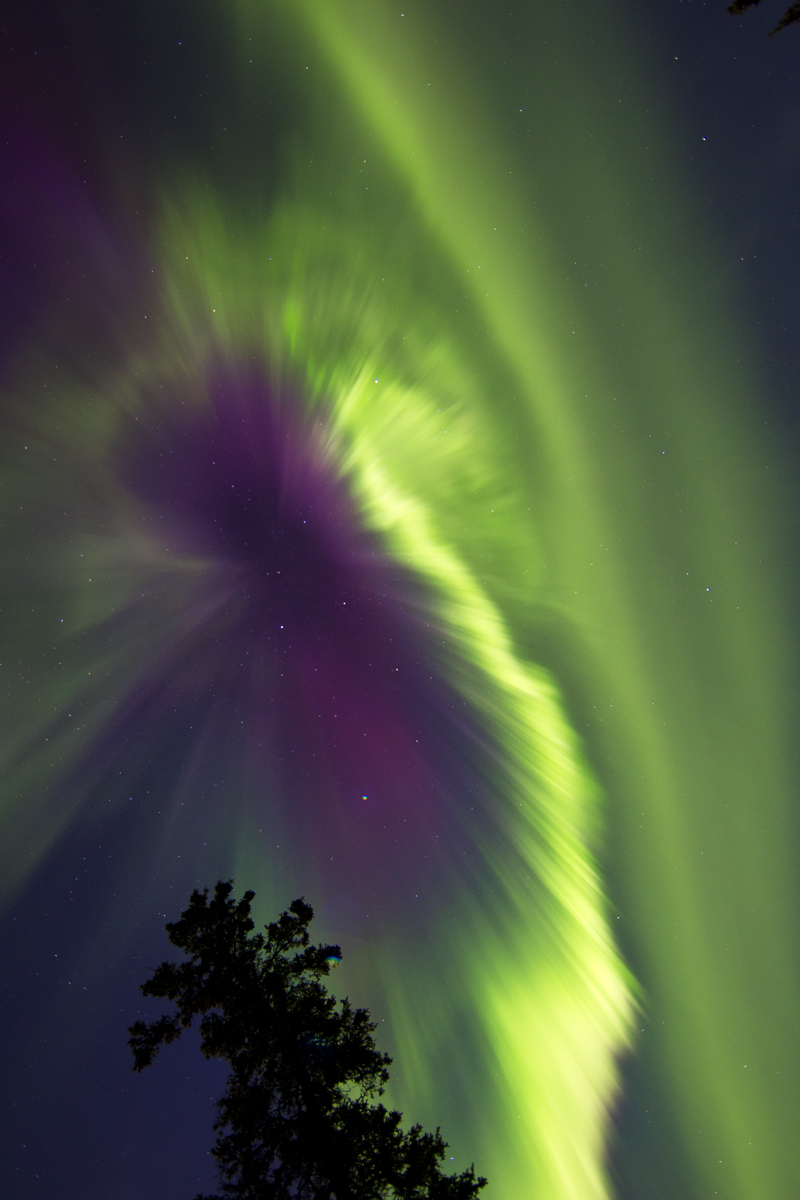
Sky watchers may get a chance at aurora this week. On October 6, sunspot region AR4549 produced two M-class flares, and each one launched a coronal mass ejection (CME). According to EarthSky's October 7 sun report, the M1.4 flare produced a full halo CME, which is a cloud that looks like a ring around the Sun from our point of view. EarthSky describes that as solar material appearing to head straight toward Earth. The M1.8 flare sent out a second CME.
NOAA's Space Weather Prediction Center (SWPC) now expects the material to reach Earth on October 9. The timing also helps sky watchers, because EarthSky notes the Moon will be nearly new, so moonlight won't wash out a faint display.
What the forecast actually says
The SWPC 3-Day Forecast, issued at 1230 UTC on October 7, says G1-G2 geomagnetic storms are likely on October 9 "due to the anticipated arrival of a CME from 06 Oct." The highest Kp expected across October 7-9 is 5.67, which is G2 (moderate) on NOAA's scale.
The forecast also shows how the storm is expected to build through October 9 (all times UTC):
- 03-06 UT: Kp 5.00, G1 (minor) storm level
- 09-12 UT: Kp 5.67, G2 (moderate) storm level
EarthSky gives a similar outlook: arrival early on October 9, with G1 storming and possibly G2. SWPC's discussion likewise says a disturbed and enhanced solar wind environment is likely to arrive early on October 9 because of CME influences. These are predictions, not guarantees. CME arrival times usually carry some uncertainty, and the storm's strength depends on things that can't be known until the cloud gets here. Treat the forecast windows as a rough guide.
The discussion also mentions a second, narrow CME that modeling showed moving mostly north of the ecliptic, with a possibility of glancing effects arriving at the same time as the partial halo CME from October 6. That is one more reason the exact timing and strength remain uncertain.
The source: a magnetically complex sunspot group
AR4549 is responsible for most of the Sun's recent activity. SWPC's forecast discussion places the region at N10W06, close to the center of the Sun's disk as seen from Earth. It classifies the region's magnetic field as beta-gamma-delta. Forecasters found delta magnetic configurations in both the leading and trailing spots, and EarthSky says the region kept growing and carries the potential for more M-class and even X-class flares.
The discussion ties one CME directly to AR4549's M1.8 flare at 0805 UTC on October 6. The CME showed up in the COR2 coronagraph on NASA's STEREO A spacecraft at 1153 UTC that day. A coronagraph blocks the bright disk of the Sun so that fainter material moving outward from it can be seen.
The region also stayed busy with smaller flares. EarthSky counted 11 C-class flares in the 24 hours covered by its report, and AR4549 produced 10 of them. The strongest was a C3.6 at 15:06 UTC on October 6, and SWPC's discussion also names it as the largest of the C-flares.
The rest of the visible disk is calmer by comparison. EarthSky lists AR4545 with a beta magnetic classification, which grew but produced no flares, and AR4548 with an alpha classification and no flare activity. A third region, AR4547, has rotated out of view to the far side of the Sun, according to EarthSky.
More flares possible
AR4549 may not be finished. SWPC puts the chance of M-class flares at 45% through October 9, particularly from AR4549 and possibly AR4545. The 3-Day Forecast also gives a 45% chance each day of R1-R2 (minor to moderate) radio blackouts, and a 5% daily chance of R3 or greater. EarthSky says the chance of M flares rose to 45% from 40% the day before, that the chance of X flares holds at 5%, and that AR4549 could produce M-class and even X-class flares.
SWPC gives a 10% chance of an S1 (minor) solar radiation storm, a greater-than-10 MeV proton event. Separately, the discussion notes that the flux of greater-than-2 MeV electrons reached high levels, with a peak of 10,956 pfu at 1555 UTC on October 6, and is expected to stay high through October 9. That measurement is a separate matter from the incoming CME.
Planning to look up
The storm is most likely during the early and mid-morning hours UTC on October 9, so the best viewing depends on where you live. Observers whose local night overlaps the 03-06 UT window, and especially the stronger 09-12 UT window, have the best chance. Other observers will be in daylight during those hours. Because CME arrival times can shift, sky watchers should check SWPC's current products as the date gets closer instead of relying on one forecast issued two days ahead.
The Moon is the most reliable part of this forecast. EarthSky says a nearly new Moon is bringing dark skies and that conditions look ideal for aurora-watching. Moonlight can easily drown out a faint display, so if the CME arrives as forecast, the sky will be about as dark as it gets for spotting it.
Why It Matters
G1 and G2 storms are modest by space-weather standards, but they are the level at which aurora can show up for people who don't normally see it. These sources agree on the main points: an active, magnetically complex region near the center of the Sun's disk, at least one CME linked to it, and a forecast arrival on October 9. That makes this a better aurora prospect than most.
The episode also shows how space weather forecasting is done. Each part of the forecast rests on a separate observation: a coronagraph spots the CME, the magnetic classification flags the region as likely to flare, and Kp predictions set out how strong the storm could get and when. Each part also comes with uncertainty. AR4549 is still close to the center of the disk, so any large flares it produces in the next few days could also send material toward Earth.
