
Each year Earth catches up with Saturn on the inside track and passes it. That happened on Oct. 4, 2026. According to EarthSky, Saturn reached opposition at about 7 a.m. CDT (12 UTC). At that moment Earth sat directly between the Sun and the ringed planet. For backyard observers this is the year's best chance to look at Saturn: EarthSky says the planet is at its brightest and closest for the year, and it stays up for much of the night.
NASA put the event first in its What's Up guide for October 2026. The same month also brings a thin crescent Moon close to Jupiter, the Orionid meteor shower, and a Moon-Pleiades pairing. Below is what opposition means, what to look for, and how to fit Saturn in with the rest of the month's sky.
What "opposition" actually means
NASA defines opposition as the point when Earth lies between the Sun and Saturn. From the ground, that puts Saturn opposite the Sun in the sky. It rises around sunset and stays visible for much of the night.
Opposition also brings Saturn closest to us for the year. EarthSky gives a distance of about 784 million miles (1.26 billion kilometers), or 8.43 astronomical units. That is still very far, but outer planets are always closest to Earth at opposition, which is why the date matters for observers.
By the numbers
- Opposition time: about 7 a.m. CDT / 12 UTC, Oct. 4, 2026 (EarthSky)
- Brightness: magnitude 0.3 (EarthSky)
- Distance from Earth: about 784 million miles / 1.26 billion km / 8.43 AU (EarthSky)
- Apparent disk size: up to 19.7 arcseconds (EarthSky)
- Ring tilt: about 7.5 degrees south by EarthSky's figure; Universe Today puts the current tilt near 12 degrees
- Location: a corner of the constellation Cetus (Universe Today), with the star Fomalhaut keeping Saturn company in the sky (EarthSky)
At magnitude 0.3, Saturn is easy to see without optical aid. EarthSky says it is brighter than any star in the eastern sky just after sunset, though it is the faintest of the bright planets. If you are unsure which point of light it is, look toward a clear eastern horizon after dark. EarthSky describes Saturn's light as golden, and notes that the fainter Fomalhaut is nearby.
Rings that are still opening up
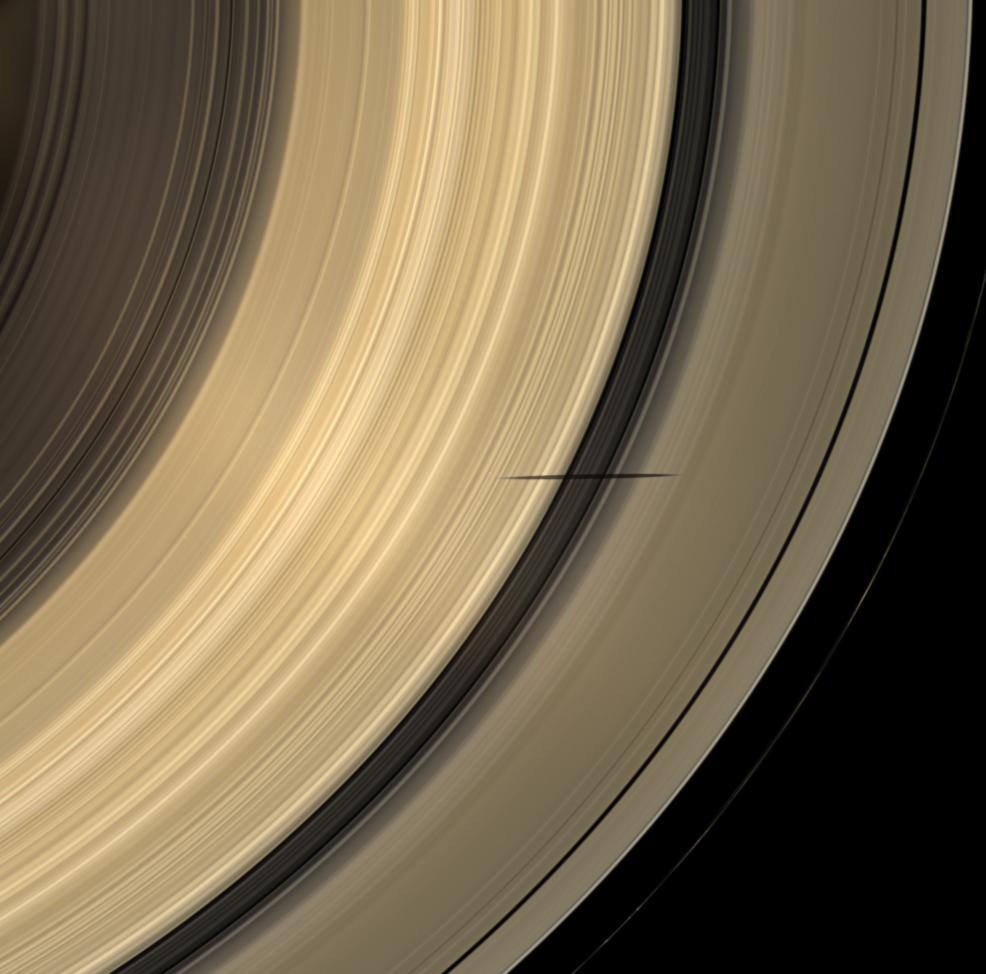
The rings are the reason most people point a telescope at Saturn, and their angle changes from year to year. EarthSky notes that Earth passed through the ring plane in March 2025, something that happens every 13 to 15 years. The rings are exceedingly thin, and around that crossing they could not be seen in small amateur telescopes for a few weeks. Since then they have been opening again.
The two sources give different figures for how far they have opened. EarthSky lists a tilt of about 7.5 degrees south relative to viewers on Earth, while Universe Today says the rings are about 12 degrees wide in late 2026, widening from edge-on in 2025 and set to reach their widest tilt in 2031. Either way, the angle is still modest, so you will need some magnification. EarthSky says binoculars will not show the rings, though steadily held or mounted binoculars will reveal Saturn as a bright oval disk. Any small backyard telescope will show the rings.
Telescope owners have a few extra things to watch for. Universe Today suggests watching for enigmatic ring "spokes," radial streaks across the rings that are thought to be due to meteoroid impacts, as the planet comes off last year's equinox season. It also points to the Seeliger Effect, or opposition surge, a brightening near opposition of about 0.3 magnitudes that varies with how wide open the rings are. Universe Today says the effect is already underway and suggests comparing Saturn with zero-magnitude stars such as Capella and Rigel as the surge fades over the following weeks.
Something brewing at the south pole
Saturn itself is also changing. NASA's October guide notes that astronomers have long known about a hexagon-shaped jet stream spanning nearly 20,000 miles across Saturn's north pole. But last month, observations by NASA's Hubble Space Telescope revealed a ten-sided atmospheric wave encircling the planet's south pole. NASA says this southern hemisphere feature appears to be strengthening, giving scientists the rare chance to watch a giant atmospheric pattern develop.
Jupiter gets its own moment: a lunar occultation
Saturn is not the only planet worth an early alarm this week. NASA's guide notes that a thin crescent Moon appears close to Jupiter before sunrise on Oct. 6. For part of North America the Moon does more than pass near the planet. Universe Today reports that the Moon occults Jupiter, covering it up, early on Oct. 6. The event is centered on 10:16 UT (6:16 a.m. EDT), under predawn skies for the eastern contiguous United States and Canada.
Jupiter shines at magnitude -1.9 and appears 34 arcseconds across, so it does not wink out instantly the way a star does. Universe Today says it takes a full minute to disappear or reappear from behind the Moon. These events are rare. According to the same report, the next good lunar occultation of Jupiter for the contiguous United States will not come until Sept. 28, 2034.
The rest of October's sky
NASA's What's Up guide, narrated by Raquel Villanueva of JPL, lists two more dates for the month:
- Oct. 21–22: Orionid meteor shower peak. Moonlight will interfere this year. NASA says a bright waxing gibbous Moon will wash out some of the fainter meteors, and your best chance may come in the few hours before dawn, after the Moon sets.
- Oct. 27–28: The Moon near the Pleiades. The Moon passes close to the well-known star cluster, also called the Seven Sisters. Look east in the evening as the Moon and cluster climb higher.
EarthSky describes opposition as the middle of the best time of year to see an outer planet, so any clear night around it is worth using.
Why It Matters
Opposition is the time each year when Saturn is at its brightest and closest, and it is visible for much of the night. For anyone with a small telescope, it is one of the easiest times to see the rings and the planet's disk clearly. This year's opposition comes as the rings continue to open after the March 2025 ring-plane crossing, so observers can follow the ring angle widening from season to season.
Professional observations add to the interest. Hubble's observations of a strengthening ten-sided wave around Saturn's south pole show that the planet's atmosphere is active. The same week also offers a Jupiter occultation that the contiguous U.S. will not see again in such a good form until 2034, about eight years away. That makes the first week of October 2026 a busy one for planetary observing.
