
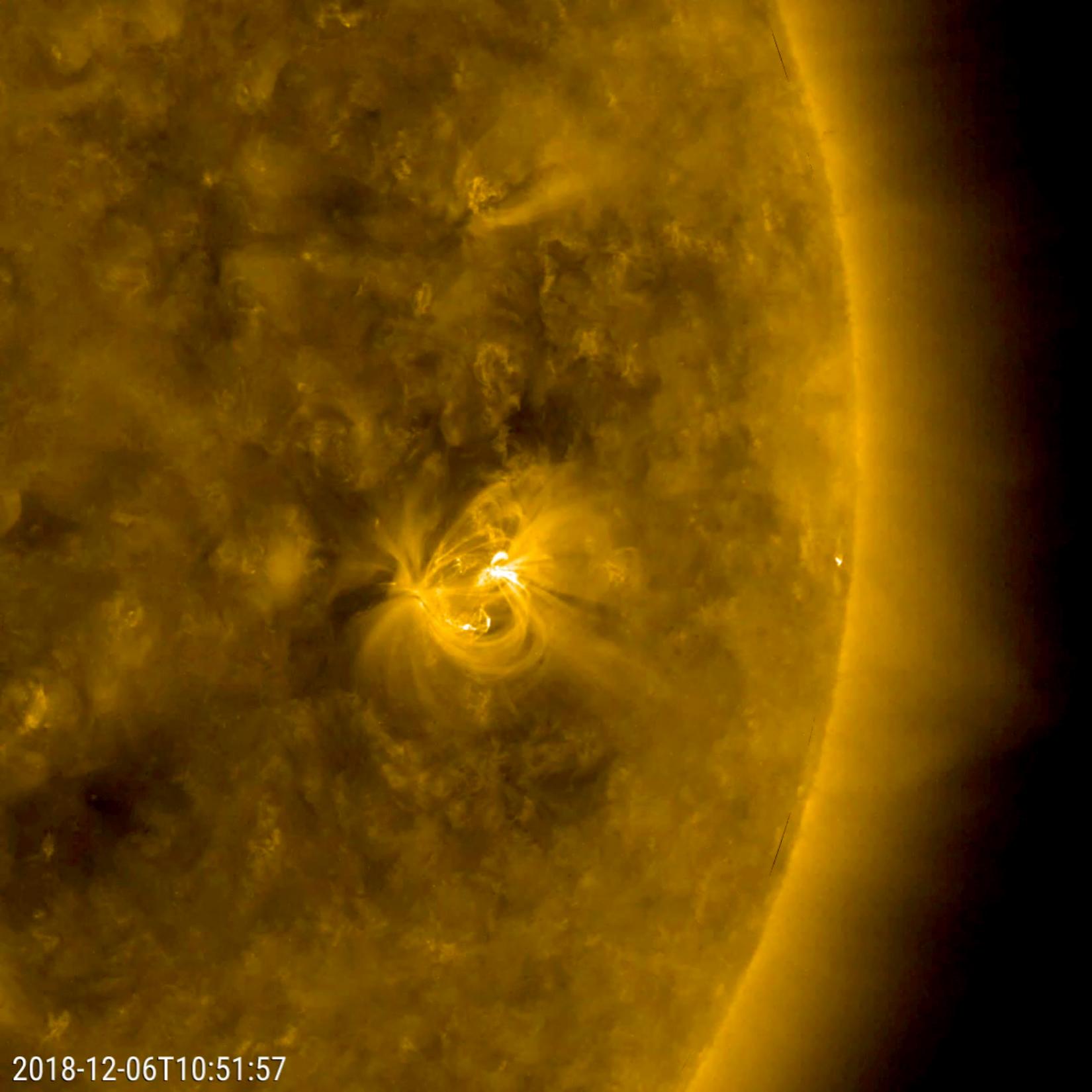
The Sun's southeastern edge has been busy for days, but until this week nobody on Earth could see what was doing it. Now the culprit has rotated into view and has a number: Active Region 4584. Over the same weekend a stream of fast solar wind from a coronal hole reached Earth and pushed geomagnetic activity to the edge of storm levels. For aurora watchers at high latitudes, the next night or two are worth a look.
A Sunspot That Was Flaring Before We Could See It
According to EarthSky's Nov 28 sun news update, AR4584 had been flaring for three days from behind the southeast limb, the Sun's eastern edge as seen from Earth, before rotation carried it onto the visible disk. Once it arrived it took over the flare count. EarthSky tallied 12 flares in its 24-hour window: eight B-class, four C-class, and no M- or X-class events. AR4584 produced all four of the C-class flares.
The largest was a C3.9 flare at 18:49 UTC on Nov 27. It launched a coronal mass ejection, but EarthSky reports the cloud was directed mostly away from Earth. That matches the National Oceanic and Atmospheric Administration's Space Weather Prediction Center (SWPC), whose forecast discussion issued at 0030 UTC on Nov 29 states that no Earth-directed CMEs were observed.
SWPC's discussion covers a slightly different window, and in it the region's biggest output was smaller: a C2.1 flare at 0419 UTC on Nov 28, which SWPC calls the largest event of its reporting period. SpaceWeather.com's front page, updated at 0152 UT on Nov 29, lists a C2 flare at 0428 UT on Nov 28 as its 24-hour maximum. The two outlets differ by a few minutes on the timing of that C2-class flare, and SWPC's C2.1 figure is the more precise one.
SWPC places Region 4584 at S10E55, about 10 degrees south of the solar equator and 55 degrees east of the disk's central meridian. It classifies the region as a "Cao" group with a beta magnetic configuration and notes slight growth. Beta regions contain both magnetic polarities, which is enough to produce flares like the ones seen this week. The region is still close to the limb, so its full structure will be easier to judge as rotation brings it toward the disk center.
Two More Newcomers Saved the Sun From Going Blank
AR4584 is not alone. EarthSky notes that AR4583, also a beta region, is new in the northeast, and SWPC describes both 4583 and Region 4585 as beta groups showing minor development. SpaceWeather.com puts the sunspot number at 30 for Nov 28. Its image caption says two new sunspots are growing rapidly and "appeared just in time to prevent a spotless day."
That caption shows how quickly the visible disk can swing between quiet and busy. Now the disk holds three numbered regions, one of them with a recent record of CME-producing flares.
The Wind Behind the Aurora Forecast
The flares are not what is shaking Earth's magnetic field this weekend. That is the solar wind. A coronal-hole high-speed stream, which is fast wind escaping from a region where the Sun's magnetic field opens out into space, was affecting Earth in the period covered by SWPC's discussion.
SWPC's numbers show the change clearly. Solar wind speed climbed from about 350 km/s to a peak of 590 km/s. The total interplanetary magnetic field strength reached 15 nT, and its north-south component, Bz, swung as far south as -11 nT. Southward Bz matters most for aurora watchers because it lets the incoming field couple efficiently with Earth's magnetosphere and feed energy into it.
By SpaceWeather.com's 0152 UT Nov 29 update the wind speed read 486.2 km/s and plasma density was a thin 1.2 protons per cubic centimeter.
Did We Get a Storm? It Depends on Whose Clock You Use
Each source describes the geomagnetic response a little differently, mostly because each looks at a different time window. EarthSky reported that the planetary K-index reached Kp 4 around 01 UTC on Nov 28, short of the G1 (Minor) storm threshold. SpaceWeather.com lists a 24-hour Kp maximum of 4.67, which it labels "unsettled," with the current value at 3.33. SWPC's discussion, issued at 0030 UTC Nov 29, states that G1 storm levels were reached during its reporting period.
The forecast matters more than the scorekeeping. SWPC expects G1 conditions again early on Nov 29 as the coronal-hole stream's influence gradually subsides, followed by quiet to unsettled conditions on Nov 30 and quiet conditions on Dec 1.
What Aurora Watchers Should Do
- Look early. The best chance of minor storming, according to SWPC, is early on Nov 29 UTC. For North American observers that falls in the evening and overnight hours of Nov 28 local time.
- Watch Bz. The -11 nT dips seen during the stream's peak are southward readings of the kind that favor geomagnetic activity. If real-time data shows Bz turning firmly south again, step outside.
- Keep expectations modest. SWPC's forecast tops out at G1 (Minor). That usually favors high-latitude skies, not a widespread display.
- Don't wait on the CME. The C3.9 eruption's cloud is headed mostly away from Earth, and SWPC sees no Earth-directed CMEs in the current data.
Why It Matters
This weekend shows the two separate ways the Sun reaches Earth. Flares and CMEs from active regions get the headlines, but this round of geomagnetic activity came from a coronal-hole stream, which is quieter, more predictable, and often recurs as the Sun rotates. Meanwhile AR4584 arrived with a recent history of CME-producing flares, so it is worth watching while it crosses the disk. SWPC gives a chance of further C-class flares from Nov 29 through Dec 1, and EarthSky puts the odds of an M- or X-class flare at just 1 percent each. Any eruption from AR4584 would also become more likely to be aimed at Earth as the region moves toward disk center over the coming days. Two other beta regions are showing minor development alongside it, though SWPC expects solar activity to stay very low overall.
All three sources used here are live pages that are overwritten daily. The figures above come from the specific issues cited: the SWPC discussion issued 2026 Nov 29 at 0030 UTC, EarthSky's Nov 28 update, and SpaceWeather.com as of 0152 UT Nov 29.
