
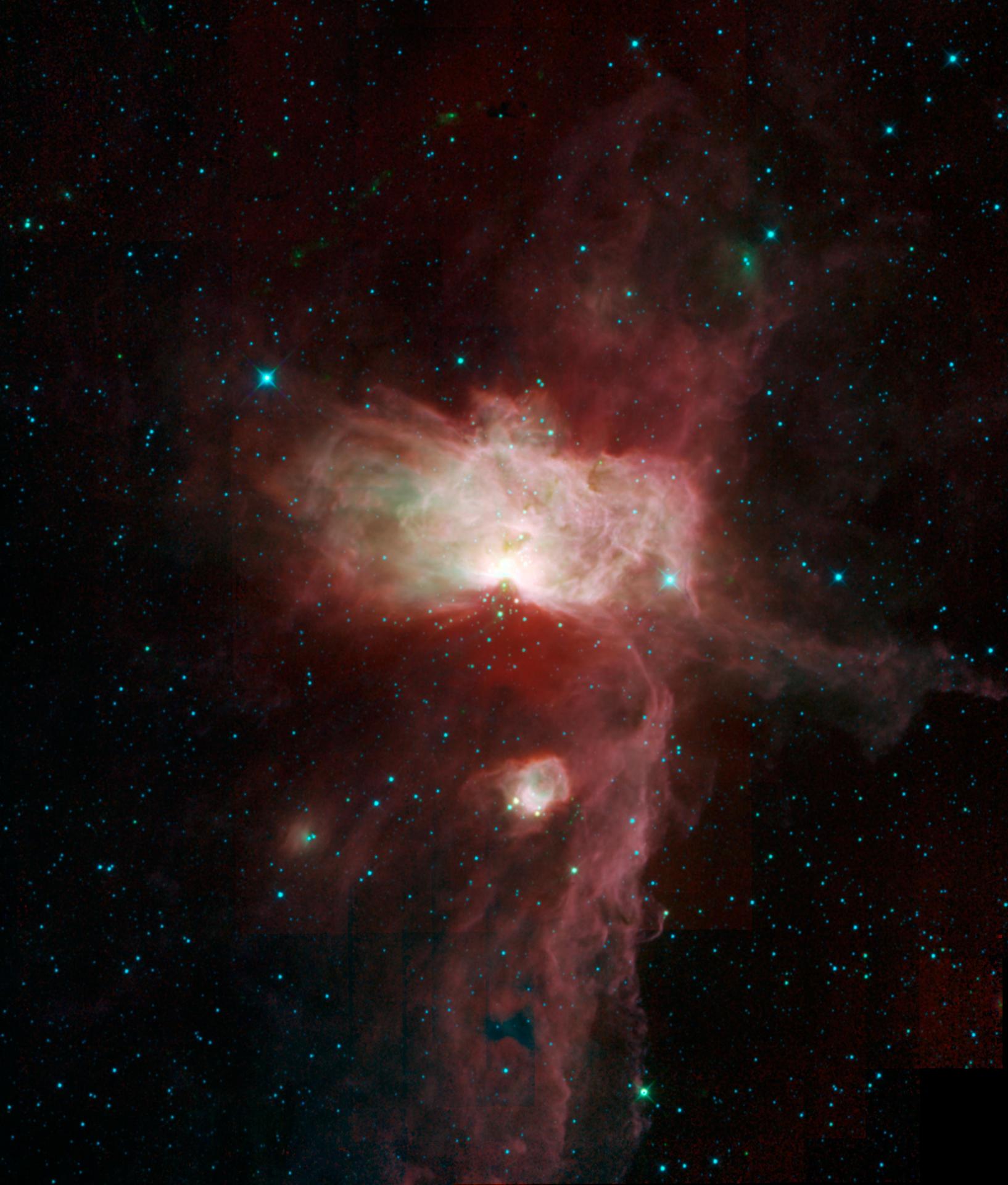
Orion is back in the evening sky. EarthSky notes that the constellation can be seen from both hemispheres from around October through April, and that in November it is just coming back to a convenient viewing time between local sunset and local midnight. Most observers look first at the Belt or the Sword. The star worth a closer look is the one on the Hunter's left shoulder: Bellatrix, also called Gamma Orionis, which EarthSky profiled on Nov. 27.
On paper Bellatrix is a blue giant. Look at the physics and you get something else: a star still in the long, steady, hydrogen-burning stage of its life, which has not yet earned the title its catalog entry gives it.
A quick field guide
Bellatrix sits at roughly right ascension 5h 25m and declination +6° 20', according to EarthSky. That puts it just north of the celestial equator, so observers in both hemispheres can find it. At visual magnitude 1.64 it is Orion's third-brightest star. Both EarthSky and Jim Kaler's long-running Stars site at the University of Illinois give that figure, and it matches the V = 1.64 listed in the International Astronomical Union's official star-name catalog.
The name comes from the Latin for "female warrior," which is why the star is sometimes called the Amazon Star. The label has wandered over the centuries. Kaler notes that in medieval times the name Bellatrix was applied to a different star, Capella. The modern assignment is now official: the IAU Working Group on Star Names approved "Bellatrix" for Gamma Orionis on June 30, 2016. The catalog entry ties the name to the star's other designations, HR 1790, HIP 25336 and HD 35468.
How far, how bright
The distance estimates differ slightly. EarthSky gives about 240 light-years. Kaler gives 252 light-years with an uncertainty of about 10 light-years either way, so the two figures overlap. For a backyard observer, "about 250 light-years" is a fair round number.
At that distance Bellatrix is a powerful star. EarthSky puts its absolute magnitude, the brightness it would have from a standard distance of 10 parsecs, at -3.3. Kaler calculates a luminosity of about 7,100 times the Sun's, after allowing for the large amount of ultraviolet light from its hot surface. Its surface temperature is about 21,750 K, almost four times hotter than the Sun's roughly 5,778 K. That heat gives the star its blue-white color.
Kaler combines the temperature and luminosity to get a radius of about 6 times the Sun's. He says this agrees with an interferometric measurement of its angular radius, 0.00072 arcseconds, far too small for any ordinary telescope to resolve as a disk. In his words, the agreement indicates that the various parameters are correct.
The "giant" that isn't (yet)
This is where the catalog label and the physics part ways. Bellatrix's spectral type is B2 III. The "B2" describes its temperature class. The Roman numeral "III" is a luminosity class, and on paper it means "giant."
Kaler says the classification is not an error: it simply means the star has the spectrum of a giant in the standard scheme. Such mismatches are common among B stars, where true dwarfs are sometimes classed as giants or subgiants. Placed against the theory of stellar structure and evolution, Bellatrix is a hydrogen-fusing dwarf of about 9.0 solar masses. In astronomers' terms, "dwarf" means a main-sequence star, one that still runs on hydrogen fusion in its core. EarthSky's profile uses the same mass, about nine Suns, and says Kaler asserts the star is probably a hydrogen-fusing dwarf still on its way to the true giant stage.
So the apparent contradiction comes down to vocabulary. "Giant" in Bellatrix's spectral type describes how its spectrum looks. "Dwarf" describes where it is in its life. Kaler puts the star's age at about 20 million years, with roughly seven million years to go before the core hydrogen runs out. It will then become a subgiant and, as it evolves further, a giant.
What happens after that is uncertain, because nine solar masses sits near an important dividing line. Kaler says Bellatrix is on the edge of supernova candidacy. If it does not explode, it will become a massive white dwarf. EarthSky likewise calls it a possible supernova candidate. Either way, nothing will happen on any timescale that matters to people looking at it tonight.
Probably not part of the Orion family
Many of Orion's bright blue stars belong to the Orion association, a group of luminous O and B stars. You might expect Bellatrix to be one of them. Kaler says it seems not to be physically part of the association: its distance of 252 light-years is only a quarter of the distance to the closest portion, the Orion Ia sub-association.
EarthSky notes that binoculars or a telescope may show a gaseous glow around Bellatrix. The glow does not originate with the star itself, EarthSky says, but with its location within the great Orion Molecular Cloud complex, a star-forming region in the same direction in space as the constellation. EarthSky quotes Robert Burnham calling the faint nebulosity an illuminated portion of the general nebulous haze that envelops much of Orion.
Bellatrix also has a faint, probable companion, Gamma Orionis B. Kaler says it has kept a constant separation of 178 arcseconds over the past 170 years and is likely a true, though very distant, companion. From its brightness he judges it to be an M0 red dwarf with about half the Sun's mass. At a minimum distance of 13,800 astronomical units it would take at least 525,000 years to orbit, which Kaler calls a fragile connection indeed. It is also too far away to feed matter onto Bellatrix.
Why It Matters
Bellatrix is a useful lesson in reading astronomical labels carefully. A spectral class like "B2 III" is shorthand built from what a spectrum looks like. Usually it lines up with a star's actual life stage, but not always. Bellatrix is a bright, easy-to-find example where a catalog's "giant" turns out, under evolutionary modeling, to be a star still fusing hydrogen in its core.
It also shows how the pieces of stellar measurement can cross-check one another. Kaler's radius from temperature and luminosity matches the radius from direct interferometry, which supports the parameters behind the nine-solar-mass model. The star's future, either a supernova or a heavy white dwarf, falls close to a mass boundary, which makes it a good test case for the models that try to place it.
For skywatchers, the practical point is simple. On a clear evening this weekend, find Orion, pick out the Hunter's left shoulder, and you are looking at a hot blue star about 250 light-years away, roughly 7,100 times as luminous as the Sun, still burning hydrogen and still short of the giant stage its spectral class already claims.
