
The Moon runs this week's sky. It reached first quarter at 16:13 UTC on Oct. 18, according to EarthSky's October night sky guide. Each evening after that it's a little fatter and a little farther east, until it's full early on Oct. 26. Along the way it passes a meteor shower, a ringed planet, and the best-known star cluster in the northern sky. Some of those meetings are worth staying up for. For the meteor shower, the Moon mostly gets in the way.
Here's what's coming, night by night, and how to work around the moonlight.
Oct. 19-21: The Moon crosses Capricornus
On the evenings of Oct. 19 and 20 the waxing gibbous Moon sits among the stars of Capricornus, the Sea-goat, EarthSky says. Capricornus has an arrowhead shape, and with a bright Moon in it the fainter stars will be hard to see. On the evening of Oct. 21 the Moon lies above Fomalhaut, a star EarthSky nicknames the loneliest star. Few bright stars sit near it, so it should still be easy to pick out beside the Moon.
Oct. 20-22: The Orionids, if you get up early
The Orionid meteor shower peaks this week. EarthSky puts the peak on the mornings of Oct. 20, 21 and 22. NASA's October skywatching guide lists Oct. 21-22. Under dark skies, EarthSky says, you might see 10 to 20 meteors per hour.
The problem is timing. The Moon is past first quarter and still growing, so it lights up the evening and much of the night. NASA warns that moonlight may interfere and suggests looking before dawn, after the Moon has set. EarthSky says the same: the waxing gibbous Moon will interfere until well after midnight on the peak mornings, so watch in the moon-free hours before dawn. In practice, set an alarm for the predawn hours, get away from city lights if you can, and give your eyes time to adjust. Staying up late in the evening won't help. With the Moon up you'll see only the brighter meteors.
Oct. 23-24: The Moon meets Saturn
On the evenings of Oct. 23 and 24, the waxing gibbous Moon lies near Saturn, according to EarthSky. The timing is good for Saturn. The planet reached opposition on Oct. 4, as both EarthSky and NASA note. At opposition Earth passes between Saturn and the Sun, which puts Saturn opposite the Sun in our sky. It rises around sunset and stays visible for much of the night. EarthSky calls the ringed planet bright, visible throughout the night and perfectly placed for observing. Three weeks later it's still a strong evening target.
The Moon makes Saturn easy to find. Look for the steady point of light near it, and use the pairing on both nights to confirm which one is the planet.
Oct. 25-26: The Hunter's Moon
October's full Moon is the Hunter's Moon. Space.com gives peak illumination as 12:11 a.m. EDT (0411 GMT) on Oct. 26. EarthSky lists the crest a minute later, at 4:12 UTC (11:12 p.m. CDT on Oct. 25). Either way, North Americans see the exact moment of full Moon around midnight between Oct. 25 and 26. Space.com's local times for Oct. 26 are 4:11 a.m. GMT in London, 1:11 p.m. JST in Tokyo, and 3:11 p.m. AEDT in Sydney.
The exact minute doesn't matter much to the eye, since the Moon looks full for a night or so either side. The better show is moonrise. Space.com says the Moon rises in the east at sunset on Oct. 25 and may turn a subtle yellow-orange near the horizon. It also tends to look bigger there. That's the Moon Illusion, a trick of perception: our brains make us think the Moon is larger than it is when it sits low with foreground objects for reference. EarthSky notes that the steady golden light of Saturn will be nearby, so the full Moon and the ringed planet will be up together that night.
Space.com cites the Old Farmer's Almanac for where the name comes from: the Moon rises around the time farmers have reaped the fields, which makes it easier for hunters to spot and catch animals to prepare food for winter. Other cultures have their own names for this Moon. The Cree call it the Migrating Moon. The Ojibwe and Haida call it the Ice Moon, or Freezing Moon.
Oct. 26-28: Past the Pleiades and Aldebaran
After full, the Moon rises later each evening. EarthSky places the waning gibbous Moon near the Pleiades on Oct. 26 and 27, with Aldebaran, the brightest star of Taurus, shining nearby. Its closest approach to the cluster comes at 2 UTC on Oct. 28, which is 9 p.m. CDT on Oct. 27. NASA describes the same pass as happening on the night of Oct. 27 into the 28th. The two guides use slightly different date ranges, but the closest approach lands on the evening of Oct. 27 for observers in North America.
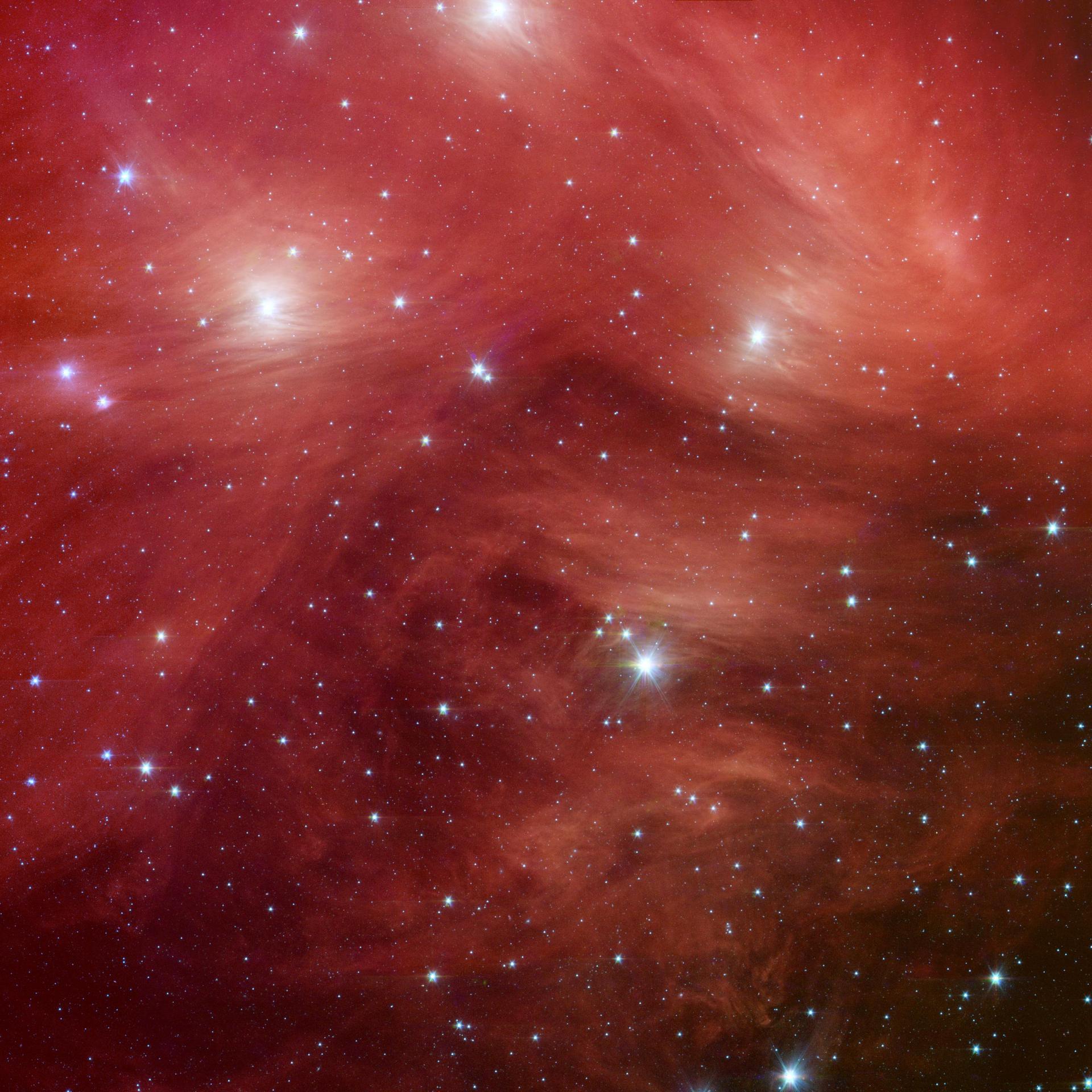
The Pleiades, also called the Seven Sisters, appear to the unaided eye as a slightly fuzzy grouping of 6 to 7 stars, NASA says, and binoculars or a telescope reveal more detail. With a bright Moon right next to them, expect to see fewer of those stars than on a dark night. EarthSky offers a binocular view of the pairing for the late evening of Oct. 27.
Why It Matters
None of these events is a once-in-a-lifetime sight, and a full Moon comes around every month. They're still worth going out for. They're also a clear lesson in how much the Moon shapes what you can see. The bright gibbous Moon that makes the Saturn pairing easy to find is the same one that interferes with the Orionids. Anyone planning to observe needs to know where the Moon is.
The week is also a good time to use the Moon as a pointer. Plenty of people can't pick out Saturn or Aldebaran unaided. With the Moon sitting nearby they're easier to find, and once you know where they are you can find them again without it. Saturn stays well placed for evening viewing for weeks after its Oct. 4 opposition, so it's worth learning now. EarthSky also notes another event to plan for: on Nov. 15, Mars passes 1.2 degrees north of Jupiter in the morning sky.
