
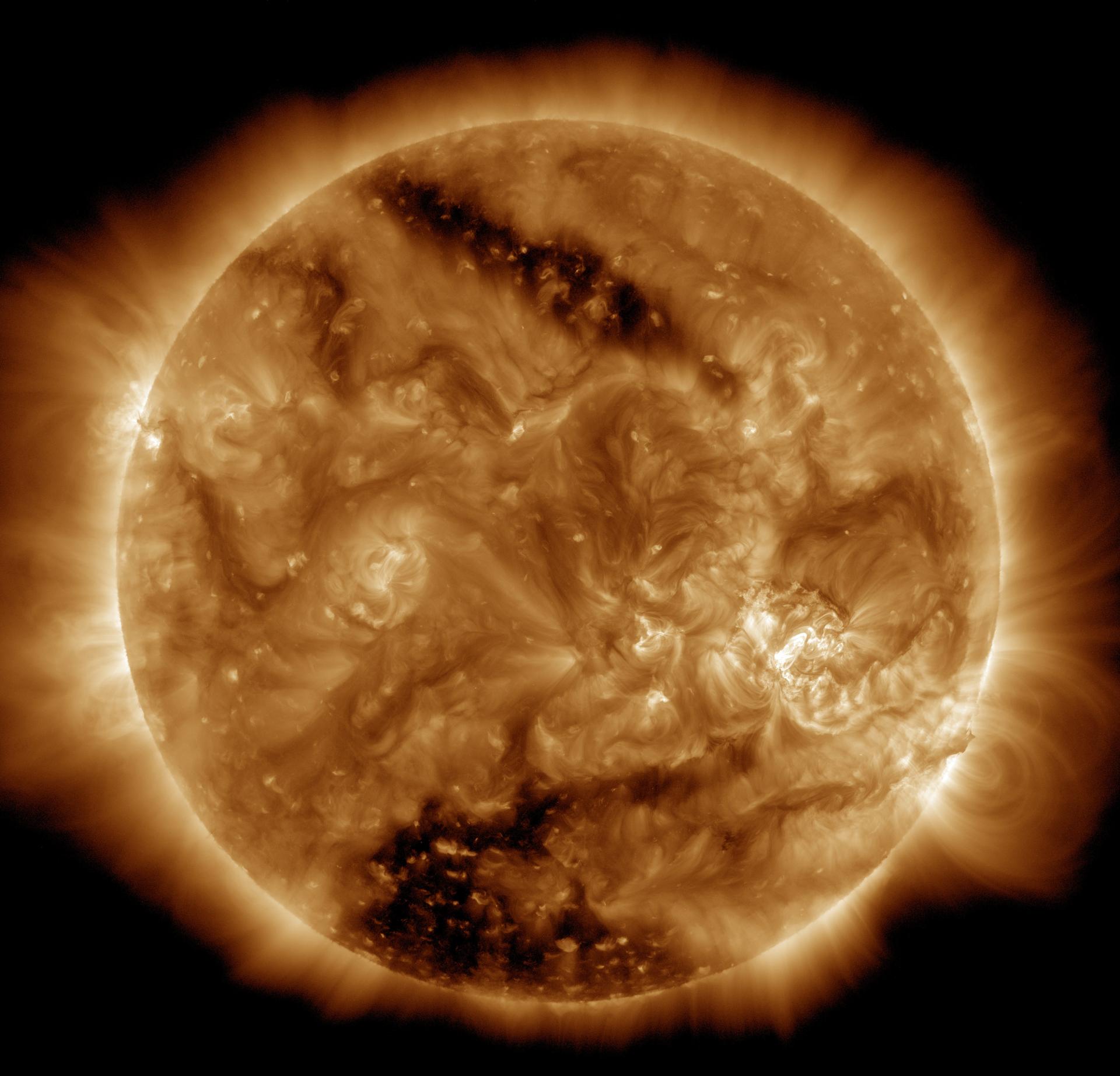
Two things are happening on the Sun at once this week, and they matter for different reasons. A coronal hole near the center of the solar disk is sending a stream of fast solar wind toward Earth, which could produce minor geomagnetic storms and high-latitude auroras. Separately, a sunspot region called AR4551 has started flaring. On Oct. 19 it produced an M1.7 flare strong enough to briefly disrupt radio signals over part of Africa.
Forecasters agree on what to expect but not on exactly when. NOAA's Space Weather Prediction Center (SWPC) expects minor (G1) storm periods on Oct. 19 and 20. SpaceWeather.com puts the wind's arrival a little later, on Oct. 20 and 21. If you live far enough north or south, plan to check the sky over all three nights.
What the official forecast says
SWPC's 3-day forecast, issued at 0030 UTC on Oct. 19, sets the greatest expected Kp index for Oct. 19 through 21 at 4.67, which the agency classifies as G1. That is the lowest level on NOAA's five-step geomagnetic storm scale. The forecast blames "coronal hole high-speed stream influences" and says G1 periods are likely on Oct. 19 and 20.
The forecast also names the hours when it expects the most activity. The 4.67 values fall in two three-hour blocks: 18:00 to 21:00 UT on Oct. 19 and 03:00 to 06:00 UT on Oct. 20. These are predictions, not schedules. Still, they tell observers when the agency thinks the storming is most likely to peak.
Most people won't have to worry about other kinds of space weather. SWPC puts the chance of an S1-or-greater solar radiation storm at just 5% on each of the three days.
Where the timing estimates differ
EarthSky's Oct. 19 sun report says the coronal hole is crossing the center of the solar disk. That is roughly the position from which its outflowing wind is aimed at Earth. EarthSky expects the high-speed wind to arrive around Oct. 20 and says it could bring G1 storms and auroras at high latitudes. It gives northern Scotland and southern New Zealand as examples.
SpaceWeather.com describes the source as a southern coronal hole and says its wind will reach Earth on Oct. 20 to 21. That is about a day later than SWPC's window.
Forecasts disagree like this all the time with coronal-hole streams. A coronal hole is a region where the Sun's magnetic field opens out into space, letting solar wind escape faster than usual. Unlike a coronal mass ejection, it is not a single eruption with a known launch time, so arrival estimates tend to be broad. Viewers should treat the whole Oct. 19 to 21 period as the window rather than focus on a single night.
When these reports were written, the wind had not arrived yet. SpaceWeather.com logged a Kp index of just 0.33 at 1145 UT on Oct. 19. The solar wind was moving at 377 km/s with a density of 2.6 protons per cubic centimeter, which is quiet. Any storming would therefore come from the incoming high-speed stream, not from conditions already in place.
Meanwhile, on the sunspot side
The flare activity is a separate story, though both are unfolding during the same few days. According to EarthSky, AR4551 produced an M1.7 flare that peaked at 09:03 UTC on Oct. 19. The flare caused an R1 radio blackout over southern Africa. EarthSky classes it as a minor (R1) blackout.
SpaceWeather.com's flare log agrees, listing the 6-hour and 24-hour X-ray maximum as an M1 event at 0903 UT on Oct. 19. It describes sunspot 4551 as having a beta-gamma magnetic field with enough energy for more M-class flares. EarthSky separately calls AR4551 a large, magnetically complex region that produced five of the 24-hour period's eight flares, including the only M-class event.
Other parts of the Sun are active too. EarthSky counted eight flares in the 24 hours it covered: one M-class, five C-class and two B-class. A newly numbered region, AR4559, accounted for two of the C-class flares. SpaceWeather.com lists the daily sunspot number at 82.
EarthSky says analysts identified no Earth-directed coronal mass ejections in its reporting period, and none of these sources links the M1.7 flare to one. The aurora forecast rests on the coronal-hole stream, not on the flare. EarthSky adds that a slow Oct. 16 CME may also arrive, though that is uncertain.
Why It Matters
G1 storms are common and mostly harmless. Their main effect for most people is visual: they push auroras toward the equator, but at this level only modestly. That is why both EarthSky and SWPC's G1 classification point to high latitudes. Observers in places like northern Scotland or southern New Zealand have a real chance. People farther from the poles probably do not, unless the stream turns out stronger than forecast.
This week also shows how two kinds of solar activity can overlap. The radio blackout is already over. It affected only the side of Earth facing the Sun at 09:03 UTC. The coronal-hole wind works on a scale of days, and its effects depend on how the stream's magnetic field lines up with Earth's when it arrives. For anyone planning a night out, the flare is something to read about, and the coronal hole is the reason to go outside.
Practical advice: take the whole Oct. 19 to 21 window seriously. Pay particular attention to SWPC's two highlighted periods, 18:00 to 21:00 UT on Oct. 19 and 03:00 to 06:00 UT on Oct. 20. After that, check live conditions instead of relying on a forecast made days earlier. Since SWPC and SpaceWeather.com differ by about a day, a quiet first night does not mean the event has fizzled.
