
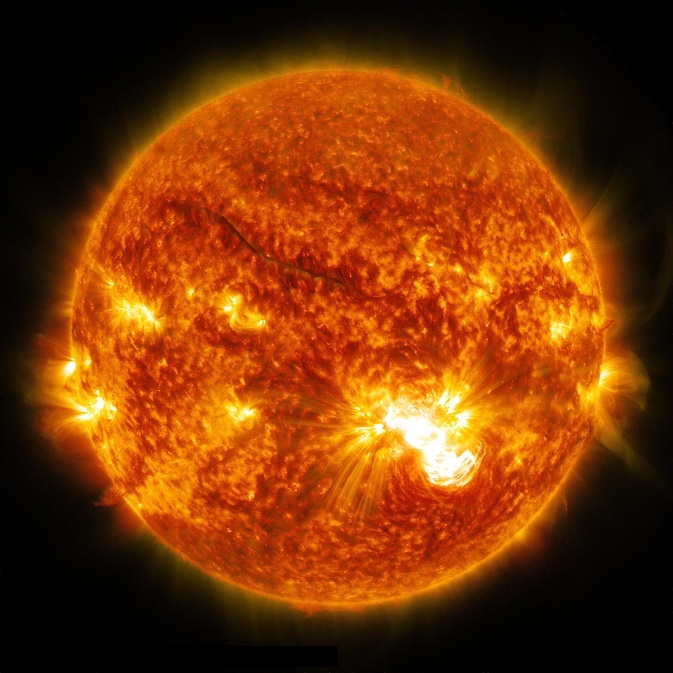
For a few days, the Sun looked sleepy. According to EarthSky's daily solar report, the day before this flare-up produced only six flares, all B-class. In the next reporting period that count jumped to 22, and three were M-class. Two of the three came from a sunspot region that hadn't existed a day earlier.
That region, numbered AR4549, is now the main thing forecasters are watching. It sits close to the center of the solar disk, which means it faces Earth almost directly, and its magnetic field is the kind that can store energy for strong flares.
Three flares in about 13 hours
The first M flare didn't come from the new region. EarthSky credits it to an older region, AR4545, which produced an M1.1 flare at 18:48 UTC on October 5. NOAA's Space Weather Prediction Center (SWPC) logged the same event a little lower, as an M1.0 at 1848 UTC, in its forecast discussion. SWPC called it the largest flare of that reporting period. Small gaps like this between two sources' flare classes are common, and here they don't change what happened.
Then AR4549 took over. EarthSky reports two flares from the region on October 6:
- M1.4 at 06:10 UTC
- M1.8 at 08:05 UTC, the strongest of the three
EarthSky says each of the three flares caused an R1 (minor) radio blackout on the sunlit side of Earth.
The M flares were only part of AR4549's output. EarthSky counted 16 flares from the region during the period, most of the jump to 22 flares across the whole disk. Four numbered sunspot regions are currently visible.
From nothing to beta-gamma-delta in a day
The striking thing about AR4549 is how fast it formed. SpaceWeather.com says the sunspot is growing rapidly and "didn't even exist yesterday." EarthSky also describes it as emerging near disk center and growing fast.
NOAA's technical description is the most specific. SWPC's discussion puts Region 4549 at N10E15, meaning 10 degrees north of the solar equator and 15 degrees east of the central meridian. It classifies the region as "Dai" in sunspot-group terms, with a beta-gamma-delta magnetic configuration. SWPC says the region gained spots and penumbra (the lighter, filamentary area around a sunspot's dark core) during the period and has a weak delta in its leading penumbra.
That "delta" is why forecasters care. A beta-gamma-delta classification describes a region where magnetic polarities are mixed together instead of sitting in two clean groups. SpaceWeather.com says the sunspot has developed an unstable magnetic field that "harbors energy for X-flares" and adds: "Don't be surprised if there is a strong solar flare today." Based on the region's complexity, forecasters are watching for more M-class flares and a possible X-class event.
A caveat matters here. SWPC calls the delta "weak." Complex regions can flare hard, but they can also stabilize, and a region one day old has no track record to judge from. Rapid growth plus delta structure raises the odds of a big flare. It doesn't guarantee one.
What about a CME?
Flares are flashes of radiation. The bigger question for space weather is usually whether a flare launched a coronal mass ejection (CME), a cloud of magnetized plasma that can hit Earth days later and set off geomagnetic storms.
So far, no Earth-directed CME has turned up. SWPC's discussion says no Earth-directed CMEs were observed in available coronagraph imagery. EarthSky notes that analysts are still modeling the flares to check for any Earth-directed component, so this assessment could change if later imagery or modeling shows something.
NOAA's 3-day forecast, issued at 0030 UTC on October 6, reflects that. The greatest expected Kp index for October 6 through 8 is 4.00, which is below NOAA's storm scale. The forecast says no G1 or greater geomagnetic storms are expected. It also puts the chance of an S1 or greater solar radiation storm at 1% for each of the three days.
The storm that already happened
Earth wasn't completely quiet before these flares. The disturbance just came from somewhere else. SWPC's discussion says G1 (minor) geomagnetic storm levels were reached early on October 5. The NOAA 3-day forecast lists the greatest observed 3-hour Kp over the preceding 24 hours as 5, which is the G1 threshold.
That activity came from a high-speed solar wind stream flowing out of a positive-polarity coronal hole, not from a flare. SWPC reports wind speeds of roughly 550 to 600 km/s, peaking at 637 km/s at 0008 UTC on October 5. SWPC also says the flux of electrons above 2 MeV reached high levels, peaking at 2,100 pfu at 1955 UTC on October 5.
Another stream may be on the way. SpaceWeather.com says solar wind from a southern coronal hole could reach Earth around October 10 to 11.
Why It Matters
This episode shows how quickly the Sun's outlook can change. A region that wasn't there a day earlier now produces most of the flares on the disk and has the magnetic structure linked to the strongest eruptions. Its location near disk center makes it more consequential, because material ejected from there is better aimed at Earth than material from a region near the limb.
Even minor flares register. Each of these three set off an R1 (minor) radio blackout on Earth's sunlit side, and a stronger flare would be expected to do more. Whether AR4549 produces one depends on whether its tangled field keeps building or relaxes. That's why forecasters are watching it closely, and why the current "no storms expected" forecast holds only as long as no CME heads our way.
For now, NOAA sees no Earth-directed CME and expects no geomagnetic storm through October 8 in its 3-day forecast, though its discussion keeps a 25% chance of isolated G1 periods on October 6 as the coronal-hole stream wanes. The forecast is current as of early October 6, and with a fast-growing delta region facing Earth, it could change quickly.